Public Speaking for Cruise Ship Professionals
Maritime PA Systems
The Unmistakable Voice
A ship's Public Address (PA) system is the vessel's central nervous system for communication. While it handles daily announcements about bingo night and dinner specials, its most critical function is safety. Every PA system on a modern cruise ship is equipped with an Emergency Override function. When activated, this feature instantly cuts through all other audio, including cabin stereos and background music in lounges. It bypasses all local volume controls, ensuring the message is broadcast at a mandatory high decibel level.
According to IMO standards, emergency announcements must be clearly audible, typically between 75 and 80 dB, which is loud enough to be heard over ambient noise but not so loud as to cause panic or hearing damage.
This isn't just about making an announcement louder. The override ensures that in a fire, security threat, or abandon ship scenario, critical instructions from the Bridge reach every single person on board without fail. It's a non-negotiable safety feature designed to save lives when seconds count.
Command and Control Stations
Access to the PA system is strictly controlled and limited to a few key locations, each with a distinct role.
- The Bridge: This is the primary control point, reserved for navigational, operational, and emergency communications from the Captain or Officer of the Deck.
- Guest Services: This station is used for routine passenger-facing announcements, like port information or changes in the daily schedule.
- Cruise Director's Office: From here, the cruise director and their staff make announcements related to entertainment, activities, and social events.
To ensure messages are not just sent but received and understood, especially between crew departments, ships use a protocol called . This isn't a specific technology, but a procedure. After broadcasting a message intended for a specific team, the sender waits for a confirmation from the receiving party, usually via a separate channel like a two-way radio. For example, if the Bridge calls for a damage control team to report to a specific deck, that team must immediately confirm they received the order and are en route. This closes the loop and prevents critical commands from being lost in the ether.
Navigating Technical Waters
Broadcasting audio on a massive steel structure floating in the ocean presents unique challenges. The first is , the high-pitched squeal that occurs when a microphone picks up the sound from its own speaker. The vast, reflective steel surfaces of a ship's corridors and atriums are perfect environments for sound waves to bounce around, making feedback a constant threat. Engineers mitigate this with directional microphones, careful speaker placement, and automated feedback suppression systems.
Another issue is latency, a slight delay in digital PA systems between when a person speaks into the microphone and when the sound comes out of the speakers. While usually only a fraction of a second, this delay can be disorienting for the speaker and can make emergency instructions feel less immediate. On a large ship with hundreds of speakers managed by a digital network, managing this latency is a key design consideration.
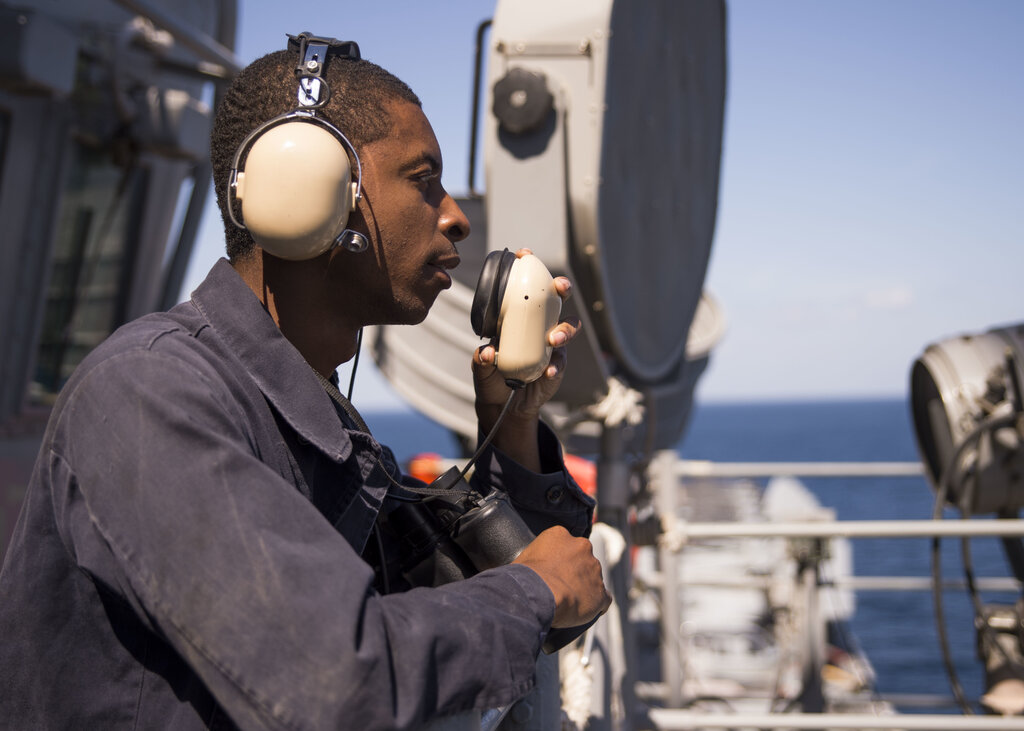
Finally, to communicate high-priority information between crew members without alarming passengers, staff use specific . These are not the familiar Alpha, Bravo, Charlie alphabet. Instead, they are codewords for specific situations. For example, hearing "Code Kilo" over the PA is a signal for all crew to report to their emergency posts immediately. An announcement like "Operation Bright Star" might signal a medical emergency, or "Zulu Zulu Zulu" could indicate a security threat. These codes allow for a swift, discreet crew response to sensitive situations.
Let's review the key concepts of shipboard PA systems.
Now, test your knowledge on these critical communication protocols.
What is the primary function of the Emergency Override feature on a ship's PA system?
An announcement regarding a change in the ship's arrival time at the next port would most likely be broadcast from which location?
Understanding these systems is fundamental to ensuring safety and smooth operations at sea. Clear, controlled communication is paramount.