Psychology of Light and Vision
Visual Perception
How Your Eyes See Light
Your eyes are incredible instruments. They capture light from the world around you and turn it into the images you see. This process starts with the basic structure of the eye, which works much like a camera to gather and focus light.
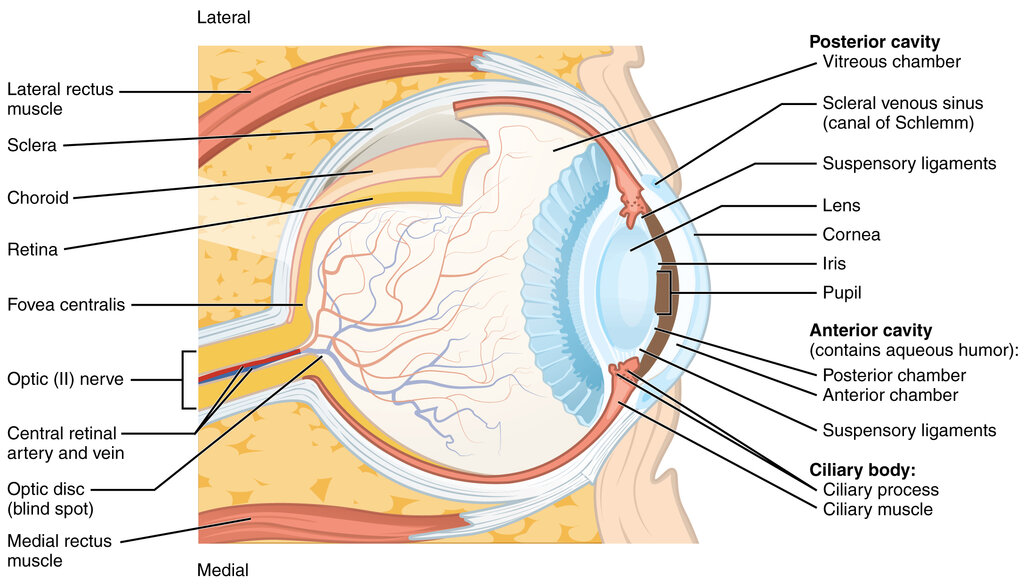
Light first enters through the cornea, a transparent outer layer that does most of the initial focusing. From there, it passes through the pupil, an opening that can change size. The colored part of your eye, the iris, is a muscle that controls the pupil, making it smaller in bright light and larger in dim light.
After the pupil, the light hits the lens. The lens fine-tunes the focus, adjusting its shape to make sure the light rays land perfectly on the back of the eye. This light-sensitive layer at the back is called the retina.
Think of the retina as the film in a camera or the sensor in a digital camera. It's where the light energy is converted into electrical signals that the brain can understand.
Rods and Cones
The retina is packed with millions of specialized nerve cells called photoreceptors. These cells are the real light-catchers of the eye. There are two main types: rods and cones, each with a very different job.
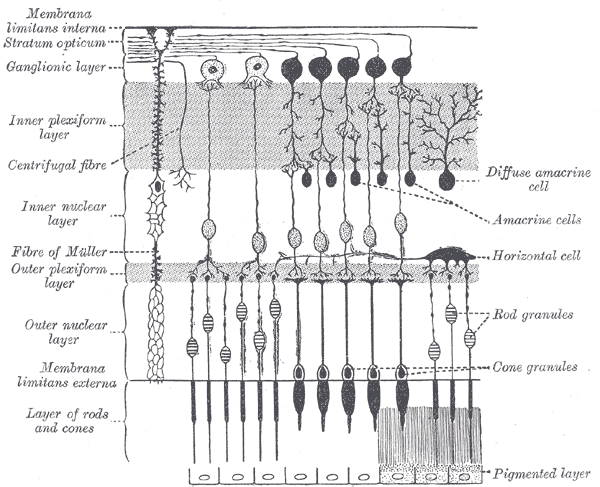
These two types of cells are not distributed evenly across the retina. Cones are highly concentrated in the center, in an area called the fovea, which is why your central vision is so sharp and colorful. Rods are found mostly in the peripheral areas of your retina, which is why you're better at detecting motion and seeing in the dark out of the corner of your eye.
Rod
noun
A type of photoreceptor cell in the retina that is sensitive to low light levels. Rods are responsible for night vision and peripheral vision but do not perceive color.
Rods are incredibly sensitive and can detect even a single photon of light. However, they don't provide a very sharp image and see the world only in shades of gray.
Cone
noun
A type of photoreceptor cell in the retina responsible for vision in bright light and for color perception. Cones provide high-acuity vision.
Cones, on the other hand, require much more light to activate. They are responsible for sharp, detailed central vision and, crucially, for perceiving color.
Three Modes of Vision
Because your rods and cones have such different jobs, your visual system operates in three distinct modes depending on the amount of available light.
| Vision Mode | Primary Photoreceptor | When It's Used |
|---|---|---|
| Photopic | Cones | Bright light (daytime) |
| Scotopic | Rods | Low light (nighttime) |
| Mesopic | Both | Intermediate light (dawn/dusk) |
Photopic vision is your daytime vision. When you're in a brightly lit environment, your cones are doing all the work. This is when your vision is at its sharpest and you can see a full spectrum of colors. Your less-sensitive rods are mostly inactive.
Scotopic vision is your night vision. In very dark conditions, your cones can't get enough light to function. Your highly sensitive rods take over completely. This is why you can't see color in near-total darkness, and why things look less detailed. Your vision is entirely in black, white, and shades of gray.
Mesopic vision is the mode used during twilight hours, like dawn and dusk, or in a dimly lit room. In these intermediate light conditions, both your rods and cones are active. It’s a trade-off: you can see some color, but not as vividly as in bright daylight, and your visual sharpness is reduced.
What is the primary function of the eye's cornea?
Which statement accurately compares rods and cones?
Understanding how our eyes process light is the first step in appreciating the complex and fascinating process of vision.