Pruning Fruit Trees for Shape and Height
Pruning Basics
The Why and How of Pruning
Think of pruning a fruit tree less like a chore and more like a conversation. You're not just hacking away at branches; you're guiding the tree's growth, encouraging it to be its healthiest and most productive self. An unpruned tree might grow wildly, but much of its energy will go into producing wood and leaves, not the delicious fruit you're after.
Proper pruning accomplishes several key goals. First, it removes any wood that is dead, damaged, or diseased. This prevents problems from spreading and keeps the tree healthy. Second, it improves air circulation and sunlight exposure throughout the tree's canopy. When sunlight can reach the inner branches, the tree can produce more fruit, and better airflow helps prevent fungal diseases. Finally, pruning helps control the tree's overall size and shape, making it easier to manage and harvest.
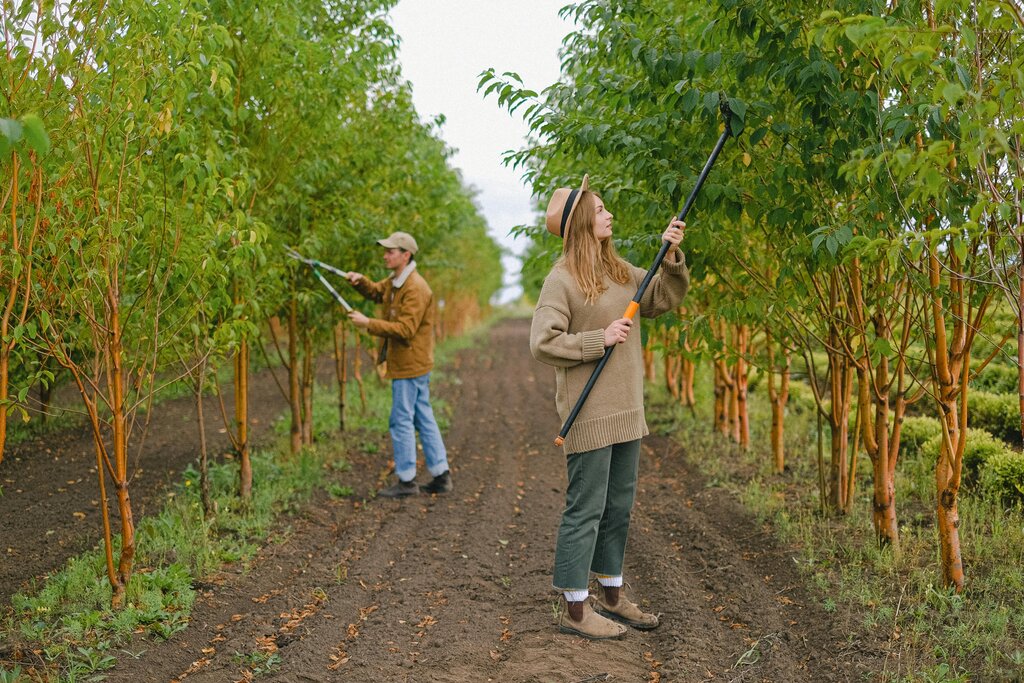
The Two Basic Cuts
While the reasons for pruning are many, the actions you'll take boil down to two fundamental types of cuts. Mastering these two techniques is the foundation of all effective pruning.
The first is the thinning cut, which removes an entire branch or shoot right back to its point of origin.
You make a thinning cut when you want to open up the tree, reduce its density, or remove a branch that's growing in an awkward direction—perhaps crossing over another branch or growing straight down. This type of cut is less likely to stimulate a burst of new growth right where you cut, making it ideal for clearing out clutter without making the tree denser.
The second is the heading cut, which shortens a branch instead of removing it entirely.
When you make a heading cut, you trim a branch back to just above a healthy bud or a smaller side branch. This signals the tree to send growth hormones to that area, stimulating the buds just below the cut to sprout into new shoots. Heading cuts are used to make the tree fuller and encourage branching in a particular area, which is key for shaping the tree's structure.
Every time you approach a tree with pruners, you'll be deciding between these two cuts. Do you need to remove a whole branch to create space? That's a thinning cut. Do you want to encourage a branch to become bushier? That's a heading cut. Understanding this distinction is the first step toward pruning with confidence.
What is a primary goal of pruning a fruit tree?
Which type of pruning cut is made to remove an entire branch back to its point of origin, in order to reduce density in the tree's canopy?