Properties of Real Numbers
Introduction to Real Numbers
The Complete Number Line
So far, we've dealt with rational numbers, which can be expressed as simple fractions. They seem to cover a lot of ground, but there are gaps on the number line—infinitely small, yet crucial holes that rationals can't fill.
To fill these gaps, we need irrational numbers. As a reminder, these are numbers that cannot be written as a fraction, like or . Their decimal representations go on forever without repeating.
When we combine the set of all rational numbers with the set of all irrational numbers, we get the real numbers, denoted by the symbol . Think of the real numbers as the complete, unbroken set of points on the number line. Every single point corresponds to a real number, and every real number has its own unique spot on the line.
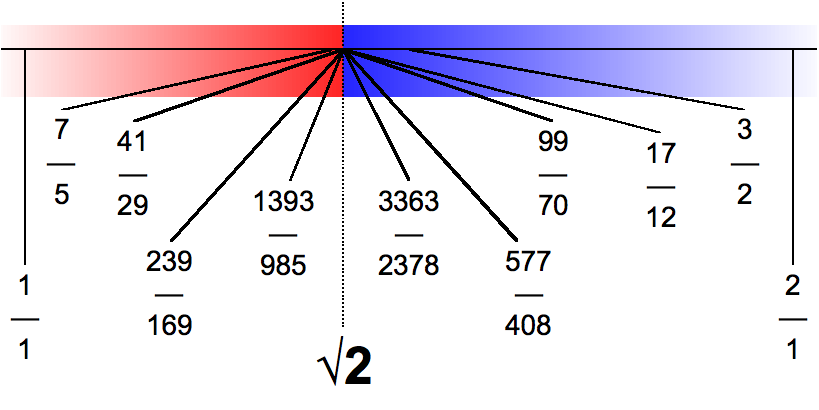
The image above shows how an irrational number like fits perfectly among the rational numbers. It creates a definitive cut on the number line. All the rational numbers whose squares are less than 2 are on one side, and all those whose squares are greater than 2 are on the other. The irrational number is the single point that divides them.
An Infinitely Crowded Line
One of the most mind-bending properties of the real number line is its density. This means that between any two different real numbers you can pick, no matter how close they are, you can always find another real number.
For example, between 0.1 and 0.11, you can find 0.105. Between 0.105 and 0.106, you can find 0.1055. This can go on forever.
This property holds true for both rational and irrational numbers. Between any two rational numbers, there is another rational number (and also an irrational one!). And between any two irrational numbers, you can find both another irrational number and a rational one.
This incredible density is what makes the number line continuous. There are no jumps or empty spaces. Every point is accounted for, creating the smooth, solid line we use in geometry and calculus.
Let's check your understanding of these fundamental concepts.
The set of real numbers, denoted by , is formed by the union of which two sets of numbers?
Which of the following numbers is irrational?
Understanding the real numbers as a complete and dense set is the foundation for almost all of higher mathematics.