Proof of Irrationality of Square Root of 2
Understanding Rational and Irrational Numbers
Numbers You Can Write as Fractions
Most numbers you work with every day are what we call rational numbers. The name comes from the word "ratio," which is just another way of saying fraction. A rational number is any number that you can write as a fraction, with an integer on top and an integer on the bottom.
Rational Number
noun
A number that can be expressed as a fraction p/q, where p and q are integers and q is not zero.
This definition includes more numbers than you might think. All integers are rational numbers because you can write them as a fraction over 1. For example, the number 7 is rational because it's the same as . The number -12 is also rational because it's just .
Decimals that stop (terminating decimals) are also rational. The decimal 0.25 is the fraction . What about decimals that repeat forever, like ? That's rational too, because it's equal to the fraction . Any decimal that either stops or falls into a repeating pattern can be written as a fraction.
| Number Type | Example | As a Fraction |
|---|---|---|
| Integer | 5 | |
| Fraction | 3/8 | |
| Terminating Decimal | 0.6 | or |
| Repeating Decimal |
The Other Kind of Number
If rational numbers can be written as neat fractions, what do we call the ones that can't? Those are irrational numbers. They are the rebels of the number line.
Irrational Number
noun
A number that cannot be expressed as a fraction p/q for any integers p and q. Its decimal representation goes on forever without repeating.
Unlike the tidy repeating pattern of a rational number like $1/3$, the decimal for an irrational number is a wild, unpredictable stream of digits that never ends and never repeats. You've probably met a few of these numbers before.
Famous irrational numbers include π (pi), which is approximately 3.14159..., and the square root of 2 (√2), which is approximately 1.41421...
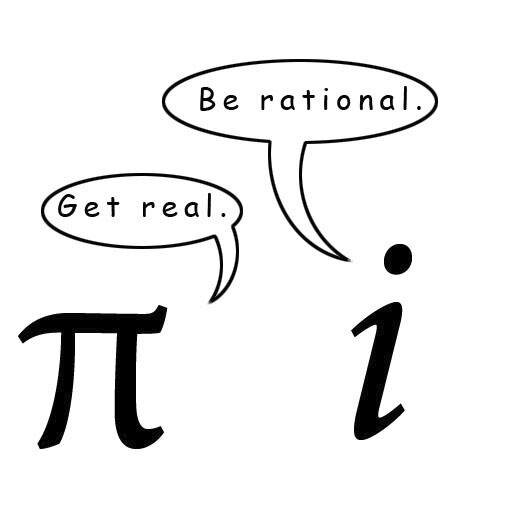
It's impossible to write down all the digits of an irrational number. That's why we use symbols like π or √2 to represent them perfectly. It's a bit of a mathematical joke that these two types of numbers don't always see eye to eye.
Two Sides of the Same Coin
So, every number you can place on a number line is either rational or irrational. There's no in-between. If it can be written as a fraction, it's rational. If it can't, it's irrational. Together, these two types of numbers make up the set of all real numbers.
Understanding this distinction is key. For our upcoming journey, we'll focus on one particular irrational number: the square root of 2. Proving that it's truly irrational, that it can't be written as a simple fraction, is a classic and beautiful piece of mathematical logic.
Before we move on, let's check your understanding of these concepts.
Which of the following best defines a rational number?
The number -15 is a rational number.
Knowing the difference between these number types is a fundamental building block in mathematics.