Prompt Engineering Essentials
Introduction to Large Language Models
What Are Large Language Models?
Large Language Models, or LLMs, are a type of artificial intelligence designed to understand and generate human-like text. Think of them as extremely well-read students. They've been trained on a vast library of books, articles, websites, and other text data—far more than any human could read in a lifetime. This allows them to recognize patterns, context, and nuance in language.
A large language model (LLM) is an AI model trained on massive amounts of text data that can understand and generate human-like text, recognize patterns in language, and perform a wide variety of language tasks without task-specific training.
Their primary purpose is to process and respond to text-based prompts. You can ask an LLM a question, tell it to write a story, or ask it to summarize a long document. The model processes your request and generates a new piece of text as a response. This ability makes them incredibly versatile tools for a wide range of tasks.
How LLMs Learn
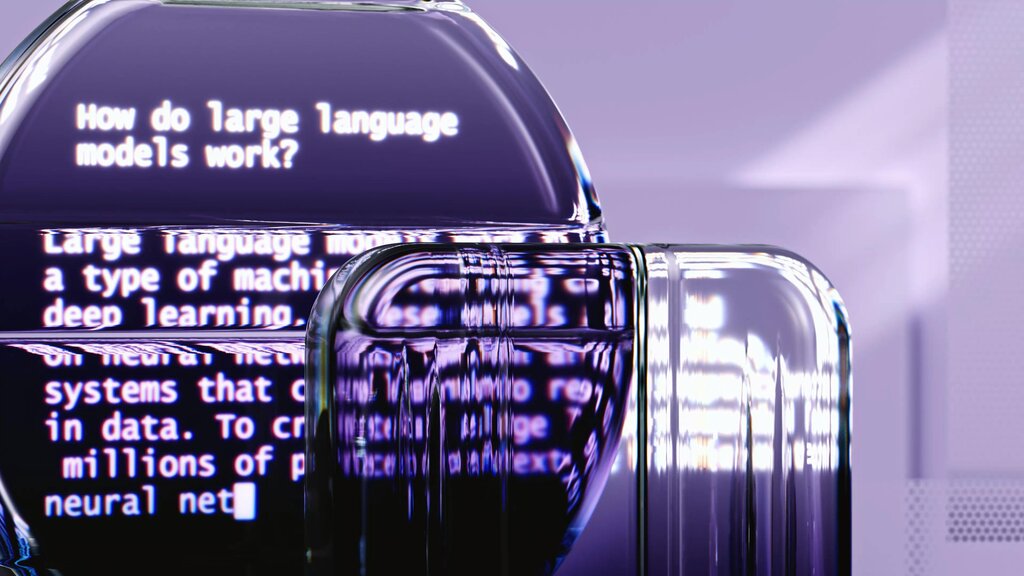
At their core, LLMs are built on neural networks, which are computing systems loosely inspired by the human brain. Most modern LLMs use a specific architecture called a Transformer. This design is especially good at handling sequential data, like sentences, because it can weigh the importance of different words when processing the text.
The training process is what makes LLMs so powerful. It generally happens in two main stages.
First is pre-training. The model is fed a massive dataset of text from the internet and digital books. Its main task is simple but powerful: predict the next word in a sentence. Given the phrase "The cat sat on the...", the model learns to predict "mat". By doing this billions of times, it develops a sophisticated understanding of grammar, facts, reasoning abilities, and even some biases present in the training data.
The second stage is fine-tuning. After pre-training, the model has a general grasp of language but isn't very good at following specific instructions or carrying on a conversation. Fine-tuning adjusts the model using a smaller, higher-quality dataset. This dataset often includes examples of conversations and instructions, helping the model learn to be more helpful, safe, and aligned with human expectations. This is how a general-purpose model becomes a useful tool like a chatbot.
What Can LLMs Do?
The abilities of LLMs are broad, making them useful in many different fields. Because they can both understand and create text, they can act as assistants, creative partners, or powerful analytical tools.
| Application | Description |
|---|---|
| Content Creation | Write emails, blog posts, marketing copy, or even poetry and scripts. |
| Summarization | Condense long articles, reports, or research papers into key points. |
| Translation | Translate text from one language to another with impressive accuracy. |
| Code Generation | Write code snippets or entire functions based on a description in plain English. |
| Chatbots | Power conversational agents for customer service or information retrieval. |
Limitations and Challenges
Despite their power, LLMs are not perfect. It's important to understand their limitations.
One major issue is hallucination. This is when an LLM generates text that sounds plausible but is factually incorrect or nonsensical. Because the model's goal is to predict the next likely word, not to state the truth, it can sometimes invent facts, sources, or details with complete confidence.
Bias is another significant challenge. Since LLMs learn from a vast swath of text written by humans, they can absorb and reproduce the biases found in that data. This can result in unfair or prejudiced outputs.
Finally, LLMs lack true understanding or consciousness. They are pattern-matching machines. They don't "know" things in the way humans do, and they don't have personal experiences or beliefs. Their knowledge is also limited to the data they were trained on and can become outdated.
Always critically evaluate the output of an LLM. Use it as a starting point or a tool, but don't blindly trust it for important or factual information.
Understanding these fundamentals—what LLMs are, how they learn, their capabilities, and their limitations—is the first step to using them effectively and responsibly.
What is the primary purpose of a Large Language Model (LLM)?
Most modern LLMs are built on a specific neural network architecture particularly effective at handling sequential data like sentences. What is this architecture called?