Prompt Engineering Essentials
Introduction to Large Language Models
What Are Large Language Models?
Large Language Models, or LLMs, are a type of artificial intelligence designed to understand and generate human-like text. Think of them as incredibly advanced prediction engines. They are trained on vast amounts of text data, from books and articles to websites and code. By analyzing this data, they learn the patterns, grammar, context, and nuances of human language.
A Large Language Model (LLM) is a type of artificial intelligence program designed to understand, generate, and work with human language.
Their main purpose isn't just to mimic language, but to perform useful tasks. You can ask an LLM to summarize a long document, translate Spanish to Japanese, write a poem, or even generate computer code. It accomplishes this by predicting the next most likely word in a sequence, over and over again, to build coherent sentences and paragraphs.
A Brief History
The idea of machines understanding language isn't new. Early attempts in the mid-20th century relied on complex, hand-written rules created by linguists. These systems were brittle and couldn't handle the sheer variety of human expression.
The game changed with statistical models, which used probabilities to guess the next word. But the real breakthrough came with neural networks, computer systems modeled loosely on the human brain. A specific type of neural network, called the Transformer architecture, introduced in 2017, was revolutionary. It allowed models to weigh the importance of different words in the input text, leading to a much deeper understanding of context.
This innovation allowed models to become much larger and more powerful, leading directly to the LLMs we use today.
How They Work
At their core, LLMs are a type of neural network. A neural network is a component of machine learning, which itself is a subfield of artificial intelligence. It consists of layers of interconnected nodes, or "neurons," that process information.
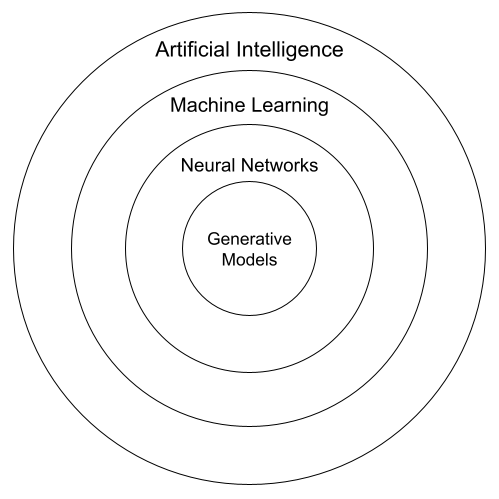
When you give an LLM a prompt, the input text is converted into numbers and fed into the first layer of the network. Each neuron in this layer performs a small calculation and passes its result to the neurons in the next layer. This process continues through many layers, allowing the model to recognize increasingly complex patterns. The final layer outputs a probability distribution over all possible next words, and the model picks one to continue the sequence.
What LLMs Can Do
Because they are trained on such a diverse range of text, LLMs are incredibly versatile. They aren't programmed for a single task but can be guided to perform many different ones. Common applications include:
- Text Generation: Writing essays, emails, poems, and creative stories.
- Summarization: Condensing long articles or reports into key points.
- Translation: Translating text between different languages.
- Question Answering: Providing direct answers to questions based on their training data.
- Code Generation: Writing snippets of code in various programming languages.
The key to unlocking these capabilities lies in how you ask, which is the essence of prompt engineering.
Tokens and Context
To understand how to prompt an LLM effectively, you need to know about two fundamental concepts: tokenization and context.
Token
noun
A piece of text that an LLM processes. A token can be a word, part of a word, or even just a punctuation mark.
Before an LLM can process your prompt, it breaks the text down into tokens. For example, the sentence "LLMs are powerful" might be tokenized into [LLMs], [are], [powerful]. A more complex word like "tokenization" might become [token], [ization].
This process turns language into a format the model can understand. The number of tokens is also important because most LLMs have a limit to how much text they can process at once. This limit is called the context window.
The context window includes your entire conversation with the model up to that point: your initial prompt, the model's response, your follow-up, and so on. This is the model's short-term memory. Everything inside the context window influences the next word the LLM generates. If information falls outside this window, the model effectively forgets it.
Understanding how LLMs see the world through tokens and a limited context window is the first step to crafting prompts that get you the results you want.