Projectile Motion Fundamentals
Introduction to Projectile Motion
The Path of a Projectile
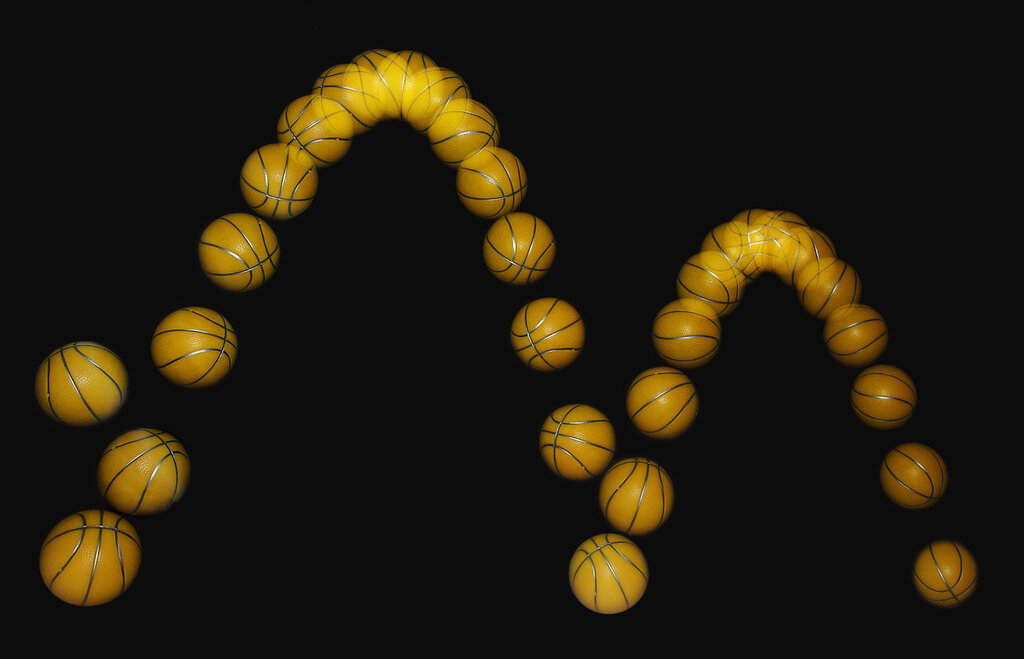
Think about tossing a ball to a friend. The instant it leaves your hand, it becomes a projectile. It follows a curved path through the air, influenced only by gravity. This is projectile motion in a nutshell.
projectile
noun
An object that is thrown or projected into the air and is subject only to the force of gravity.
Anything moving through the air without its own power source is a projectile. A cannonball fired from a cannon, a diver jumping off a platform, or an arrow shot from a bow all follow the rules of projectile motion. Their path through the air is called a trajectory, which is typically a parabolic curve.
Keeping It Simple
To understand the fundamental principles, physicists make a few key assumptions when analyzing projectile motion. These simplifications allow us to focus on the core concepts without getting bogged down in complex details.
First, we assume that gravity is the only force acting on the object. This means we ignore factors like air resistance or wind. For many heavy, slow-moving objects, this is a very good approximation.
Second, we consider the acceleration due to gravity, represented by , to be constant. We assume it's always pointing straight down and has a value of about near the Earth's surface. We also ignore the rotation of the Earth.
In reality, air resistance can significantly affect the path of light objects like feathers or paper airplanes, but for dense objects like a baseball, its effect is often small enough to ignore in basic calculations.
Divide and Conquer
The most powerful trick for solving projectile motion problems is to break the motion into two separate parts: a horizontal component and a vertical component. The two components are completely independent of each other, except that they happen for the same amount of time.
You can treat the horizontal motion (x-direction) and the vertical motion (y-direction) as two separate one-dimensional kinematics problem.
Let's look at each component individually.
Vertical Motion
The vertical component of a projectile's velocity is all about the battle with gravity. As the object flies upward, gravity pulls it down, causing its upward speed to decrease. At the very peak of its trajectory, the vertical velocity is momentarily zero. Then, as it falls back to Earth, its downward vertical velocity increases. The key takeaway is that the vertical motion experiences constant downward acceleration due to gravity, .
Horizontal Motion
The horizontal component is much simpler. Because we're ignoring air resistance, there are no forces acting in the horizontal direction. According to Newton's first law, an object in motion stays in motion with the same speed and in the same direction unless acted upon by an unbalanced force. Therefore, the horizontal velocity of a projectile is constant. It never changes throughout the entire flight.
A bullet fired horizontally from a gun will hit the ground at the same time as a bullet dropped from the same height. This is because their vertical motions are identical, and the horizontal motion doesn't affect the vertical.
By analyzing these two components separately, we can describe the complete motion of any projectile. This separation is the foundation for calculating an object's trajectory, how high it will go, and how far it will travel.
Time to test your understanding of these core ideas.
Which statement best describes the horizontal motion of a projectile, assuming air resistance is ignored?
At the very peak of a projectile's trajectory, which of the following is true?
Understanding these basic principles is the first step toward mastering the physics of motion. Next, we'll learn how to apply these concepts with mathematical equations.