Project Management Essentials
Introduction to Project Management
What Is Project Management?
At its core, project management is the process of turning an idea into a finished product. It’s the framework used to guide a team's work to achieve specific goals within a set timeframe and budget. Think of building a new community park. You can't just show up with a shovel. You need a plan for the design, a budget for the playground equipment, a schedule for construction, and a team to do the work. Project management provides the structure to handle all these moving parts.
Project management is the art and science of turning ideas into reality.
Without it, projects can easily go off track. Deadlines get missed, costs spiral, and the final result might not be what anyone wanted. Good project management helps ensure that what you set out to do is what you actually get, all while keeping the process smooth and organized.
The Role of a Project Manager
Every project needs a leader, and that’s the project manager (PM). A PM is like the captain of a ship, responsible for steering the project from its starting point to its final destination. They don't do all the work themselves. Instead, they guide the team, clear roadblocks, and keep everyone focused on the goal.
Key responsibilities include defining the project goal, creating a clear plan, leading the team, managing the budget and schedule, and communicating with everyone involved.
A big part of a PM's job is communicating with stakeholders. These are the people or groups who have an interest in the project's outcome, like the client, your team members, or company leadership.
Stakeholder
noun
Any person, group, or organization that can affect or be affected by a project's outcome.
The Project Lifecycle
Projects don't happen all at once. They unfold in a series of stages, known as the project lifecycle. While the details can vary, most projects follow a similar path from start to finish. This structure helps everyone understand where the project is and what needs to happen next.
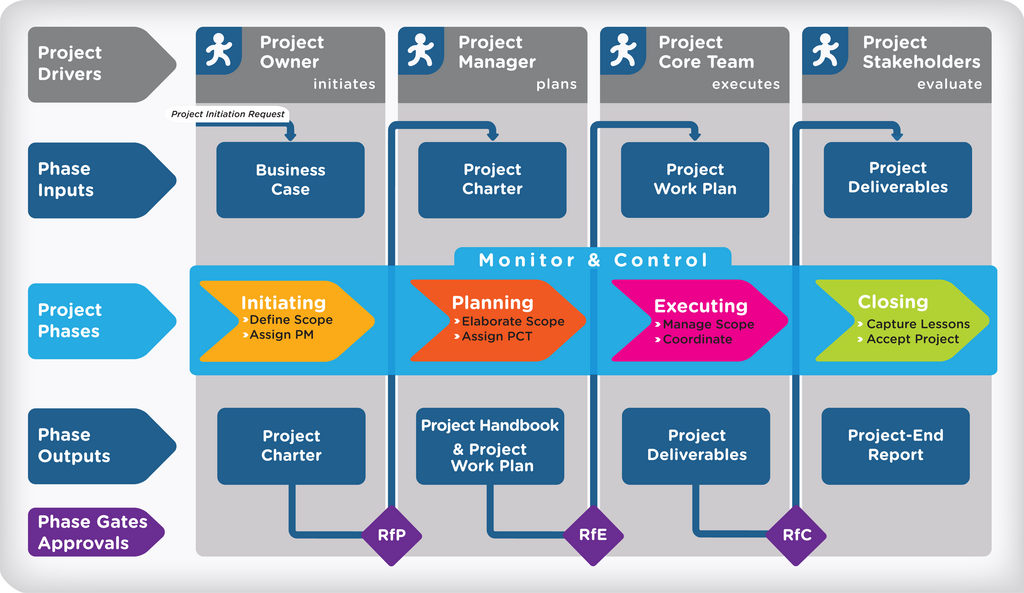
The five common stages are:
-
Initiation: This is the starting line. The project is defined at a high level. You figure out if the project is feasible and what you want to achieve. It’s about asking, “Should we do this?”
-
Planning: Once the project is approved, it’s time to create a detailed roadmap. This is where you break down the work, create a schedule, set a budget, and identify potential risks. A good plan is the foundation for a successful project.
-
Execution: Here, the plan is put into action. The team gets to work creating the project deliverables, whether that's building software, constructing a bridge, or planning an event. The project manager keeps the team coordinated and motivated.
-
Monitoring & Controlling: This stage happens at the same time as execution. The PM tracks progress against the plan, manages any changes, and makes sure the project stays on course. It’s about asking, “Are we on track?” and making adjustments as needed.
-
Closing: The finish line. The work is complete and delivered. In this final stage, you wrap up any loose ends, release the project team, and review the project to capture lessons learned for the future.
Managing Project Constraints
Every project operates within certain limits, or constraints. A project manager's job is to balance these constraints to deliver a successful outcome. The six most common constraints are often visualized as a hexagon, where changing one can affect the others.
Let's break them down:
- Scope: This is the what of the project. It defines all the work that needs to be done and exactly what the project will deliver. Defining the scope clearly prevents
Scope creep—when extra features or work get added to a project without approval, threatening the schedule and budget.
-
Time: This is the project's schedule, including the final deadline and any key milestones along the way.
-
Cost: This is the project's budget. It includes all expenses, from team salaries to materials and software.
-
Quality: This defines how good the final result needs to be. It's measured against a set of standards or requirements.
-
Resources: This includes everything needed to do the work, like team members, equipment, and facilities.
-
Risk: These are any potential problems that could negatively impact the project, such as a key team member leaving or a technology failing.
A project manager constantly juggles these six elements. If a client wants to add a new feature (increasing scope), it will likely require more time and cost. If the budget is cut, the scope or quality might need to be reduced. Finding the right balance is key to success.
Understanding these core concepts is the first step in managing projects effectively. It provides the language and structure needed to lead a project from a simple idea to a successful launch.