Programming Logic Fundamentals
Introduction to Programming Logic
The Thinking Behind the Code
At its heart, programming isn't about mastering a specific language like Python or Java. It's about learning how to think in a structured way to solve problems. This structured thinking is called programming logic. It’s the set of rules and principles that guide how you tell a computer what to do.
Think of it like a recipe. A recipe provides clear, step-by-step instructions. If you follow them in the right order, you get a delicious cake. If you add the eggs after baking the flour, you get a mess. Programming logic is the recipe that ensures your code produces the right result.
This logic is universal. Once you understand it, you can apply it to any programming language. The specific words, or syntax, will change, but the underlying thought process remains the same.
Writing a program is not just about syntax. It's about giving logic to the computer.
Algorithms The Recipe for Code
The recipe itself has a formal name in computer science: an algorithm. An algorithm is simply a finite sequence of well-defined, computer-implementable instructions to solve a class of problems or to perform a computation.
Algorithm
noun
A step-by-step procedure or formula for solving a problem or achieving a result.
Let's create a simple algorithm for a common task: deciding if you need to take an umbrella when you leave the house.
- Start.
- Look outside.
- Is it raining?
- If yes, take an umbrella.
- If no, do not take an umbrella.
- Leave the house.
- End.
This set of instructions is clear, has a definite start and end, and leads to a specific outcome. It’s a perfect, simple algorithm.
Planning Your Logic
Before writing a single line of code, programmers plan their logic. This helps them catch errors in their thinking early on and makes the coding process much smoother. Two of the most common planning tools are flowcharts and pseudocode.
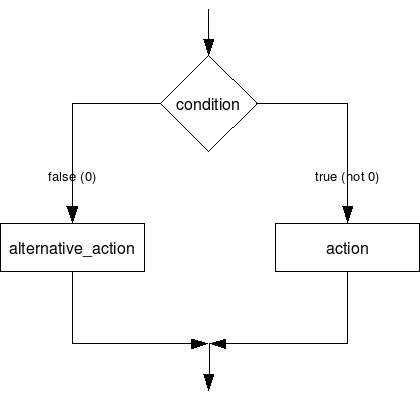
A flowchart is a visual diagram that shows the steps and decisions within a process. It uses standard shapes to represent different types of actions, making the flow of logic easy to follow.
Pseudocode, on the other hand, is a way of writing out your algorithm in a format that's a mix of plain English and programming syntax. It's not actual code, so it doesn't need to be perfect, but it helps structure your thoughts before you start coding.
START
    IF it is raining THEN
        take_umbrella
    ELSE
        do_not_take_umbrella
    ENDIF
    leave_house
END
Both tools achieve the same goal: they map out the logic of a program before the programmer gets bogged down in the details of a specific language.
The Building Blocks of Control
No matter how complex, all programs are built from three basic control structures. These structures dictate the order, or flow, in which a program's instructions are executed.
1. Sequence: This is the most straightforward structure. Instructions are executed one after another, in the order they are written. Making a sandwich is a sequence: get bread, add filling, put slices together.
Our umbrella algorithm used the next control structure.
2. Selection: This structure allows a program to make a choice. It uses a condition to decide which path of code to execute. This is often done with
IF...THEN...ELSEstatements. If it's raining, take an umbrella. Otherwise (else), don't.
Finally, we have a way to repeat actions.
3. Iteration (or Looping): This structure repeats a block of instructions as long as a certain condition is true. If you're hammering nails, you repeat the action of hitting the nail until it is flush with the wood. That's a loop.
These three structures—sequence, selection, and iteration—are the fundamental building blocks of all programming logic. By combining them, you can create algorithms to solve incredibly complex problems.
Ready to test your understanding of these core ideas?
What is the primary concept that underpins all programming, regardless of the specific language used?
A finite sequence of well-defined, computer-implementable instructions to solve a problem is called a(n) ______.
Mastering these concepts is the first and most important step on your journey to becoming a programmer. They provide the foundation upon which all other skills are built.