Programming Language Paradigms and Selection
Execution and Type Systems
Code Meets Machine
When you write code, you're giving a computer a set of instructions. But your computer's central processing unit (CPU) doesn't understand Python, C++, or any other human-readable language. It only understands machine code, a low-level language of ones and zeros. The process of translating your source code into machine code is where different programming languages take dramatically different paths.
Think of it like translating a book. You could meticulously translate the entire book from start to finish before anyone reads it. Or, you could have an interpreter translate it line by line as someone reads it aloud. A third option might be to translate it into a simplified, universal language first, then have local experts perform the final, on-the-spot translation. Each method has its own advantages, and programming languages employ similar strategies.
Three Paths to Execution
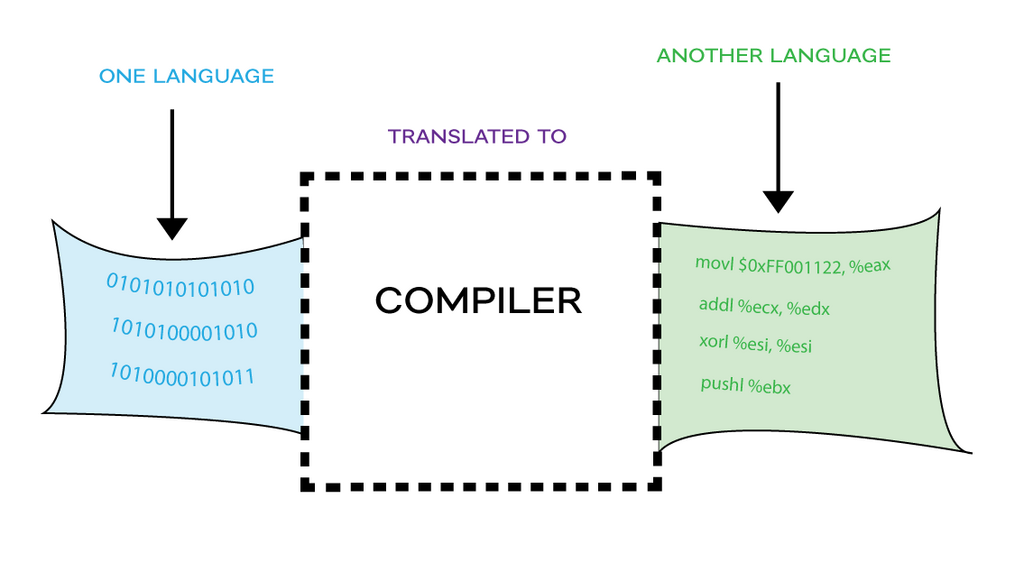
The most traditional approach is Ahead-of-Time (AOT) compilation. Languages like C++, Go, and Rust use this model. A program called a compiler reads your entire source code and translates it directly into an executable file of native machine code. This process happens once, before you ever run the program.
The major upside is performance. Because the translation is already done, the program runs incredibly fast. The compiler can also perform deep analysis and optimizations, catching many errors before the program is even executed. The downside is a loss of portability; an executable compiled for a Windows machine with an Intel chip won't run on a Mac with an Apple chip. You need to recompile for each target architecture.
On the opposite end is interpretation. In a purely interpreted language, there's no pre-compilation step. An interpreter program reads your source code line by line, executing each instruction as it goes. Early versions of languages like Python and Ruby worked this way. This makes development fast and flexible, and the same code can run on any machine that has the right interpreter installed. The obvious trade-off is speed. The interpreter is doing the translation work in real time, which adds significant overhead.
Most modern "interpreted" languages, like Python, Java, and C#, actually use a hybrid approach. They first compile your code into an intermediate representation called bytecode. This bytecode isn't machine code; it's a platform-neutral set of instructions. When you run the program, a runtime environment—like the Java Virtual Machine (JVM) or the .NET runtime—takes over. This environment uses a Just-in-Time (JIT) compilation model. It translates the bytecode into native machine code on the fly, as the program runs. The JIT compiler is smart; it can identify frequently executed sections of code (or "hot paths") and spend more time optimizing them for maximum performance. This gives you much of the portability of an interpreted language with performance that approaches that of a compiled one after the program has been running for a bit.
The Rules of Types
Beyond execution, languages also differ in how they handle data types—the classification of data like integers, strings, and booleans. This is governed by the language's type system, which enforces rules about how different types can interact. The main distinction is when these rules are checked.
| System | When are types checked? | Key Benefit | Example Languages |
|---|---|---|---|
| Static | At compile-time | Safety & Predictability | C++, Java, Go, Rust |
| Dynamic | At runtime | Flexibility & Speed of Prototyping | Python, JavaScript, Ruby |
| Gradual | Both | Best of both worlds | TypeScript, Python with type hints |
In a statically-typed language, every variable's type must be known at compile-time. If you try to assign a string to a variable declared as an integer, the compiler will throw an error, and the program won't even build. This is like a chef meticulously labeling every ingredient container before they start cooking. It prevents you from accidentally pouring salt into your cake instead of sugar. This safety net is invaluable in large, complex applications, making code easier to reason about and refactor.
This upfront strictness can feel a bit rigid, but it pays off by eliminating an entire class of runtime errors. Modern static languages have softened this rigidity with type inference, where the compiler can often deduce the type of a variable from its initial value, saving you some typing.
In a dynamically-typed language, type checking is deferred until runtime. You can create a variable, assign it a number, and later assign it a string without any issue until you try to perform an operation that doesn't make sense, like trying to divide the string "hello" by two. This is like a chef working with unlabeled jars, relying on memory and context to grab the right ingredient. It allows for incredible flexibility and rapid prototyping, but it means type errors can lie dormant in your code, only surfacing when a user triggers a specific code path in production.
The industry has found a middle ground here, too, with gradual typing. Languages like TypeScript (a superset of JavaScript) and Python (with optional type hints) allow developers to add static type annotations to their code. You can start with a dynamic, prototype-style codebase and gradually add type safety as it matures. A static analysis tool can then check these types before runtime, giving you the safety of a static language without forcing you to abandon the flexibility of a dynamic one. This approach offers a powerful way to balance speed and safety.
What is the primary output of an Ahead-of-Time (AOT) compiler, used by languages like C++ and Rust?
What is the main role of a Just-in-Time (JIT) compiler in a modern language like Java or C#?