Programmable Logic Controllers Explained
Introduction to PLCs
What Is a PLC?
Think of a programmable logic controller, or PLC, as the brain of an industrial operation. It's a ruggedized computer designed to withstand harsh factory environments like extreme temperatures, vibrations, and electrical noise. Its job is to automate processes, from assembling a car to bottling a beverage.
PLCs are specialized computers designed to control and automate various electromechanical processes.
Before PLCs, automation relied on complex webs of electromechanical relays. A relay is a switch that is opened and closed by an electromagnet. To create logic, engineers would wire hundreds or even thousands of these relays together in massive cabinets. If the production process needed to change, the entire cabinet had to be painstakingly rewired by hand. This was slow, expensive, and prone to errors.
In the late 1960s, General Motors challenged companies to design a solid-state, programmable replacement for these relay systems. The winning design, from a company called Modicon, became the first PLC. It was a game-changer, swapping physical wires for flexible software logic.
The PLC Advantage
The shift from hardwired relays to programmable controllers brought massive benefits to manufacturing and industrial processes.
| Feature | Relay Logic | PLC |
|---|---|---|
| Flexibility | Low. Requires manual rewiring for any change. | High. Logic is changed through software. |
| Reliability | Lower. Mechanical parts wear out. | Higher. Solid-state components are more durable. |
| Cost | High initial cost and very expensive to modify. | Lower overall cost, especially for complex systems. |
| Size | Large. Cabinets can take up significant floor space. | Compact. Much smaller for the same capability. |
| Troubleshooting | Difficult. Requires checking individual wires and relays. | Easier. Software diagnostics can pinpoint problems. |
Essentially, PLCs made automation more accessible, affordable, and adaptable. Factories could now update their processes with a few keystrokes instead of a complete electrical overhaul.
Inside the Box
While PLCs come in many shapes and sizes, they all share the same fundamental hardware components. A typical PLC is a modular system, allowing it to be customized for a specific task.
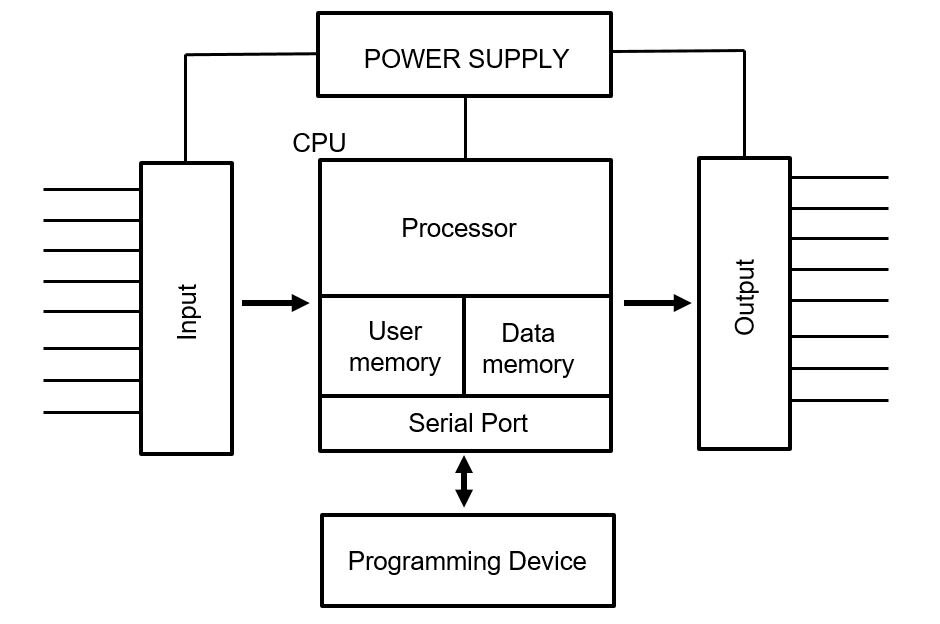
Here's a breakdown of the key parts:
-
Central Processing Unit (CPU): This is the PLC's core. It executes the control program, performs calculations, and manages communication between all the other components.
-
Input/Output (I/O) Modules: These are the PLC's connection to the real world. Input modules receive signals from sensors, switches, and buttons. Output modules send signals to control devices like motors, lights, and valves.
-
Power Supply: This component takes the main AC voltage and converts it into the low-voltage DC that the internal components of the PLC require to operate.
-
Communication Interface: This port allows the PLC to connect to other devices, such as a programming terminal (a computer), other PLCs, or higher-level supervisory systems.
How a PLC Thinks
A PLC operates by continuously running a program in a repeating loop. This process is called the scan cycle. It happens very quickly, often thousands of times per second, ensuring the PLC can respond to changes in the industrial process in real-time.
The scan cycle consists of three main steps:
-
Read Inputs: The PLC checks the status of every input device connected to it. Is the button pushed? Is the sensor detecting an object? It stores this information in its memory.
-
Execute Program: The CPU runs the user-created program one instruction at a time. Based on the input statuses it just read, the program's logic determines what the outputs should do.
-
Update Outputs: After the program has run, the PLC updates the status of all its output devices. It will turn on a motor, open a valve, or activate a warning light according to the program's logic.
This cycle repeats endlessly, allowing the PLC to constantly monitor and control a machine or process with high speed and reliability.
This foundational knowledge sets the stage for understanding how to program and apply these powerful devices.