Professional Video Editing Mastery
Advanced Narrative Continuity
Guiding the Viewer's Heart
Editing is more than just assembling clips in order. It’s about psychology. A great editor doesn't just show what happened; they shape how the audience feels about what happened. This requires prioritizing certain elements over others, even if it means breaking conventional rules.
Legendary film editor developed a hierarchy for what matters most when deciding where to make a cut. He called it the "Rule of Six," and it’s a powerful guide for making choices that serve the story’s core.
| Priority | Question to Ask | Worth (% of total) |
|---|---|---|
| 1. Emotion | Does the cut reflect what the audience should be feeling? | 51% |
| 2. Story | Does the cut advance the story? | 23% |
| 3. Rhythm | Does the cut occur at a moment that is rhythmically interesting? | 10% |
| 4. Eye-Trace | Does the cut respect the viewer's focus on the screen? | 7% |
| 5. 2D Plane | Does the cut follow the 180-degree rule of screen geography? | 5% |
| 6. 3D Space | Is the cut true to the physical space of the scene? | 4% |
The percentages are Murch's way of showing the relative importance. Notice how emotion is worth more than everything else combined. If a cut feels right and serves the emotional truth of the scene, it's the correct choice, even if it breaks spatial continuity (the 3D Space rule). Your first job is to make the audience feel something.
Making Dialogue Flow
When editing conversations, hard cuts between speakers can feel jarring and robotic. To create a smoother, more natural rhythm, editors use split edits, where the audio and video change at different times. The two most common types are the J-cut and the L-cut.
A J-cut is when the audio from the next clip begins before the video. We hear the person speaking before we see them.
An L-cut is the opposite: the audio from the current clip continues after the video has cut to the next shot. We see the listener's reaction while the speaker finishes their thought.
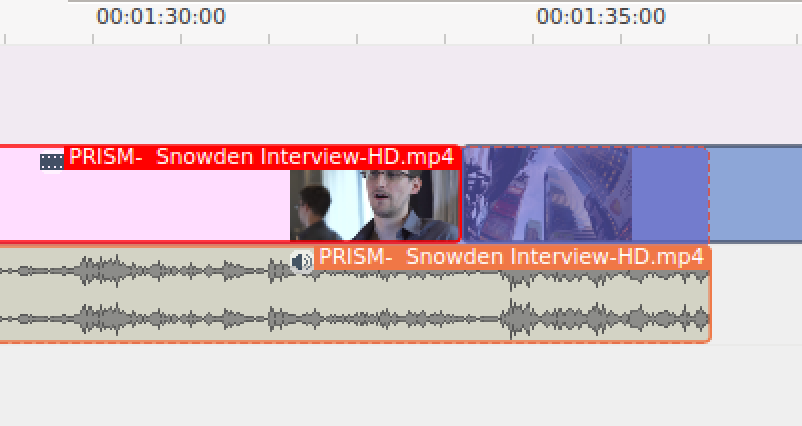
These techniques are essential for pacing dialogue. They pull the audience through the conversation, focusing attention on reactions and creating a seamless flow that mimics how we experience real-life interactions. We often hear something and then turn our heads to see the source.
Clever Connections
Continuity isn't just about making sure a character's shirt is the same color in two different shots. Advanced continuity uses visual and auditory cues to bridge scenes, creating connections that are felt more than seen. This is the domain of the match cut.
A transitions between two scenes by matching a specific element from the first shot with one in the second. There are three main types:
-
Graphic Match: Connecting two shots that have similar shapes or compositions. Think of the famous cut in 2001: A Space Odyssey, where a bone thrown by a primate transforms into a satellite floating in space. The similar shapes link millions of years of human evolution in a single, powerful transition.
-
Match on Action: Cutting from one shot to another in the middle of a continuous gesture. If a character starts to open a door in a wide shot, you can cut to a close-up of their hand on the knob as the door continues to open. This feels like a single, uninterrupted movement to the viewer, hiding the cut completely.
-
Sound Bridge: Using sound to connect two thematically different scenes. The sound from the next scene starts before the visuals appear (a J-cut), or the sound from the first scene carries over into the second (an L-cut). A character's scream might blend into a train whistle, linking their emotional state to the new location.
The right rhythm and pace of the edit can determine the progression of the narrative – true, but it can also change how the audience receives the message of the film entirely.
Effective editing controls the story's pulse. A fast-paced action sequence uses a flurry of short cuts to create tension and excitement, barely giving the audience a moment to breathe. In contrast, a dramatic, emotional scene might use long, uninterrupted takes to let the actors' performances unfold naturally, drawing the viewer deeper into their experience.
The key is variation. By consciously manipulating the length and frequency of your cuts, you create a rhythm that supports the emotional arc of the story, making it more dynamic and engaging.
According to Walter Murch's "Rule of Six," what is the single most important factor to consider when making a cut?
An editor is cutting a dialogue scene. They want to show a character's reaction to what's being said before cutting to the person speaking. The audio from the next shot (the speaker) begins while the video is still on the first shot (the listener). What is this type of edit called?
Ultimately, editing is a dance between technical skill and emotional intuition. By mastering these advanced techniques, you can move beyond simply connecting shots and begin to truly shape the viewer's journey through your story.