Professional UI UX Product Design Mastery
Strategy and Discovery
The First Diamond
You've likely seen the Double Diamond framework. It's a simple, powerful map for the design process. The first diamond represents the journey from a problem to a clear, defined challenge. This is where strategy lives. It’s split into two parts: Discover and Define.
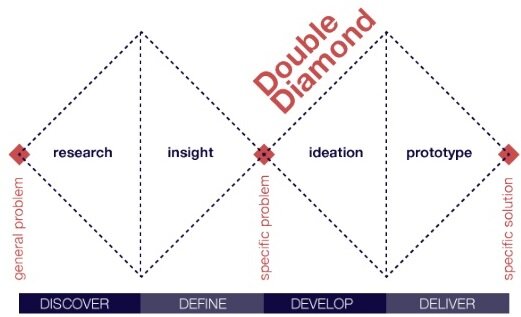
The Discover phase is about divergent thinking—going wide to understand the problem space fully. This means moving beyond basic personas and surveys. We need to observe what users do, not just what they say. This is where behavioral user research and ethnographic inquiry come in. Instead of asking a user how they manage their finances, you might observe them using their banking app over a week, noting their workarounds and moments of frustration.
Behavioral research reveals the gap between what people say they do and what they actually do.
In 2025, this isn't just about field notes. We now use AI-powered analytics tools to sift through massive amounts of interaction data—clickstreams, session recordings, and support tickets. These tools excel at recognizing non-obvious patterns. An AI might find that users who hesitate for more than 2.5 seconds on the checkout page are 70% more likely to abandon their cart, even if they never report the page as confusing. This is the kind of insight that shapes a winning product strategy.
Defining the Job to be Done
After discovering a world of user problems, the Define phase begins. This is about convergent thinking—narrowing your focus to the right problem to solve. A common mistake is to jump straight to a list of features. A more powerful approach is the Jobs-to-be-Done (JTBD) framework.
The core idea is that customers don't buy products; they "hire" them to do a job.
This shifts the focus from the product itself to the user's goal. A user doesn't want a "faster photo-sharing feature." They want to "share a moment with family quickly so they can feel connected." Framing the problem as a JTBD statement keeps the team focused on the user's motivation, not just the technical solution. This clarity is crucial for writing a sharp, data-backed problem statement that will guide the entire project.
| Feature-Based Thinking | Jobs-to-be-Done Thinking |
|---|---|
| "Users need a way to save articles." | "When I find an interesting article, I want to save it for later so I can read it when I have more time." |
| "We should add a dark mode." | "When I'm reading at night, I want to reduce eye strain so I can read comfortably." |
| "Let's build a recipe filter." | "When I'm planning my meals, I want to find recipes that match my dietary needs so I can cook with confidence." |
Justifying the Work
Strategy isn't just about having good ideas; it's about getting buy-in to execute them. Once you have a defined problem, you need to justify the design intervention to stakeholders. Two key tools here are competitive audits and feature scorecards. A competitive audit analyzes how competitors are solving a similar "job," identifying gaps and opportunities. A feature scorecard helps prioritize what to build by scoring potential solutions against user impact and business goals.
This all comes together in an 'as-is' vs. 'to-be' journey map. The 'as-is' map uses your research to illustrate the current, painful user experience. The 'to-be' map shows how your proposed solution will resolve those pain points and deliver a better outcome. This simple before-and-after story is one of the most effective ways to align your team and convince stakeholders that you're solving a problem worth solving.
What is the primary goal of the Discover phase in the Double Diamond framework?
The Jobs-to-be-Done (JTBD) framework is most useful during which phase?
By mastering the Discover and Define stages, you ensure you're not just building features, but creating genuine value for both users and the business.