Professional Screenwriting and Narrative Structure
Three-Act Mechanics
The Heart of the Story
Most stories have a beginning, a middle, and an end. In screenwriting, this is the three-act structure. While Act I sets the stage and Act III resolves the conflict, Act II is where the real work happens. It's the longest and most complex part of a screenplay, often called the 'Confrontation'. This is where your protagonist truly grapples with the central problem.
Every scene must serve one of these purposes:Advance the Plot – Something significant happens that pushes the narrative forward.Develop Characters – Readers gain new insights into your characters’ motivations, relationships, or flaws.Build the World or Theme – Subtly weave in elements of your world or reinforce thematic aspects without info-dumping.
In a standard 90-110 page feature film script, where one page roughly equals one minute of screen time, the proportions are uneven. Act I and Act III are typically 25-30 pages each. Act II, however, takes up the massive chunk in between.
This expansive middle section is often where writers get lost. It's easy for the story to lose momentum, wander, or feel repetitive. This problem is so common it has a name: the 'muddy middle'. To navigate it, screenwriters rely on key structural anchors, the most important being Plot Points and the Midpoint.
Structural Anchors
Think of your story as a long bridge. Act I is the on-ramp, and Act III is the off-ramp. Act II is the long span in the middle, and it needs support pillars to keep from collapsing. These pillars are called Plot Points.
-
Plot Point I (around page 25-30): This is an event that spins the story in a new direction and locks the protagonist into the central conflict. It's the 'point of no return' that ends Act I and launches us into Act II. For example, in Star Wars, this is when Luke Skywalker finds his aunt and uncle murdered, leaving him no reason to stay on Tatooine. He commits to joining Obi-Wan.
-
Plot Point II (around page 85-90): This event pushes the story into its final confrontation. It often represents a low point for the protagonist, where all seems lost, forcing them to rally for one last push. It ends Act II and begins Act III. In The Matrix, this is when Morpheus is captured, forcing Neo to decide to risk everything to save him.
These plot points aren't just random events. They are the primary structural anchors popularized by screenwriting guru in his influential book Screenplay. They provide a framework that helps maintain narrative drive and ensures the story is always moving forward.
The Midpoint Shift
Even with plot points, the 50-60 pages of Act II can feel like a desert. The solution is another anchor, placed right in the center: the Midpoint. This occurs around page 55-60 and represents a crucial shift in the story and the protagonist's journey.
The Midpoint changes the entire dynamic. It raises the stakes, often reveals new information, and marks the moment the protagonist shifts from reacting to the conflict to proactively taking charge of it.
Before the Midpoint, in the first half of Act II, the protagonist is usually on their back foot. They are responding to the forces unleashed by Plot Point I. They are learning the new rules of the world they've been thrust into. They are often failing and struggling to gain a foothold. This is the reactive phase.
After the Midpoint, the protagonist starts to fight back. Armed with new knowledge or a new sense of purpose, they begin to form a plan and take direct action against the antagonist. This is the proactive phase.
In Jaws, the Midpoint is when Chief Brody, Quint, and Hooper are on the boat and finally see the sheer size of the shark. The abstract threat is now a very real, very large monster. The goal shifts from merely hunting it to surviving it, and Brody becomes an active participant in the fight.
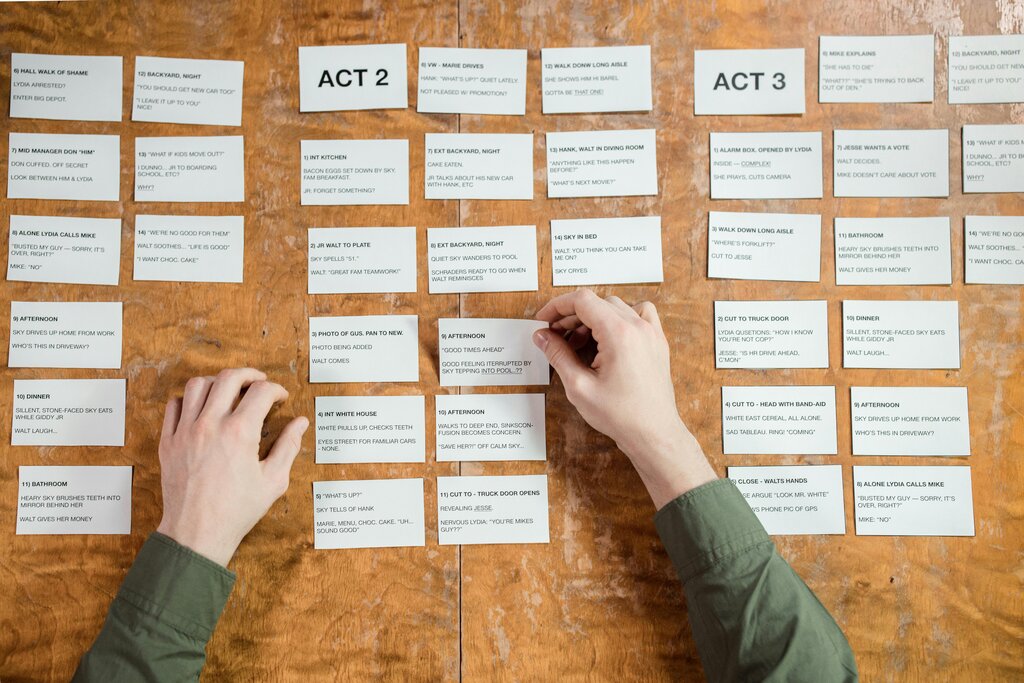
By breaking Act II into two distinct halves with a clear dividing line, the 'muddy middle' becomes manageable. You now have two smaller, 25-30 page sections to write, each with a clear focus. The first half builds toward the Midpoint revelation, and the second half drives toward the desperation of Plot Point II. This structure provides momentum and ensures every scene serves a purpose in the protagonist's escalating journey.
Ready to test your knowledge of narrative structure? Let's see how well you've grasped these concepts.
In screenwriting, what is the common term for the problem where the long second act loses momentum and direction?
What is the primary function of Plot Point I?