Professional Pharmacy Assistant Mastery
Optimizing Pharmacy Workflow
The Left-to-Right Principle
An efficient pharmacy operates like a well-designed assembly line. The most effective physical layout follows a simple, unidirectional principle: work should flow in one direction, typically from left to right. This linear setup minimizes wasted movement, prevents staff from crisscrossing paths, and makes the status of any prescription instantly clear.
A prescription's journey begins at the intake station on the far left. From there, it moves sequentially through data entry, clinical verification by the pharmacist, filling, and a final accuracy check. The process concludes at the bagging and pickup station on the far right. Nothing moves backward. This logical progression prevents a half-filled prescription from being mistaken for a completed one and reduces the chaos of staff searching for orders.
This physical discipline creates a mental one. Every team member knows where a prescription should be and what the next step is. It's a simple change that dramatically improves order and efficiency.
Pinpointing Bottlenecks
Even with a perfect layout, workflow can grind to a halt. The culprit is always a bottleneck, a single point in the process that can't handle the volume of work flowing to it. Throughput, the rate at which prescriptions move through the system, is limited by its slowest step. If the data entry station can process 30 scripts per hour but the pharmacist can only verify 20, the pharmacy's maximum output is 20 scripts per hour. The verification station is the bottleneck.
Identifying these chokepoints requires observation. Where do prescriptions physically pile up? Is it a stack of baskets waiting for a pharmacist's check? Or perhaps a queue of patients waiting while the technician at the counter is also answering phone calls and handling intake? A common bottleneck in retail is the final pickup point, where one person is often tasked with too many different functions.
To increase overall speed, you must fix the slowest part of the process. Optimizing any other step will have no effect on the final output.
Once a bottleneck is found, the solution is often to either reallocate resources—like adding a second pharmacist to verify during peak hours—or to redesign the process to protect that station from unnecessary work and interruptions.
Specialized Roles for a Smart Flow
Generalizing roles is a common cause of bottlenecks. When every technician does a little of everything, crucial tasks are constantly interrupted. The 'SmartFlow' methodology addresses this by creating specialized roles that divide and conquer the workload, protecting focused work from chaotic, unpredictable tasks.
The two most important roles to separate are the Entry Technician and the Counter Technician.
| Role | Key Responsibilities | Primary Goal |
|---|---|---|
| Entry Technician | Manages all intake (walk-in, phone, e-prescription). Prioritizes orders (e.g., waiters vs. next day). Answers phone calls. | Absorb all interruptions and organize incoming work for the dispensing team. |
| Counter Technician | Handles final bagging. Manages the pickup counter and cash register. Calls patients when orders are ready. | Provide a smooth, efficient final interaction for the patient, free from dispensing distractions. |
By funneling all interruptions to the Entry Technician, the technicians and pharmacists performing the core dispensing and checking functions can maintain focus. This separation is critical. The dispensing workflow is shielded from the constant stop-and-start rhythm of the front counter, leading to higher accuracy and faster throughput. In high-volume retail settings, this is often managed with visual cues, like color-coded baskets (e.g., red for 'waiters,' green for 'next day') that the Entry Tech uses to signal priority to the rest of the team.
Automation and Virtual Queues
Technology is a powerful tool for eliminating bottlenecks, especially in high-volume or hospital settings. Automated pouch packaging machines, for instance, can assemble complex multi-dose medication schedules for patients, a task that is incredibly time-consuming and error-prone when done manually. When integrated into the workflow, the technician's role shifts from counting pills to preparing the machine and verifying its output with tools like strip detection scanners, which confirm the right pills are in the right pouches.
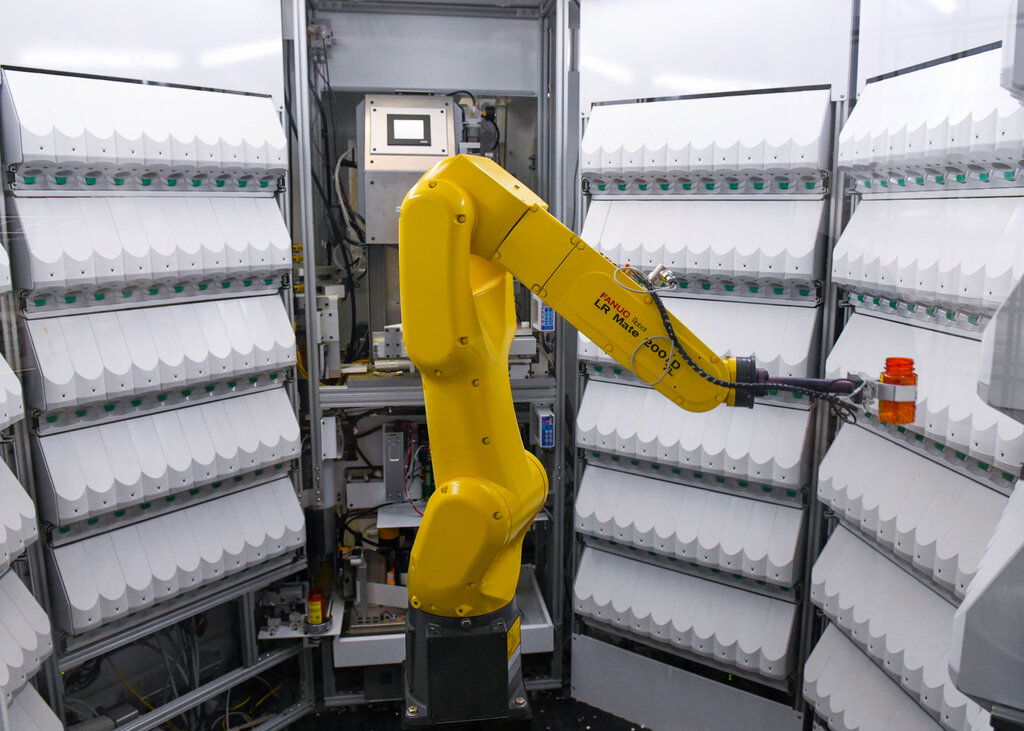
Telepharmacy introduces another layer of optimization: the virtual smart queue. In this model, prescriptions from multiple locations are routed digitally to a central processing pharmacy. Technicians and pharmacists work through a single, prioritized queue on their screens.
This system allows for incredible efficiency. Work is distributed automatically based on staff availability, eliminating downtime. A pharmacist in a quiet location can verify prescriptions for a pharmacy that is experiencing a sudden surge. Smart queues can automatically flag high-priority medications or prescriptions that have been waiting longest, ensuring that urgent needs are always met first without manual sorting.
Now, let's test your understanding of these workflow optimization strategies.
What is the primary principle for designing an efficient physical pharmacy layout?
A pharmacy's data entry station can process 30 prescriptions per hour, the pharmacist can verify 22, and the filling station can prepare 45. What is the maximum throughput of this pharmacy?
By implementing these principles of layout, role specialization, and technology integration, a pharmacy can transform a chaotic environment into a streamlined operation that enhances both patient safety and team productivity.