Professional Football English Mastery
Football Terminology
Player Positions on the Pitch
A football team has 11 players on the field at once, each with a specific job. These roles can be grouped into four main categories: goalkeepers, defenders, midfielders, and forwards. While every player needs to be a good all-around footballer, their position determines their primary focus during a match.
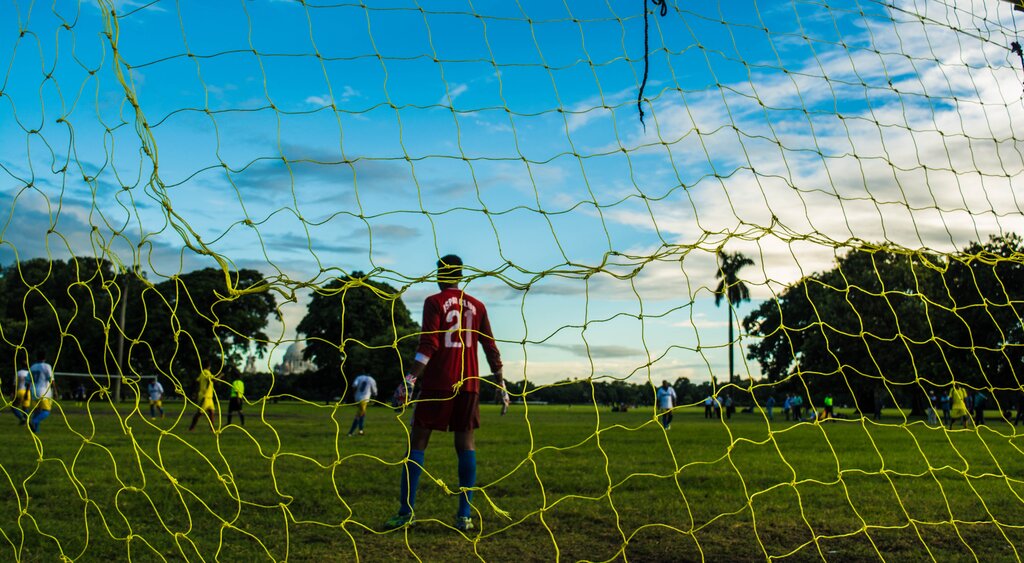
The Goalkeeper (GK) is the most specialized position. They stay in or near the penalty area and are the only player allowed to use their hands to touch the ball (and only within their own penalty box). Their main objective is simple: prevent the other team from scoring a goal.
Defenders form a line in front of the goalkeeper. Their main responsibility is to stop the opposing team's attackers. They need to be strong tacklers and good at reading the game to intercept passes and block shots.
- Center-Back (CB): Positioned in the middle of the defense, center-backs are often the team's strongest and tallest players. They defend against the opponent's main strikers.
- Full-Back (LB/RB): These defenders play on the left and right sides of the pitch. They defend against wide players (wingers) and often support their team's attack by running up the sidelines.
Midfielders are the engine of the team, connecting the defense and the attack. They play in the middle of the field and have a mix of defensive and offensive duties. They need incredible stamina because they cover the most ground.
- Defensive Midfielder (DM): Sits just in front of the defenders, breaking up opposition attacks before they get dangerous.
- Attacking Midfielder (AM): Plays a more creative role, positioned behind the forwards to set up scoring chances.
Forwards, also called strikers, are the primary goal-scorers. They play closest to the opponent's goal and are responsible for finishing the attacks created by their teammates. They need to be fast, skilled with the ball, and excellent shooters.
Team Formations
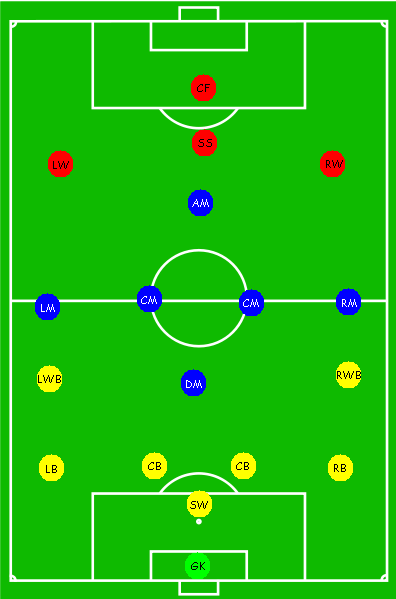
A formation describes how the players (excluding the goalkeeper) are arranged on the pitch. It's a tactical plan that a coach chooses to balance defense and attack. Formations are written as a series of numbers, starting from the defenders and moving up to the forwards. For example, a 4-4-2 formation means four defenders, four midfielders, and two forwards.
The 4-4-2 is a classic, balanced formation. It uses two lines of four players, providing solid defensive cover and width in attack. It's straightforward and gives the team a strong presence across the entire field.
The 4-3-3 is a more attacking formation. It sacrifices a midfielder for an extra forward, creating a potent front three. This setup is great for teams that want to press high up the pitch and dominate possession, but it can sometimes leave the defense a bit exposed if the midfielders don't track back.
The 3-5-2 is a flexible formation that packs the midfield. With three central defenders, it's defensively solid in the middle. The five midfielders control the center of the pitch, with the two wide players (wing-backs) responsible for both defending the flanks and providing width in attack. This formation requires players with excellent stamina.
Talking the Talk
Like any sport, football has its own language. Understanding these common terms is key to following the game and communicating effectively with a team.
| Term | Meaning |
|---|---|
| Offside | An attacking player is offside if they are nearer to the opponent's goal line than both the ball and the second-to-last opponent when the ball is played to them. It's a tricky rule, but it prevents players from just waiting by the goal. |
| Set Piece | A situation when the ball is returned to open play after a stoppage, such as a free kick, corner kick, or throw-in. |
| Free Kick | Awarded to a team after a foul by the opposition. It can be direct (can be shot directly into the goal) or indirect (must touch another player before a goal can be scored). |
| Corner Kick | Awarded when the defending team puts the ball out of play over their own goal line. The attacking team takes the kick from the corner of the pitch. |
| Tackle | Using the feet to take the ball from an opponent. A slide tackle involves sliding on the ground to take the ball. |
| Dribbling | Moving the ball along the ground with the feet while running. |
| Nutmeg | Kicking the ball between an opponent's legs. |
| Clean Sheet | When a team or goalkeeper finishes a match without conceding any goals. |
Time to review what you've learned about football's language.
Ready to test your knowledge?
What is the only position in football allowed to use their hands to touch the ball within their own penalty area?
In a 4-4-2 formation, what do the numbers represent?
Understanding these core concepts of positions, formations, and terminology provides a strong foundation for appreciating the strategy and skill involved in football.