Professional Fire Extinguisher Inspection and Compliance
NFPA 10 Regulatory Standards
The Rulebook for Readiness
When it comes to fire safety, good intentions aren't enough. Every portable fire extinguisher in a commercial or public space is governed by a detailed set of rules. The primary standard in the United States is , the "Standard for Portable Fire Extinguishers." Think of it as the industry's complete guide, covering everything from manufacturing to final disposal.
While NFPA 10 is a voluntary standard developed by a non-profit organization, it carries significant weight. It's often adopted into law by local and state governments. This is where the (AHJ) comes in. The AHJ—typically a fire marshal or building inspector—is the official who enforces the code. They have the final say on whether your equipment and procedures meet the legal requirements in your area.
On a national level, the Occupational Safety and Health Administration (OSHA) also sets workplace safety rules. Their standard, OSHA 29 CFR 1910.157, directly addresses fire extinguishers in the workplace. The good news is that OSHA's requirements are closely aligned with NFPA 10. If you are fully compliant with NFPA 10, you will generally satisfy OSHA's requirements as well. This alignment simplifies things, allowing businesses to follow one primary set of guidelines.
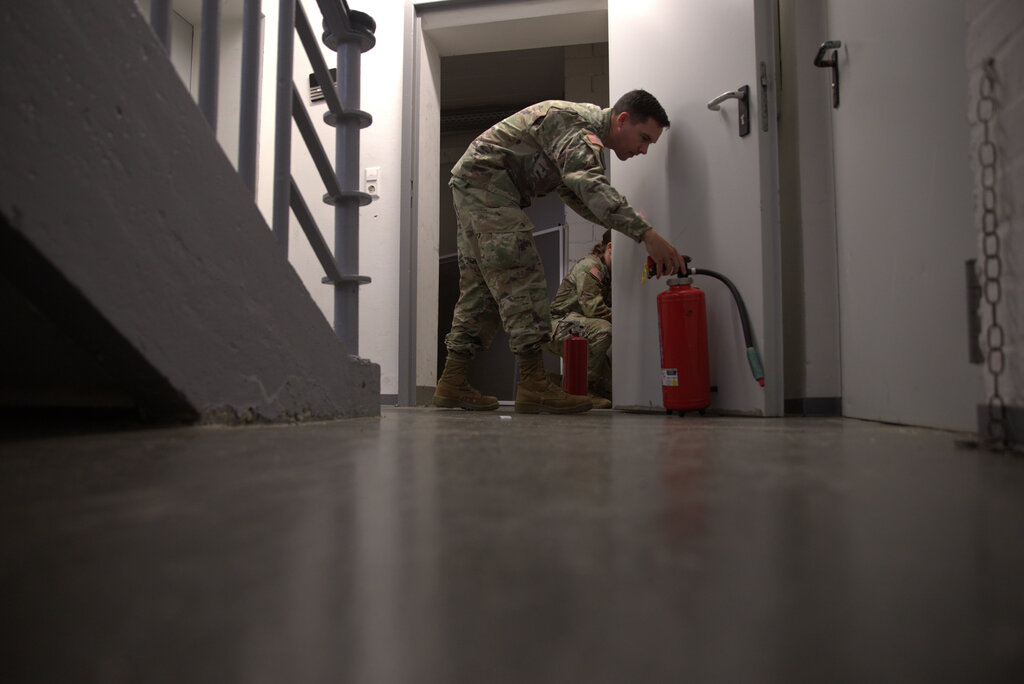
Inspection, Maintenance, and Testing
NFPA 10 establishes a clear hierarchy of service levels. These terms are not interchangeable, and understanding the difference is crucial for compliance. The three main categories are inspection, maintenance, and testing.
Inspection
noun
A quick visual check to ensure an extinguisher is in its designated place, has not been tampered with or used, and is not obviously damaged. It's a confirmation of readiness.
Visual inspections are the most frequent check. They're designed to be performed quickly by on-site staff, without any special tools. The goal is to catch obvious problems before they become serious.
NFPA 10 mandates these checks happen at least every 30 days.
Maintenance
noun
A thorough examination of the extinguisher. It involves a detailed check of all mechanical parts, the extinguishing agent, and the delivery system. This is a hands-on, in-depth service.
Maintenance procedures are more involved and must be performed by a certified technician. These professionals have the training, tools, and knowledge to service the equipment according to manufacturer specifications. They'll check things like the pressure gauge, seals, and hoses, and verify the extinguisher is properly charged and ready for use.
| Frequency | Service Level | Performed By | Key Actions |
|---|---|---|---|
| Monthly | Inspection | Facility Staff | Check presence, pressure gauge, pin & seal, signs of damage |
| Annually | Maintenance | Certified Technician | Full external exam, weigh extinguisher, verify nameplate, update service tag |
| 6 Years | Maintenance | Certified Technician | Empty and recharge stored-pressure dry chemical & halogenated agent extinguishers |
| 5-12 Years | Hydrostatic Test | Certified Technician | Pressure test the cylinder for leaks or weakness (interval depends on type) |
Finally, there's hydrostatic testing. This involves pressure testing the cylinder itself to ensure it can safely hold its charge. It’s the most intensive service and is performed less frequently, typically every 5 or 12 years depending on the extinguisher type. This test must be done by a qualified facility with specialized equipment.
Staying Current
Fire safety standards are not static. The NFPA updates its codes on a regular cycle to incorporate new technology and safety data. The 2022 edition of NFPA 10 introduced several important changes that affect compliance.
One of the biggest updates is the formal acceptance of electronic monitoring. Instead of relying solely on a person walking around to perform the 30-day visual inspection, facilities can now use listed and approved electronic monitoring systems. These devices constantly check an extinguisher's pressure, presence, and whether it's blocked, providing real-time status updates. This can improve reliability and reduce labor costs, but the annual maintenance by a certified person is still required.
The 2022 code also finalized the phase-out of certain older types of extinguishers. Specifically, dry chemical stored-pressure extinguishers manufactured before October 1984 are now considered obsolete and must be removed from service. This is due to concerns about their reliability and performance after decades of service. Staying on top of these updates is a key responsibility for any facility safety manager.
Compliance isn't just about following rules. It's about ensuring that the first line of defense in a fire emergency is reliable, effective, and safe to use.
Finally, the standard clarifies who is qualified to perform these tasks. While anyone can be trained to do the monthly visual check, the annual maintenance and more intensive testing require a certified person who has been properly trained and has the correct manuals, tools, and materials. This ensures that the work is done correctly and that the equipment is safe and effective.
Now, let's test your knowledge of these regulatory standards.
What is the primary standard for portable fire extinguishers in the United States, often adopted into law by local governments?
A facility manager walks the building once a month to verify that all fire extinguishers are in their proper place, are not blocked, and appear to be in good working order. What level of service is this?
Understanding these standards is the foundation of a reliable fire protection program.