Professional Cricket Career Pathway
Advanced Technical Skills
Bowling with Professional Intent
At the professional level, a bowler's action is more than just a way to deliver the ball. It's a highly tuned system built for endurance and deception. The key is biomechanical efficiency, ensuring every part of the body works in a smooth sequence to generate pace and control without unnecessary strain. This is what allows fast bowlers to maintain speeds over 140 km/h for long spells and spinners to land the ball on a sixpence, delivery after delivery.
This efficiency comes from mastering the —the transfer of energy from the run-up, through the core, into the shoulder, and finally exploding through the wrist at the point of release. A break in this chain not only leaks pace but is also a common cause of career-threatening injuries. Elite bowlers spend countless hours with coaches optimising their action to be both powerful and repeatable, making it a weapon they can rely on under immense pressure.
The goal is an action that is powerful enough to threaten the batter, but economical enough to repeat for 30 overs in a day.
With a solid mechanical base, bowlers can focus on the subtle arts of variation. Seam and swing are a fast bowler's primary tools. By altering the angle of the seam at release, a bowler can make the ball move in the air (swing) or off the pitch (seam). Controlling this requires immense finger and wrist strength. Beyond conventional swing, there's reverse swing, a darker art where the ball moves deceptively late towards the worn, rougher side of the leather.
Variations in pace are just as crucial, especially in limited-overs cricket. These are not just slower balls; they are deliveries designed to look identical to a stock ball until the last moment.
| Variation | Grip & Release | Intended Effect |
|---|---|---|
| Off-Cutter | Similar to an off-spinner's grip, fingers cut across the right side of the ball. | The ball grips the pitch and deviates from right to left (for a right-handed bowler). |
| Leg-Cutter | The opposite of an off-cutter; fingers cut across the left side of the ball. | The ball deviates from left to right, cramping the right-handed batter for room. |
| Split-finger Slower Ball | Index and middle fingers are split wide across the seam. | Kills the pace as the ball comes out with less rotation, tumbling towards the batter. |
| Knuckle Ball | The ball is held with the knuckles or fingertips of the index and middle fingers. | Creates an unpredictable, floating delivery with almost no spin, causing it to dip or wobble. |
Elite Batting Mechanics
Facing a professional bowler is a completely different challenge. Batters have fractions of a second to judge the line, length, and speed of a delivery that might be swinging or seaming at over 150 km/h. To cope, technique must be flawless and decision-making instant.
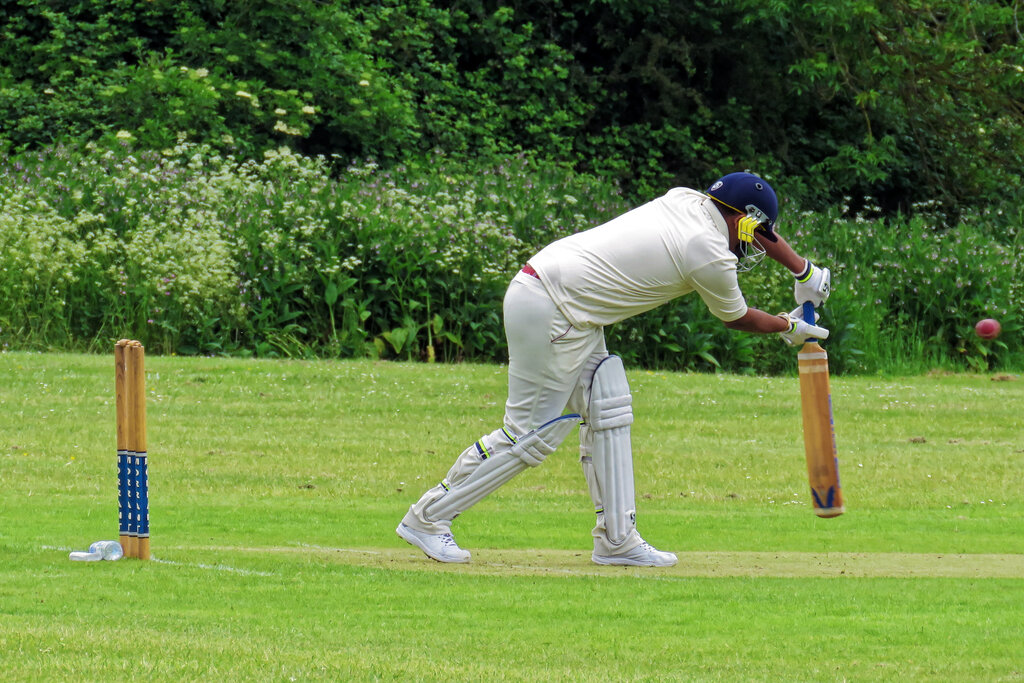
Against extreme pace, there is no time for extravagant movements. The backlift becomes shorter and more direct. Batters often employ a just before the ball is released, like a small back-and-across shuffle, to get into a balanced position and avoid being static at the crease. This pre-emptive motion helps them get into position quicker to either play a shot or leave the ball.
Playing high-quality spin on a turning pitch is another test of skill, often described as a chess match. Elite spinners don't just turn the ball; they use subtle changes in flight, dip, and drift to deceive the batter. The key for the batter is precise footwork. They must decide in an instant whether to go fully forward, getting to the pitch of the ball to smother the spin, or go deep in the crease to give themselves more time to read the turn and play the ball late.
Hesitation against spin is fatal. A batter must commit to their plan, whether it's attack or defence.
Adapting to the Format
The rise of Twenty20 cricket has placed new demands on batters. The format requires a blend of explosive power hitting and clever strike rotation. It's not enough to simply hit sixes; batters must also be able to manipulate the field for ones and twos to keep the scoreboard ticking over.
The mechanics of power hitting involve creating a stable base, using the ground to generate force, and rotating the hips and torso to create massive bat speed. Batters like are masters of this, clearing the boundary with what seems like minimal effort. They achieve this by keeping their head still and swinging through the line of the ball, ensuring a clean transfer of energy.
However, relying solely on power is a flawed strategy. The best T20 batters are also expert manipulators of the field. They use the pace of the bowler, employ delicate touches like the late cut or ramp shot, and are incredibly quick between the wickets. This constant pressure forces the fielding captain to change their plans and often creates gaps for the next big shot.
Whether defending a red ball or attacking a white one, the jump from amateur to professional relies on this deep technical refinement. It's about turning raw talent into a repeatable, pressure-proof skill set.
What is the primary benefit of a biomechanically efficient 'kinetic chain' for a professional bowler?
What is the main purpose of a 'trigger movement' for a batter facing extreme pace?