Professional Business Analysis and Strategic Requirements Engineering
Advanced Elicitation Strategies
Beyond the Interview
In complex projects, simply asking stakeholders what they need isn't enough. People often can't articulate the nuances of their daily work or the unspoken rules they follow. To build effective solutions, we need to move from passive gathering to active discovery. This involves using dynamic techniques to unearth the requirements that hide beneath the surface.
Use multiple elicitation techniques (like interviews, workshops, and surveys) to gather comprehensive and accurate requirements.
Let's explore several advanced strategies that help you see the full picture, starting with how to leverage group dynamics.
Groups, Goals, and Games
Bringing stakeholders together is efficient, but the format of the meeting determines its outcome. The two most common group elicitation formats are focus groups and workshops, and they serve very different purposes.
A Focus Group is a moderated discussion designed to collect opinions, feelings, and attitudes about a specific product, service, or idea. Think of it as a collective interview. The goal is to understand perceptions and gauge reactions. For example, you might run a focus group to see how users feel about a proposed user interface design.
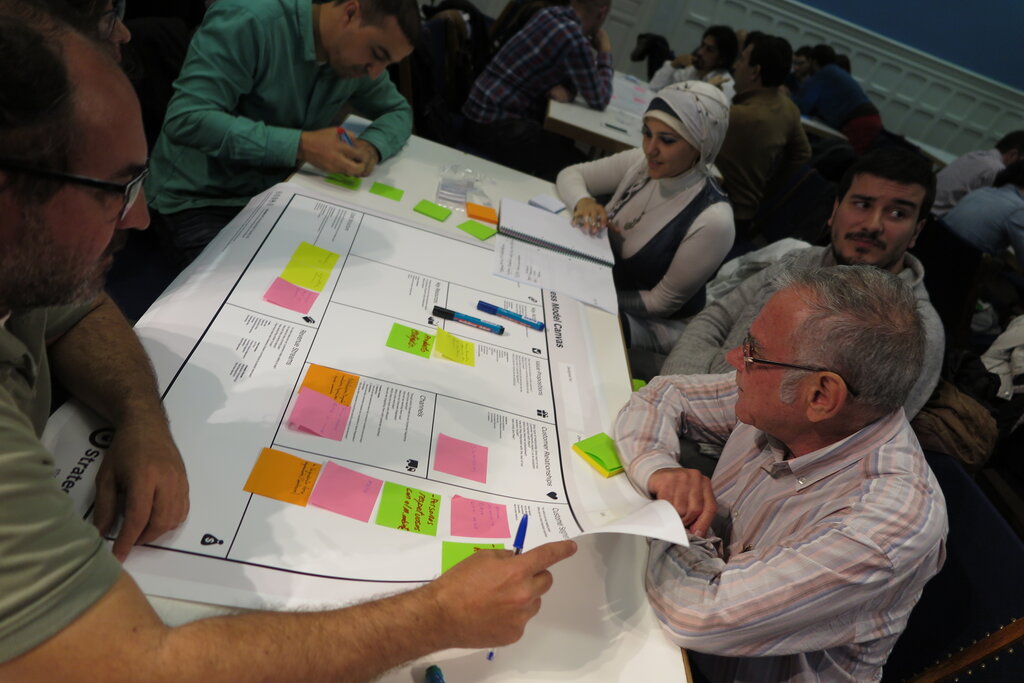
A Workshop, on the other hand, is a structured and collaborative working session. Participants don't just talk; they actively create something. The goal is to produce a tangible deliverable, such as a process model, a set of user stories, or a prioritized feature list. A workshop is about building consensus and defining a solution together.
| Focus Group | Workshop | |
|---|---|---|
| Objective | Gather opinions & attitudes | Create a tangible deliverable |
| Primary Activity | Discussion & feedback | Collaboration & creation |
| Outcome | Qualitative data, insights | Process maps, prototypes, requirements |
| Facilitator's Role | Guide conversation | Structure activities, drive to outcome |
To make workshops even more productive, especially when dealing with conflicting priorities, you can introduce collaborative games. These aren't about winning or losing; they're structured activities that encourage creative thinking and negotiation.
A popular game is "Buy a Feature." Stakeholders are given a limited budget of play money and must collectively decide which features to "fund." This simple constraint forces them to negotiate, justify their priorities, and make tough trade-offs, revealing what is truly most valuable.
Seeing is Believing
Sometimes the most critical requirements are the ones users don't even know they have. People get so used to their workarounds that they forget they're even doing them. That's where observation comes in.
Shadowing
noun
An observation technique where an analyst follows a user for a period of time to see how they perform their job in their natural work environment.
By shadowing someone, you see their process in action, complete with interruptions, frustrations, and clever shortcuts. For instance, an analyst shadowing an accountant might notice that every Friday, she exports a report to a spreadsheet, manually adds three columns, performs a calculation, and emails the result to her manager. When asked, she says, "Oh, I've just always done it that way." She never would have mentioned this in an interview because it's a routine part of her job. Yet, this observation reveals a clear opportunity for automation and a functional requirement that was completely hidden.
Analyzing the Artifacts
Before you build something new, it's wise to understand what came before. Document analysis and interface analysis are two ways to investigate existing systems and processes.
Document Analysis involves reviewing existing materials to extract relevant business rules, processes, and requirements. These "legacy artifacts" can be a gold mine of information. They include:
- Business plans and marketing materials
- Existing process diagrams and user manuals
- Old requirements specifications
- Support logs and issue trackers
Analyzing these documents helps you understand the current state, learn the domain's vocabulary, and identify constraints or rules that must be carried into the new system.
Interface Analysis focuses on the boundaries where systems, people, or processes connect. Every time data is passed from one system to another, an interface is involved. A failure at this boundary can bring a whole process to a halt.
For example, consider an e-commerce website that needs to send order information to a third-party shipping provider. A thorough interface analysis would involve identifying every single data field being exchanged: customer name, address, product SKU, quantity, shipping method, and so on. It would also define the format, timing, and validation rules for the data exchange. This ensures that when the two systems "talk" to each other, nothing gets lost in translation.
A project team wants to gather user opinions and feelings about a new proposed user interface design before starting development. Which technique is most appropriate for this purpose?
What is the primary advantage of using observation (shadowing) to gather requirements?
Mastering these advanced techniques allows you to actively uncover requirements instead of just collecting them. By choosing the right strategy for the situation, you can build a deeper, more accurate understanding of the real business need.