Professional Artistic Drawing Techniques
Structural Form Construction
From Shapes to Forms
You know how to draw a square, a circle, and a triangle. Now, let's give them depth. In animation and character design, objects aren't flat outlines; they are solid forms that exist in three-dimensional space. Thinking in 3D is the single most important shift you can make to bring your drawings to life. Instead of seeing a character's arm as two parallel lines, you must see it as a cylinder. A torso isn't a rectangle; it's a box or a collection of spheres. This is structural thinking.
Every complex object can be broken down into a combination of simpler geometric volumes: cubes, cylinders, spheres, and cones. Mastering these forms is the key to drawing anything convincingly.
Defining Volume with Cross-Contours
How do you make a simple cylinder look solid and round on paper? You use cross-contour lines An arm isn't just a tube; it has muscles that create subtle shifts in the surface. Cross-contour lines are like lines of latitude and longitude on a globe, wrapping around the form to describe its surface. They follow the 'landscape' of the object, dipping into valleys and climbing over hills. When you draw these lines, you force yourself to think about the object's volume and the way it turns in space. They reveal the three-dimensional reality of the form.
Placing Forms in Space
Once you can construct a form, you need to place it accurately within a scene. This is where the technique comes in. Imagine every object, no matter how complex, fits inside a transparent glass box. First, you draw this box in the correct perspective. Then, you sketch the object inside it, using the box's walls, corners, and centre lines as guides. This method anchors your object in the scene, ensuring its proportions and angle are correct relative to everything else. It prevents characters from looking like they are floating and gives them a tangible presence and weight. Whether you're drawing a character leaning against a wall or a spaceship landing on a planet, the bounding box establishes the foundational rules of the space.
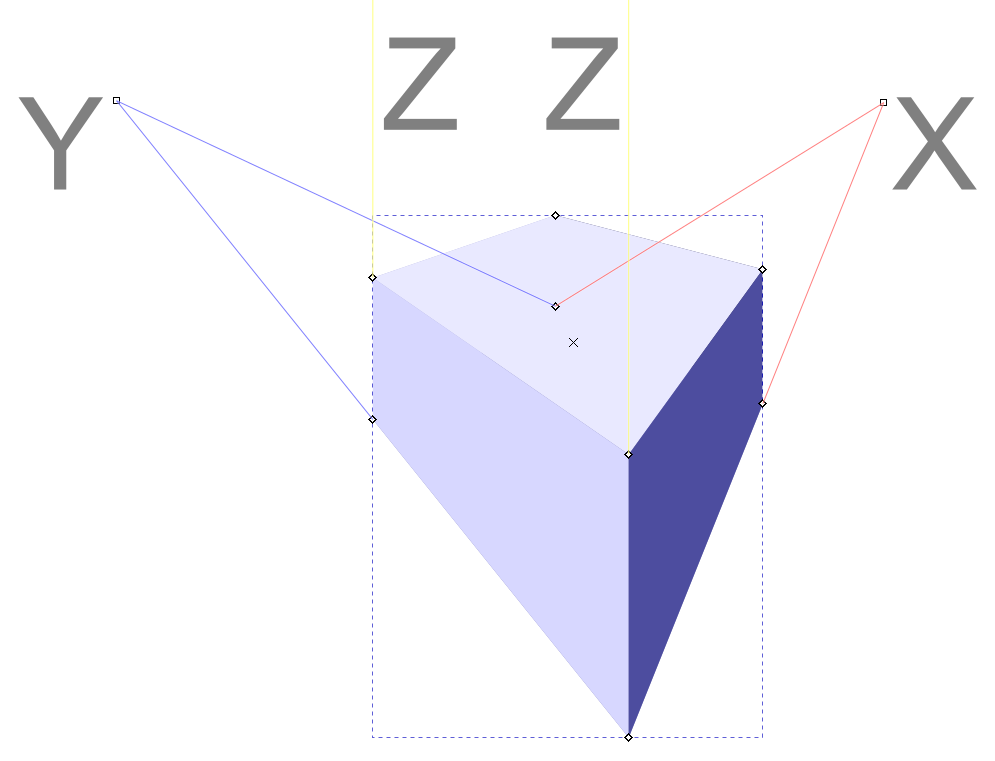
This process forces you to commit to the object's overall volume and placement before getting lost in details. It’s a structural approach that builds a solid foundation for your drawing, making the final result much more believable.
By combining these techniques—seeing in forms, defining them with cross-contours, and placing them with bounding boxes—you move from simply copying what you see to truly constructing it. This is the foundation for creating dynamic characters that can move, act, and exist convincingly in their world.