Professional App Development and Software Engineering
Advanced Software Architecture
From Code to Systems
Writing functional code is one thing; designing a system that can grow and adapt over years is another. The leap from programmer to architect involves thinking about structure. How do you organize code so it's easy to test, maintain, and understand, especially when working in a team? The answer lies in architectural patterns.
These patterns are not rigid rules but proven blueprints for structuring applications. They help us tackle a core problem in software engineering: managing complexity. By separating different responsibilities of the application into distinct sections, we prevent our codebase from becoming a tangled mess often called "spaghetti code."
This principle is known as separation of concerns. Instead of having one massive file that handles user input, business rules, and data storage, we divide these tasks into independent modules. This makes the system more modular, flexible, and easier for multiple developers to work on simultaneously.
Decoupling
noun
The practice of separating software components so that they are not dependent on one another's specific implementation details. Decoupled components are easier to replace, reuse, and test independently.
The MVC Pattern
One of the oldest and most influential architectural patterns is Model-View-Controller (MVC). It proposes splitting an application into three interconnected components.
Model: This is the brain of the application. It manages the data, logic, and rules. The Model is not concerned with how the data is displayed; it simply represents the state of the application. For example, in a to-do list app, the Model would handle the list of tasks, adding new tasks, and marking them as complete.
View: This is what the user sees—the user interface (UI). It displays the data from the Model and sends user actions (like button clicks) to the Controller. The View should be as "dumb" as possible; its main job is presentation.
Controller: This acts as the intermediary. When a user interacts with the View, the Controller receives the input and decides what to do. It might update the Model with new data or tell the View to change its display. It orchestrates the communication between the Model and the View.
MVC is popular in web frameworks like Ruby on Rails and Django because it cleanly separates the concerns of a request-response cycle. The Controller handles an incoming web request, works with the Model to fetch or update data, and then selects a View to render the final HTML page.
Evolving MVC with MVVM
While MVC is powerful, it can become cumbersome in applications with complex, stateful user interfaces, like modern single-page web apps or mobile apps. In these scenarios, the Controller can get bloated with logic for updating the View. This led to the development of the Model-View-ViewModel (MVVM) pattern.
MVVM is a refinement of MVC. It keeps the Model and the View but replaces the Controller with a ViewModel.
The ViewModel is a special type of controller designed specifically for the View. It holds the UI's state (e.g., what's typed in a text box, whether a checkbox is ticked) and exposes data from the Model in a format that's easy for the View to use. The key innovation is two-way data binding.
This means the View and ViewModel are synchronized automatically. If the user types into an input field in the View, a property in the ViewModel updates instantly. Conversely, if the code updates that property in the ViewModel, the input field in the View shows the new value without any manual DOM manipulation. This reactive approach simplifies UI development significantly and is a core feature of frameworks like Angular, Vue, and React (with hooks).
| Feature | MVC | MVVM |
|---|---|---|
| Core Components | Model, View, Controller | Model, View, ViewModel |
| Primary Use | Web applications (request-response) | Complex UIs (mobile, single-page apps) |
| Communication | Controller mediates View-Model interaction | View and ViewModel linked by data binding |
| Coupling | View and Controller are often tightly coupled | View and ViewModel are loosely coupled |
| State Management | Often stateless (web) or managed by Controller | Handled within the ViewModel |
These architectural patterns and styles provide a framework for designing and building robust, scalable, and maintainable software systems.
Clean Architecture
Both MVC and MVVM are excellent for organizing the presentation layer of an application. But what about the core business logic? How do we protect it from changes in technology, frameworks, or delivery mechanisms (like web vs. mobile)? This is where Clean Architecture comes in.
Proposed by Robert C. Martin ("Uncle Bob"), Clean Architecture is a set of principles for arranging code in concentric layers, like an onion. The central idea is the Dependency Rule: source code dependencies can only point inwards. Nothing in an inner circle can know anything at all about something in an outer circle.
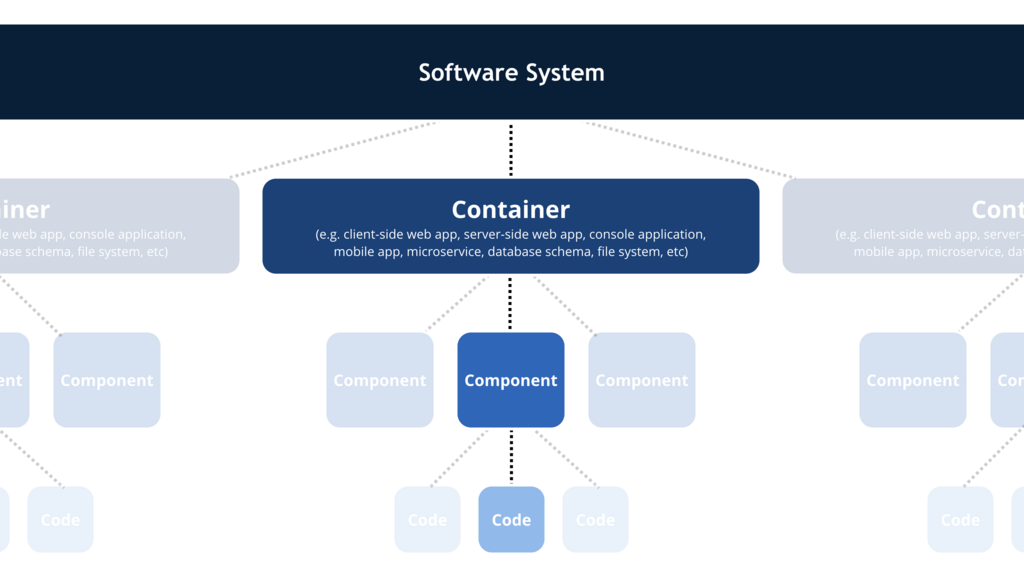
The layers typically are:
- Entities: These are the core business objects of your application. They contain the most general and high-level rules and are the least likely to change when something external changes.
- Use Cases (Interactors): This layer contains the application-specific business rules. It orchestrates the flow of data to and from the Entities to achieve a specific goal (e.g.,
RegisterUser,CreateOrder). - Interface Adapters: This layer acts as a set of converters. It takes data from the format most convenient for the outer layers (like a database or the web) and converts it to the format most convenient for the inner layers (Entities and Use Cases). This is where patterns like MVC or MVVM would live.
- Frameworks & Drivers: This is the outermost layer. It's composed of frameworks and tools like the Database, the Web Framework, and the UI. These details are kept on the outside, where they can do the least harm.
This structure enforces a powerful form of decoupling. Your core business logic (Entities and Use Cases) has no dependency on a specific database, UI framework, or external service. You could swap your web framework or change your database from PostgreSQL to MongoDB without changing a single line of code in the inner layers. This is achieved through Dependency Injection, where dependencies are provided to an object rather than created by it, allowing for flexible and testable code.
By following the Dependency Rule, you create a system that is testable, independent of the UI and database, and resilient to technological change.
Now, let's test your understanding of these architectural patterns.
What is the primary principle behind architectural patterns like MVC, MVVM, and Clean Architecture?
In the MVC pattern, which component is responsible for managing the application's data and business logic?
Understanding these patterns is the first step toward designing robust and scalable systems. They provide a common language for development teams and a structured approach to managing complexity as an application grows.