Productionizing Transformer AI Models
Transformer Architectures
The Rise of Transformers
For a long time, artificial intelligence models designed for language, like Recurrent Neural Networks (RNNs), processed text one word at a time, in order. This was logical—it's how we read—but it created a major bottleneck. Processing long documents was slow, and the models often forgot the beginning of a sentence by the time they reached the end. This made it difficult to capture complex relationships and context.
The game changed in 2017 with a paper titled "Attention Is All You Need." It introduced the Transformer architecture, a new model that reads the entire sequence of text at once. This parallel processing was not only faster but also far more effective at understanding the intricate connections between words, no matter how far apart they were.
The Transformer architecture, introduced by Vaswani et al. in the seminal paper "Attention is All You Need", eschews the traditional recurrent and convolutional neural network structures in favor of self-attention mechanisms, thereby enabling the model to capture long-range dependencies and contextual information in a more efficient and effective manner.
Core Components
What gives Transformers their power? It comes down to a few key innovations that work together: a self-attention mechanism, positional encoding, and feed-forward networks.
Self-Attention
noun
A mechanism that allows a model to weigh the importance of different words in an input sequence and draw connections between them, regardless of their position.
Self-attention is the heart of the Transformer. It allows the model to look at other words in the input as it processes a specific word. For example, in the sentence, "The animal didn't cross the street because it was too tired," the word "it" is ambiguous. Is the street tired, or is the animal tired? A self-attention mechanism can learn to associate "it" strongly with "animal," giving it a deeper understanding of the sentence's meaning.
Because Transformers look at all words simultaneously, they lose the inherent sequence order. This is a problem—word order is crucial for meaning. To fix this, the model uses positional encoding. It adds a small piece of information, a vector, to each word's input that tells the model where the word is in the sequence. It's like giving each word a unique GPS coordinate so the model knows "king" comes after "the" and before "is".
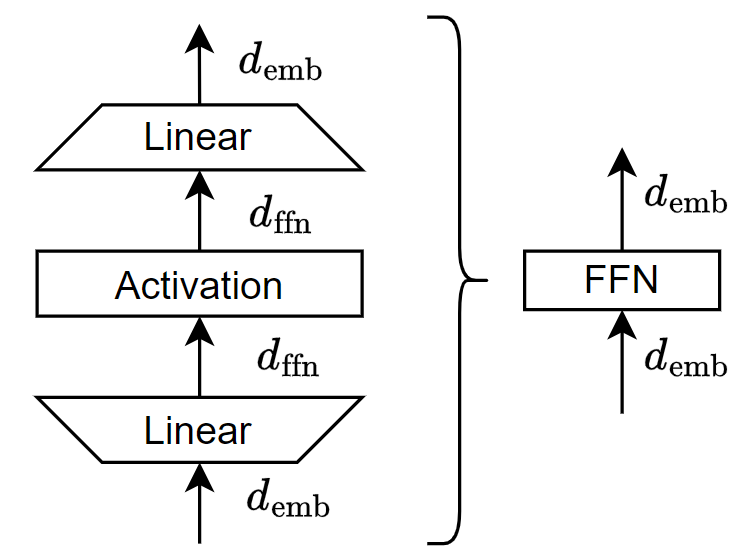
Finally, after the self-attention mechanism weighs the words and positional encodings provide context about their order, the outputs for each word are passed through a simple feed-forward network. This network processes each word's representation independently, adding another layer of complexity and allowing the model to learn more abstract features.
A Family of Transformers
The original Transformer architecture was so successful that it spawned many variants, each tailored for specific tasks. You've likely heard of some of the most famous ones:
-
BERT (Bidirectional Encoder Representations from Transformers): Developed by Google, BERT is designed to understand the context of a word based on both what comes before and after it. This makes it incredibly powerful for tasks like search queries and sentiment analysis.
-
GPT (Generative Pre-trained Transformer): Developed by OpenAI, GPT models are designed for generation. They read text from left to right and are excellent at predicting the next word in a sequence. This makes them ideal for writing essays, composing emails, and carrying on conversations.
-
T5 (Text-to-Text Transfer Transformer): T5, also from Google, reframes every NLP task as a text-to-text problem. Whether it's translation, summarization, or question answering, the input is text and the output is text. This unified approach simplifies the training process.
| Model | Primary Use | Key Feature |
|---|---|---|
| BERT | Understanding Context | Bidirectional (looks at words before and after) |
| GPT | Generating Text | Autoregressive (predicts the next word) |
| T5 | General Purpose | Treats every task as a text-to-text problem |
These models are now used everywhere. Netflix, for instance, uses Transformer architectures to power its content recommendation systems. By understanding the descriptions, titles, and genres of its vast library as a language, it can make much more nuanced and accurate suggestions for what you might want to watch next. It's not just about matching keywords; it's about understanding the underlying relationships between different pieces of content.
The key advantages of Transformers are their ability to handle long-range dependencies in text and their parallel processing capability, which makes training large models much more efficient than with older architectures.
Time to check your understanding of these core concepts.
What fundamental problem with Recurrent Neural Networks (RNNs) did the Transformer architecture's parallel processing capability solve?
In the sentence, 'The cat couldn't climb the tree because it was too high,' what mechanism helps a Transformer understand that 'it' refers to the 'tree' and not the 'cat'?
From understanding language to recommending movies, the Transformer architecture has fundamentally reshaped the capabilities of modern AI.