Production MLOps Pipelines with MLflow Airflow Grafana
Introduction to MLOps
From Lab to Real World
Building a machine learning model is a lot like crafting a high-performance race car in a workshop. You spend weeks, maybe months, tinkering with the engine, tuning the suspension, and perfecting the aerodynamics. In the controlled environment of your lab—your computer—it runs beautifully. It’s fast, accurate, and does exactly what you designed it to do.
But what happens when you take that car out of the workshop and onto a real racetrack? Suddenly, it has to deal with changing weather, bumpy track surfaces, and the unpredictable actions of other drivers. The perfect machine from the lab might spin out on the first turn. Getting a model from your laptop to a live production environment presents a similar set of challenges.
This is the core problem that Machine Learning Operations, or MLOps, is designed to solve. It’s the bridge between building a model and running it successfully in the real world.
MLOps
noun
A set of practices that aims to deploy and maintain machine learning models in production reliably and efficiently. It combines machine learning, data engineering, and DevOps.
Without MLOps, a data science team can get stuck in a loop. They build a great model, hand it over to the engineering team, and then face a mountain of practical problems. The data formats might be different, the software libraries might conflict, and there's no clear plan for what to do when the model's performance inevitably starts to degrade over time. It's a recipe for models that never make it out of the lab.
This whole process of deploying, managing, and monitoring models in a production environment is known as MLOps (Machine Learning Operations).
The MLOps Lifecycle
MLOps isn't a single tool or technology, but a philosophy and a workflow. It treats the machine learning process as a continuous cycle, not a one-time project. This ensures models are not only deployed but also maintained, retrained, and improved over time.
Think of it as a living system. A model that predicts customer churn, for example, needs to adapt as customer behaviors change. A process that worked last year might fail with new data. MLOps creates the infrastructure to manage this evolution gracefully.
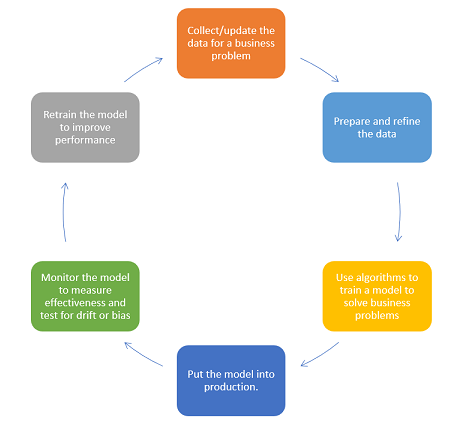
This lifecycle is supported by a few key components.
Core Components
Experiment Tracking During development, a data scientist might train hundreds of slightly different models. Which data was used? Which parameters were set? Which version performed best? Experiment tracking is like a detailed lab notebook for machine learning. It logs everything automatically, making it easy to compare results and reproduce successful models without guesswork.
Workflow Orchestration The journey from raw data to a deployed model involves many steps: cleaning data, transforming features, training the model, and validating its performance. A workflow orchestrator automates this entire pipeline. It ensures each step runs in the correct order, handles failures, and can automatically trigger a full retrain when new data becomes available. This automation is crucial for scalability and reliability.
Monitoring Once a model is live, its job is just beginning. How is it performing? Is the incoming data different from the data it was trained on? This is called data drift. Monitoring systems watch the model's predictions and the data it receives in real-time. If performance drops or the data drifts significantly, the system can alert the team or even trigger an automatic retraining of the model. This proactive approach prevents a model from slowly becoming useless without anyone noticing.
Together, these components create a robust framework. It makes deploying and managing machine learning models predictable, scalable, and efficient.
Now, let's test your understanding of these foundational concepts.
What is the primary problem that MLOps aims to solve in machine learning?
A data scientist trains hundreds of models, changing parameters and datasets each time. Which MLOps component is specifically designed to log these details for reproducibility and comparison?
By embracing MLOps, organizations can turn machine learning from a research-focused activity into a core, reliable part of their business operations.