Production Grade Agentic AI Systems
Advanced Multi-Agent Orchestration
Beyond the Chain
Simple agent chains, where one agent hands off its output to the next in a line, are powerful but limited. They work like an assembly line: predictable and efficient for linear tasks. But what happens when a problem requires judgment, specialized skills, and parallel workstreams? For that, we need to think less like an assembly line and more like a project team.
Advanced multi-agent orchestration involves designing systems where agents collaborate in more dynamic ways. Instead of a simple hand-off, these architectures allow for delegation, parallel processing, and even collective problem-solving. This approach mirrors how human organizations tackle complex challenges.
The Supervisor-Worker Model
The most common and intuitive multi-agent pattern is a hierarchical one. In this model, a single Supervisor agent acts as a project manager. It receives a complex goal, decomposes it into smaller, manageable sub-tasks, and delegates those tasks to specialized Worker agents.
A Supervisor doesn't do the work itself. Its primary job is to understand the goal, break it down, route tasks to the right specialist, and synthesize the results.
Imagine you ask an AI system to "launch a marketing campaign for our new product." A single agent would struggle with such a broad request. A Supervisor-Worker system, however, would excel.
- Goal Decomposition: The Supervisor agent breaks the goal into distinct parts: market research, content creation, social media planning, and performance analysis.
- Delegation: It then assigns each part to a Worker with the right skills: a
DataAnalystagent, aCopywriteragent, aSocialMediaStrategistagent, and aPerformanceTrackeragent. - Synthesis: As the workers complete their tasks, they report back. The Supervisor integrates their outputs—market insights, ad copy, post schedules, and tracking dashboards—into a cohesive campaign plan.
This pattern prevents a single model from getting overwhelmed. By separating concerns, each worker can use a different model, prompt, or set of tools best suited for its specific job. This modularity makes the system easier to debug, maintain, and scale.
Orchestrating the Workflow
Once tasks are delegated, the orchestrator (often the Supervisor) must decide how they run. This leads to a critical architectural choice: sequential vs. parallel execution.
| Execution Model | Description | Best For... | Key Challenge |
|---|---|---|---|
| Sequential | Tasks are executed one after another in a fixed order. The output of one task is the input for the next. | Workflows with clear dependencies (e.g., must research market before writing copy). | Can be slow, as the total time is the sum of all task times. |
| Parallel | Multiple tasks are executed simultaneously. | Workflows with independent sub-tasks (e.g., writing ad copy and designing graphics can happen at the same time). | Requires more complex state management to avoid conflicts. Results must be synchronized at the end. |
A sophisticated orchestrator doesn't just pick one. It builds an execution graph, running independent tasks in parallel while creating dependencies for sequential tasks. This branched reasoning is key to efficiency. For example, market research and competitor analysis might run in parallel, but both must finish before the copywriting and strategy agents can begin their work.
By distributing responsibilities across specialized agents, each with its own model, tools, and memory and coordinating their actions through a central orchestrator, organizations gain modularity, improved fault tolerance, and clearer separation of concerns.
This control over the execution flow is crucial for avoiding common pitfalls like hallucination loops, where agents get stuck repeating or contradicting each other. By defining a clear graph and managing the state of each task, the orchestrator ensures the system makes steady progress toward the final goal.
Collaborative Swarms
Not all problems can be neatly decomposed. Some require creative brainstorming, where multiple perspectives converge on a single solution. For these scenarios, a hierarchical model can be too rigid. This is where joint collaboration, or swarm intelligence, comes in.
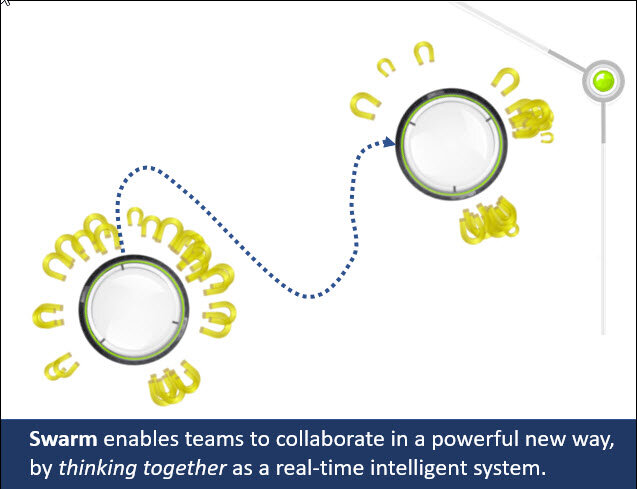
In a swarm model, multiple agents tackle the same problem concurrently. They share a common context or workspace and iteratively refine a solution together. Think of it like a writers' room or a team brainstorming on a whiteboard. There isn't a single supervisor dictating tasks; instead, agents contribute ideas, critique each other's work, and vote on the best path forward.
Communication is the core challenge in swarm models. There are two main approaches:
- Orchestrator-Mediated: A central orchestrator acts as a facilitator, not a manager. It collects contributions from all agents, shares them back with the group, and may summarize the current state or call for a vote. This keeps the conversation organized.
- Peer-to-Peer: Agents communicate directly with each other. This is more chaotic but can lead to faster, more organic discovery. It often requires agents to have sophisticated protocols for broadcasting messages and resolving conflicts.
Swarm patterns are ideal for tasks like generating a wide range of creative ideas, exploring multiple solutions to a complex coding problem, or red-teaming a plan to find its weaknesses. The goal is emergent intelligence, where the group's output is greater than the sum of its individual parts.
Simple, linear agent chains, where one agent's output is passed to the next, are most analogous to which real-world concept?
In a Supervisor-Worker multi-agent model, what is the primary role of the Supervisor?
Choosing the right orchestration pattern, whether it's a clear hierarchy or a collaborative swarm, depends entirely on the nature of the task. The most robust systems often blend these patterns, using a supervisor to manage the overall workflow while deploying swarms for specific, creative sub-tasks.