Product Management Essentials
Introduction to Product Management
What Is a Product?
Before we can talk about managing a product, we need to agree on what a product is. It's a simple word, but the meaning is broad. A product isn't just a physical item you can buy in a store. It's anything created to solve a problem or meet a need for a group of people, called users or customers.
Think about the app you use to order coffee, the streaming service where you watch movies, or the software your company uses to track expenses. These are all products. They provide value. The coffee app saves you time. The streaming service provides entertainment. The expense software simplifies a tedious task. A product can be a physical good, a digital service, or even an internal tool used only by employees of a company.
A product solves a specific problem for a specific group of people while also creating value for the business that provides it.
The Product Lifecycle
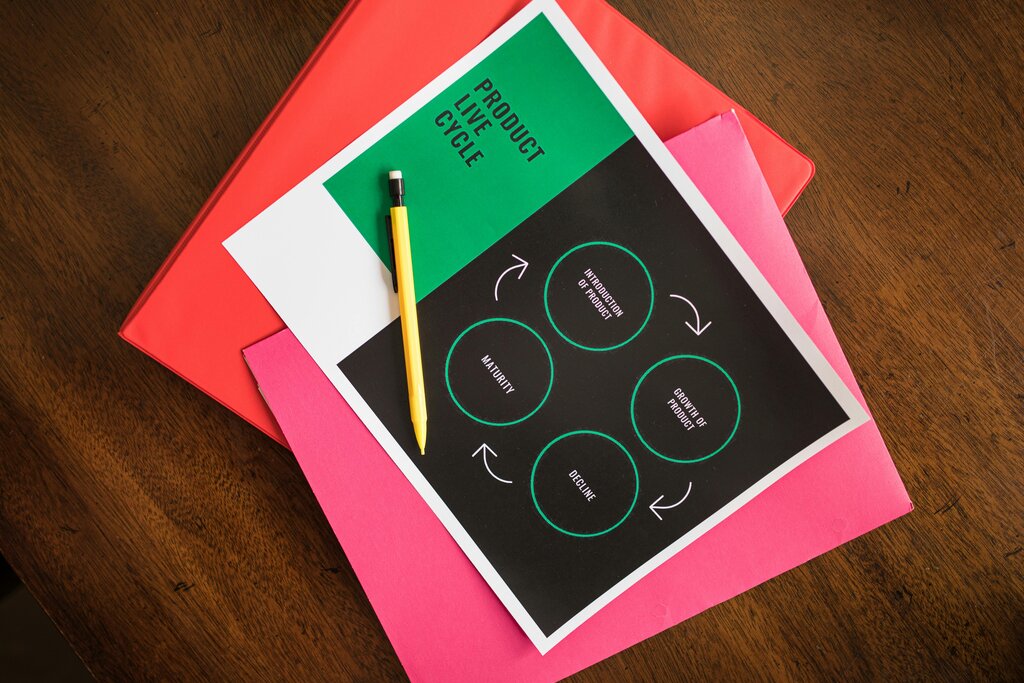
Products have a natural lifespan, much like living things. They are introduced, they grow, they reach maturity, and eventually, they decline. Understanding this cycle helps teams make smart decisions about what to do next. The four main stages are Introduction, Growth, Maturity, and Decline.
-
Introduction: This is the launch. The product is new, and not many people know about it. The main goal is to find the first customers and prove that the product is actually solving a real problem.
-
Growth: Word is getting out. More and more people are using the product, and its popularity is rising quickly. The focus shifts to scaling up, adding new features, and reaching a wider audience.
-
Maturity: The rapid growth phase is over. The product is now a well-established player in the market. The main goals are to keep existing customers happy, fend off competitors, and look for ways to improve efficiency.
-
Decline: The market has changed, a new technology has emerged, or customer needs have shifted. The product is no longer as popular as it once was. The business must decide whether to reinvent the product for a new purpose or retire it gracefully.
The Role of a Product Manager
If a product is the 'what,' the Product Manager (PM) is the person obsessed with the 'why.' A PM is the central point of contact for a product. They are responsible for its success from beginning to end.
Their job involves wearing many hats. One day they might be analyzing data to understand user behavior, and the next they could be talking to customers to hear about their frustrations. They work closely with engineers to figure out what’s possible to build, with designers to create a great user experience, and with marketing and sales to make sure the product reaches the right people.
The role of a product manager is to bring together stakeholders, to align and focus the team, and to collaborate for the best possible outcome for the customer and the business.
Ultimately, a product manager's core responsibility is to guide the team to build the right product for the right people at the right time. They set the product's vision and strategy, decide what features to build next by creating a prioritized list called a 'roadmap,' and ensure everyone on the team is moving in the same direction.
Product vs. Project Management
The titles 'Product Manager' and 'Project Manager' sound similar, and while they both involve managing work, their focus is fundamentally different. The easiest way to think about it is that a project has a clear start and end, while a product is an ongoing effort.
| Product Management | Project Management |
|---|---|
| Focuses on the 'what' and 'why' | Focuses on the 'how' and 'when' |
| Manages the entire lifecycle of a product | Manages a specific project with a defined scope |
| Measures success with business outcomes (e.g., user satisfaction, revenue) | Measures success by completing the project on time and on budget |
| Ongoing, cyclical work | Temporary, with a clear start and finish |
A project manager might be tasked with organizing the work to launch a new feature. Their job is done once that feature is live. The product manager, on the other hand, owns that feature for its entire life. They were involved in deciding to build it in the first place, and they will continue to monitor its performance, gather feedback, and decide on future improvements long after the initial project is 'done.'
A company might run many projects to support a single product.
Product managers focus on the "what" and "why" behind building products, while project managers concentrate on the "how" and "when" of getting things done.
Now that you understand the basics of what a product is and the role of the person who guides it, let's test your knowledge.
Which of the following best defines a product?
A new fitness app has just launched. The team is focused on acquiring its first 1,000 users and gathering feedback to validate its core features. Which stage of the product lifecycle is this app in?