Product Management Collaboration Essentials
Engineering Team Structures
How Teams Are Built
As a product manager, you don’t just work with individual engineers. You work with engineering teams. How that team is structured shapes everything: how you communicate, how decisions get made, and how quickly your product gets built.
Understanding the underlying structure of your engineering organization is key to effective collaboration. Let’s look at the three most common models you'll encounter: functional, cross-functional, and matrix.
Functional Teams
The functional structure is the classic approach. It groups engineers by their specialty. All the backend engineers report to a backend manager, all the mobile developers report to a mobile manager, and so on. Think of it like an orchestra where all the violinists are in one section and all the percussionists are in another.
Each department becomes a center of deep expertise in its specific area. This structure provides a clear career path for engineers and makes it easy for managers to mentor and evaluate people with similar skills.
The main challenge for a product manager is that this model creates silos. To build a single feature, you might need to coordinate with the backend, frontend, and QA teams. This means multiple meetings, handoffs, and potential for miscommunication as work passes from one silo to another. Decisions can be slow, as they often have to go up one chain of command and down another.
In this environment, your primary role is to act as a bridge, ensuring all the separate functional groups are aligned and moving in the same direction.
Cross-Functional Teams
To break down those silos, many companies now favor cross-functional teams. These teams are organized around a product, feature, or mission. A single team includes all the skills needed to deliver: a product manager, a designer, backend engineers, frontend engineers, and QA analysts all working together.
Think of it as a special ops team. Instead of grouping by specialty, you create a self-sufficient unit with all the expertise required for a specific mission. This structure is designed for speed and autonomy.
By contrast, cross-functional teams bring together individuals from different departments to collaborate on shared objectives.
With everyone focused on the same goal, communication is direct and constant. The team has a strong sense of ownership over its piece of the product, and decisions can be made quickly without needing to consult multiple managers.
For a product manager, this is often the easiest structure to work within. Your team is your team, and you are all in it together. The downside is that engineers can feel isolated from their peers in the same discipline. It can also be challenging to maintain consistent engineering standards and practices across different, independent teams.
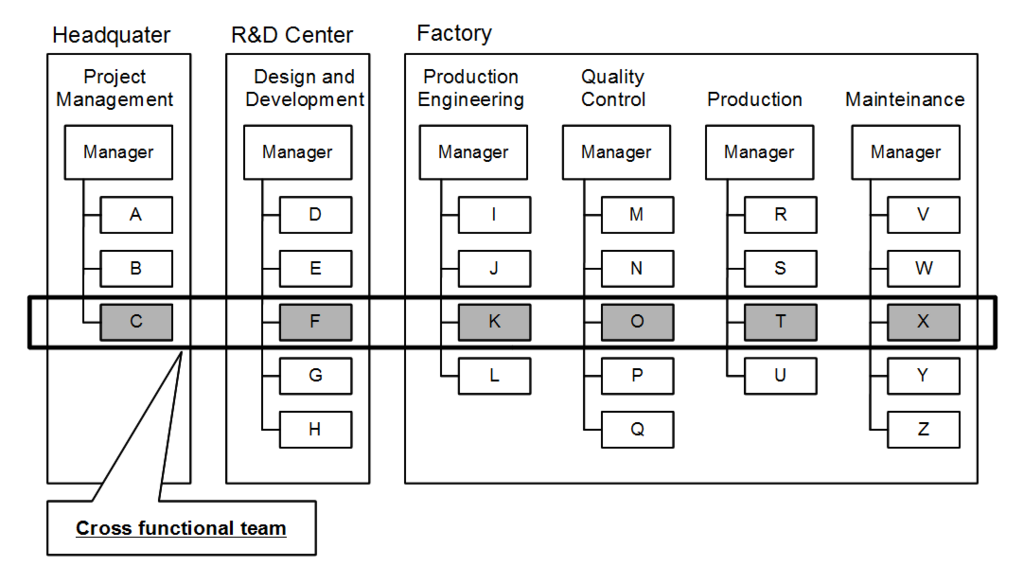
Matrix Organizations
A matrix organization is a hybrid model that tries to capture the best of both worlds. In this setup, an engineer is part of a cross-functional product team for their day-to-day work, but they also report to a functional manager.
For example, a frontend engineer works on the "Search" team with a product manager and other engineers. However, she also reports to the Head of Frontend Engineering. This means she has two managers: the product manager for what she works on, and the functional manager for how she does her work and for her career development.
This structure aims to provide the focus of a cross-functional team while maintaining the technical excellence and career mentorship of a functional one.
The biggest challenge is the complexity of having two bosses. It can create conflicting priorities for the engineer. As a product manager, it’s crucial to have a strong relationship with the functional managers. You need to align with them on priorities, performance expectations, and resource allocation. Clear communication isn't just a good idea, it's essential for a matrix organization to function without confusion.
In a matrix structure, alignment between product and functional managers is the foundation for success.
Making It Work
Regardless of the formal structure, your goal as a product manager is to build a cohesive team focused on a shared vision. Your approach will just need to adapt to the environment.
In a functional setup: Over-communicate. Be the central hub that connects the spokes of different engineering teams. Make sure everyone understands how their piece fits into the larger puzzle.
In a cross-functional setup: Foster a strong team identity. While the team is self-contained, make sure they don't become an island. Encourage engineers to share knowledge with peers on other teams to maintain high standards.
In a matrix setup: Build alliances. Your success depends on your partnership with functional managers. Work together to set clear goals and provide unified direction to the engineers.
By understanding how your engineering partners are organized, you can navigate the dynamics more effectively and build the strong relationships needed to create great products.
An engineering organization groups all mobile developers under a single manager and all backend developers under another. To launch a new feature, a product manager must coordinate work between these separate groups. What is this organizational structure called?
What is the primary advantage of a cross-functional team structure from a product manager's perspective?