Probability for Everyday Decisions
Probability Basics
What is Probability?
Probability is simply a way to measure how likely something is to happen. We use it every day, whether we're checking the weather forecast or deciding if we should buy a lottery ticket. It’s a number between 0 and 1, where 0 means an event is impossible, and 1 means it's absolutely certain.
A probability of 0 means it won't happen. A probability of 1 means it will definitely happen. Everything else is somewhere in between.
The most basic way to calculate probability is with a simple formula. For an event A, its probability is:
Let's take a coin flip. There are two possible outcomes: heads or tails. If we want to find the probability of getting heads, there's only one favorable outcome (heads) out of two total outcomes. So, the probability is $1/2$, or 0.5.
Sample Spaces and Events
To calculate probability, we first need to know all the possible results. This complete set of all possible outcomes is called the sample space.
sample space
noun
The set of all possible outcomes of a random experiment.
For a single six-sided die, the sample space is {1, 2, 3, 4, 5, 6}. For a coin flip, it's {Heads, Tails}.
An event is any specific outcome or group of outcomes you're interested in. It's a subset of the sample space. For example, rolling an even number on a die is an event. The outcomes that fit this event are {2, 4, 6}.
Rules of the Game
Probability isn't just about single events. We often want to know how different events relate to each other. A few basic rules help us do this.
First, let's talk about things that can't happen. The complement of an event is everything else in the sample space. If our event is 'rolling a 6', its complement is 'not rolling a 6' (rolling a 1, 2, 3, 4, or 5).
The probability of an event and its complement always add up to 1. This gives us a handy shortcut. If we call our event , its complement is often written as or .
So, the probability of not rolling a 6 is .
Combining Events
What about the probability of one event or another happening? For this, we use the addition rule. But first, we need to know if the events are mutually exclusive.
mutually exclusive
adjective
Two events that cannot occur at the same time.
If two events can't happen together, like rolling a 2 and a 4 on a single die roll, they are mutually exclusive. To find the probability of one or the other occurring, we just add their individual probabilities.
The probability of rolling a 2 or a 4 is , which simplifies to .
But what if the events can happen at the same time? For example, what's the probability of drawing a King or a Heart from a standard deck of 52 cards? These are not mutually exclusive because you can draw the King of Hearts. If we just add them, we'll count the King of Hearts twice.
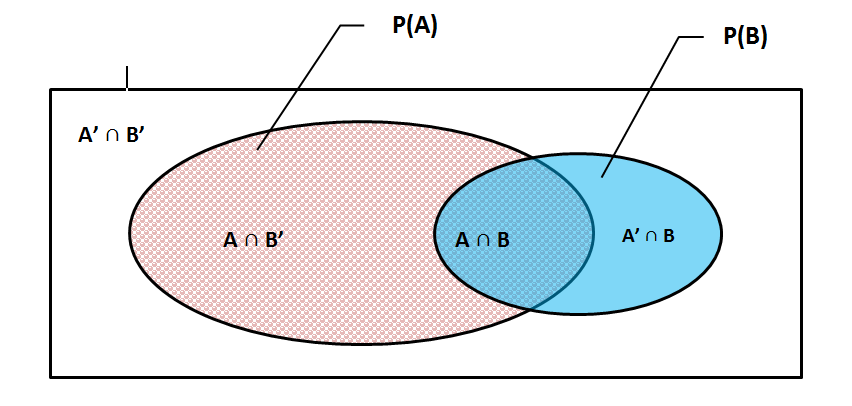
To fix this, we subtract the probability of both events happening together (the overlap).
In our card example: and . The overlap, , is . So, the probability is .
Finally, let's look at the multiplication rule. This rule helps us find the probability of two events both happening. If the events are independent, meaning the outcome of one doesn't affect the other, we can simply multiply their probabilities.
Flipping a coin twice is a classic example of independent events. The result of the first flip has no impact on the second.
What's the probability of getting heads twice in a row? It's .
What is the range of possible values for the probability of an event?
If you roll a standard six-sided die, what is the sample space?
These basic concepts are the building blocks for understanding the world in a more quantitative way, from games of chance to complex financial models.