Private Pilot Foundational Knowledge
Principles of Flight
The Four Forces of Flight
An aircraft in flight is a study in balance. Four fundamental forces are constantly at play, pushing and pulling on the plane. Understanding these forces is the first step to understanding how flight is possible. They are lift, weight, thrust, and drag.
Let's break them down:
- Weight is the force of gravity pulling the aircraft toward the center of the Earth.
- Thrust is the forward-moving force produced by the engine and propeller or jet engine.
- Drag is the backward force caused by air resistance as the plane moves through the air.
- Lift is the upward force created by the effect of the air on the wings, which opposes weight.
For an aircraft to maintain steady, level flight, these forces must be in balance. Lift must equal weight, and thrust must equal drag.
How Is Lift Created?
Lift is the magic of flight, but it's not magic, it's physics. The shape of a wing, called an airfoil, is key. There are two complementary principles that explain how an airfoil generates lift: Bernoulli's principle and Newton's third law.
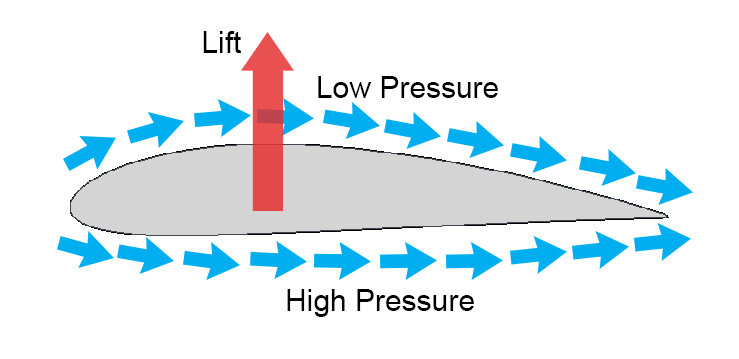
Bernoulli's principle states that as the speed of a fluid (like air) increases, its pressure decreases. An airfoil is curved on top and flatter on the bottom. As the wing moves through the air, the air flowing over the curved top surface has to travel a longer distance than the air flowing underneath. To meet up at the same time, the air on top must move faster.
This faster-moving air creates a lower-pressure zone above the wing, while the slower-moving air below maintains a higher pressure. This pressure difference results in a net upward force: lift.
Newton's third law offers another perspective: for every action, there is an equal and opposite reaction. As the wing moves through the air, it is angled slightly upward. This angle forces the air downward. In reaction, the air pushes the wing upward. This downward deflection of air is called downwash, and the upward reaction is lift.
Controlling the Aircraft
A pilot doesn't just need to get a plane into the air; they need to control it. An aircraft rotates around three axes of motion: pitch (nose up or down), roll (wings banking left or right), and yaw (nose moving left or right). Pilots use control surfaces—movable sections of the wings and tail—to manage these movements.
The main control surfaces are:
- Ailerons: Located on the trailing edge of the wings, they control roll. When one aileron moves up, the other moves down, causing one wing to generate more lift and the other less, banking the plane.
- Elevators: Found on the horizontal stabilizer (the small wing on the tail), they control pitch. Moving the elevators up or down changes the angle of the tail, pushing the nose up or down.
- Rudder: Located on the vertical stabilizer (the tail fin), it controls yaw. Pushing the rudder left or right swings the nose of the aircraft in that direction.
Basic Flight Maneuvers
By manipulating the four forces and using the control surfaces, a pilot can perform basic maneuvers.
To climb, a pilot increases thrust and pulls back on the control column to raise the elevators. This increases the wing's angle to the oncoming air (angle of attack), generating more lift. The increased engine power overcomes the increase in drag. In a descent, the pilot reduces thrust and lowers the nose, allowing gravity to assist in losing altitude in a controlled way.
A turn is a coordinated maneuver. The pilot uses the ailerons to roll the aircraft into a bank. In a bank, lift is no longer pointing straight up; part of it now pulls the aircraft sideways, causing it to turn. The pilot also uses the rudder to keep the nose of the plane pointed smoothly through the turn and may need to pull back slightly on the control column to increase lift and maintain altitude.
Which of the four fundamental forces of flight directly opposes the forward motion generated by the engine?
According to Bernoulli's principle, how does the shape of an airfoil generate lift?
These principles form the foundation of aviation. By balancing forces and using controls, pilots can guide aircraft through the sky with precision.