Principles of Microeconomics
Market Mechanics
Finding the Market's Sweet Spot
In any market, from your local farmers' market to the global stock exchange, two powerful forces are at play: supply and demand. Sellers want the highest price possible, while buyers want the lowest. Where do they meet? At a point called equilibrium.
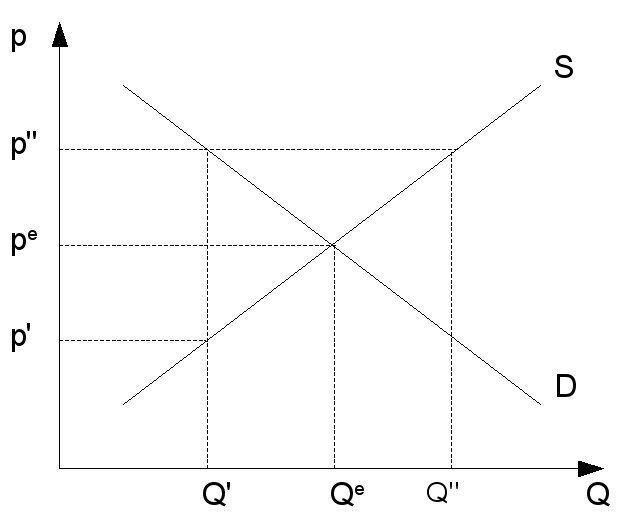
The equilibrium price is the one price where the quantity of a good that buyers are willing to buy is exactly equal to the quantity that sellers are willing to sell. The corresponding quantity is the equilibrium quantity. At this point, the market is “cleared”—everyone who wants to buy at that price finds a seller, and every seller finds a buyer. There's no waste and no unmet demand.
When the Price Is Wrong
Markets aren't always in perfect balance. Often, prices are set above or below equilibrium, leading to predictable problems.
Imagine a new video game is released for $90, but the equilibrium price is actually $60. At this inflated price, the manufacturer produces a million copies, but only 500,000 gamers are willing to pay that much. The result is a surplus of 500,000 unsold games. To clear the inventory, the company will have to lower the price, moving it down toward the equilibrium point.
Now, let's flip the scenario. What if the game is priced at just $40? At this bargain price, two million people want to buy it, but the company only supplied one million units. This creates a shortage. The game sells out instantly, and you'll see it being resold online for much higher prices. This upward pressure on price from eager buyers pushes the market back toward the $60 equilibrium.
A surplus occurs when Price > Equilibrium Price, leading to Quantity Supplied > Quantity Demanded. A shortage occurs when Price < Equilibrium Price, leading to Quantity Demanded > Quantity Supplied.
This self-correction is the market clearing process in action. Surpluses push prices down, and shortages pull prices up, constantly guiding the market toward its natural balance. This dynamic was dramatically illustrated during the , when political events led to a sudden, severe shortage of oil. The limited supply caused gas prices to skyrocket and led to long lines at gas stations as the market struggled to find a new, much higher, equilibrium price.
The Shifting Landscape
The shortages and surpluses we just discussed describe movements along the supply and demand curves, driven by changes in the good's own price. But what happens when an outside factor changes the entire market dynamic? This is called a shift in the curve.
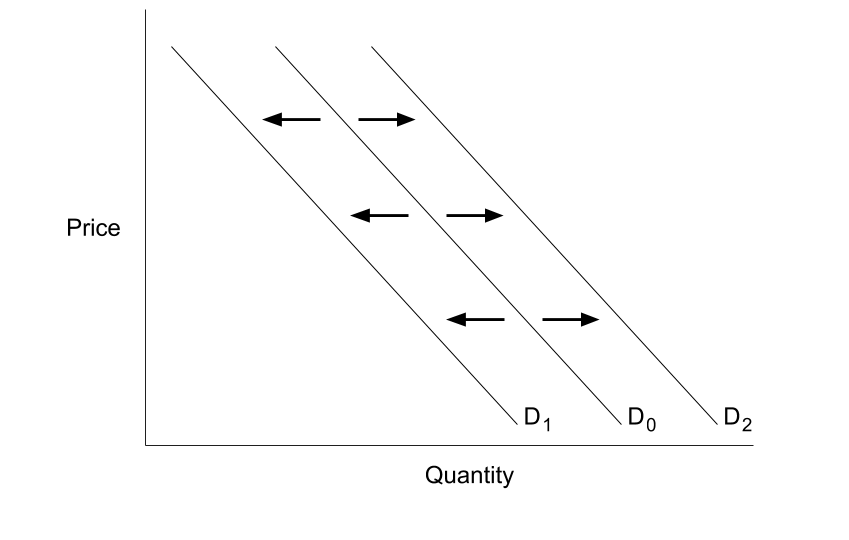
Let's say a popular celebrity endorses a brand of headphones. Suddenly, more people want those headphones at every price. This is a rightward shift of the demand curve. The old equilibrium of $100 and 10,000 units sold is no longer valid. Now, at $100, there's a shortage. The price will be bid up until a new equilibrium is reached, perhaps at $120 and 12,000 units sold.
Conversely, if a new study reveals a health risk associated with a certain food, its demand curve will shift to the left. Fewer people want it at any price, leading to a surplus and a new, lower equilibrium price and quantity.
The supply curve can shift, too. If a new manufacturing robot doubles the speed of car production, automakers can supply more cars at every price level. This is a rightward shift of the supply curve. The increased competition and efficiency drive the equilibrium price down and the equilibrium quantity up.
On the other hand, if a frost wipes out half the coffee bean crop in Brazil, the supply of coffee will decrease. This leftward shift of the supply curve means less coffee is available at every price, leading to a higher equilibrium price and a lower equilibrium quantity. Economists use a method called to analyze these scenarios—comparing the old equilibrium (the 'static' state) to the new one after a shift.
Understanding these mechanics is fundamental to microeconomics. By analyzing how supply and demand interact and respond to new information, we can predict how prices and quantities will change in real-world markets, from the cost of your morning coffee to the price of gasoline at the pump.
What is the equilibrium price?
If a video game is priced at $40, but the market equilibrium price is $60, what is the most likely immediate outcome?