Principles of Large AI Models
Introduction to AI Models
What is an AI model?
At its heart, an AI model is a program trained to recognize patterns in data. Think of it as a specialized brain built for a specific task. It's not a physical machine, but a complex set of mathematical rules and calculations that can make predictions or decisions without being explicitly programmed for every scenario.
The purpose of an AI model is to take an input (like an image or a question) and produce an output (like a label or an answer) by leveraging the patterns it learned from data it has seen before.
Early models were much simpler. Imagine trying to sort apples and oranges. You could write a program with rules like, "If it's round and orange, it's an orange. If it's round and red, it's an apple." This is a rule-based system, a precursor to modern AI. But what about a greenish-yellow apple? Or a small orange? The rules quickly become complicated and brittle.
AI models take a different approach. Instead of hand-coding rules, we show the model thousands of pictures of apples and oranges, each labeled correctly. The model learns the underlying patterns on its own—the subtle differences in color, texture, shape, and size. After training, it can look at a new picture of an apple or an orange and make a highly accurate prediction.
Three styles of learning
AI models don't all learn in the same way. We can group them into three main categories based on how they're trained.
1. Supervised Learning This is the most common type. The model learns from data that has been manually labeled with the correct answers. It’s like studying with flashcards. The model sees a picture of a cat (the input) and is told, "This is a cat" (the label). After seeing thousands of examples, it learns to identify cats in new, unlabeled photos. Spam filtering is a classic example: the model learns from emails you've marked as "spam" or "not spam."
2. Unsupervised Learning Here, the model is given a dataset without any labels and must find patterns or structures on its own. It's like being handed a box of mixed Lego bricks and asked to sort them into piles. You might group them by color, size, or shape without being told which categories to use. Unsupervised learning is great for customer segmentation (finding groups of similar customers) or identifying anomalies, like fraudulent transactions.
3. Reinforcement Learning This type of learning is based on trial and error. The model, often called an "agent," learns to make decisions by performing actions in an environment to achieve a goal. It receives rewards for good actions and penalties for bad ones. Think of teaching a dog a new trick. You give it a treat (a reward) when it sits correctly. Over time, the dog learns that sitting leads to treats. Reinforcement learning powers everything from game-playing AI to robotic systems that learn to walk.
The leap to large models
For decades, AI models were highly specialized. You'd train one model to identify cats, another to translate German to English, and a third to analyze customer sentiment. These are what we now call "traditional" models. They are powerful but narrow, typically trained on relatively small, custom datasets.
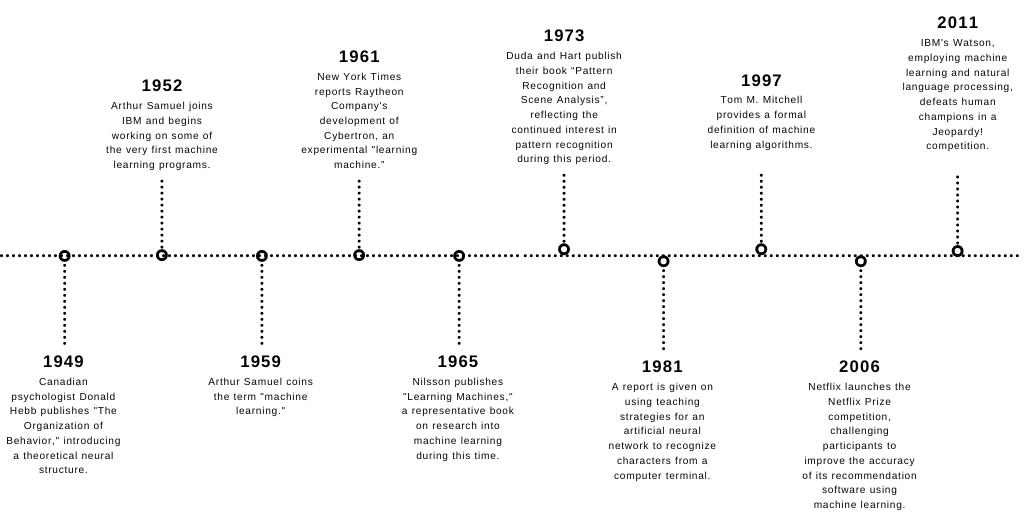
The big shift came with two key ingredients: massive amounts of data and a huge increase in computing power. The internet provided a nearly endless supply of text, images, and other data to learn from. At the same time, specialized hardware like GPUs (Graphics Processing Units) made it possible to process this data on a scale never seen before.
This combination allowed researchers to build what we call large AI models, or foundation models. Instead of being trained on a specific task, these models are trained on a vast and diverse dataset—like a huge chunk of the internet. This pre-training gives them a broad, general-purpose understanding of language, images, or code.
The key difference isn't just size. It's a shift from single-task specialists to multi-talented generalists. A single large language model can write an email, summarize a report, translate a sentence, and write a piece of code.
This evolution from specialized, traditional models to powerful, large-scale models marks a major turning point in the history of artificial intelligence, opening up new possibilities and applications that were once the stuff of science fiction.