Prime Intellect Business & Tech Analysis
Decentralized Training Architecture
Training Models on a Global Scale
Training billion-parameter AI models typically requires a massive, centralized supercomputer. These machines use expensive, high-speed interconnects like InfiniBand to link thousands of GPUs together. Prime Intellect takes a different approach. Their PRIME framework is designed to train large models on a geographically distributed network of computers, connected by standard, low-bandwidth internet connections ranging from 500 Mb/s to 4 Gb/s.
This method transforms a collection of non-homogeneous, unreliable hardware into a cohesive 'Open Superintelligence Stack.' The key is a distributed training method called OpenDiLoCo, which stands for Distributed Low-Communication. It allows the system to achieve 90-95% compute utilization, a figure usually reserved for tightly integrated supercomputers, by rethinking how distributed machines collaborate.
The DiLoCo Dual-Optimizer
At the heart of OpenDiLoCo is a clever dual-optimizer strategy that minimizes the need for constant communication. It splits the training process into two loops: an 'inner' loop for local computation and an 'outer' loop for global synchronization.
Inner Loop: Each distributed node, or worker, independently trains its local copy of the model for hundreds of steps (typically around 500). It uses a standard optimizer like AdamW to process its local data batches and update the model weights. During this phase, there is zero communication with other nodes.
Outer Loop: After completing its local steps, each worker computes a 'pseudo-gradient.' Instead of sending a raw gradient, it sends the difference between its starting model weights and its newly updated weights. A central server aggregates these pseudo-gradients from all workers and uses a [{
}] to compute a single, global update. This update is then sent back to all workers, who synchronize their models to the new state before beginning the next inner loop.
This asynchronous, periodic synchronization is what makes training over low-bandwidth connections feasible. Workers spend most of their time computing independently, only requiring a brief, infrequent data exchange to stay aligned.
Hybrid Power: FSDP and DiLoCo
To maximize efficiency, the PRIME framework uses a hybrid strategy. It combines two different parallelization techniques: one for communication within a node, and another for communication between nodes.
Within a single multi-GPU worker, PRIME uses PyTorch's (FSDP). FSDP is a memory optimization technique that shards, or partitions, the model's parameters, gradients, and optimizer states across all available GPUs in the node. This allows for the training of massive models that would otherwise not fit into a single GPU's memory. Since the GPUs within a node are connected by high-speed links like NVLink, the frequent communication required by FSDP is not a bottleneck.
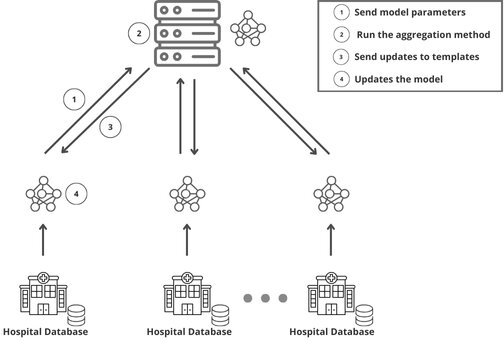
For communication between the geographically distributed nodes, PRIME uses the DiLoCo method. This hybrid model gets the best of both worlds: memory efficiency from FSDP inside the node, and communication efficiency from DiLoCo between the nodes. To further reduce the data sent over the internet, the framework employs techniques like int8 all-reduce, where the pseudo-gradients are converted to 8-bit integers before being sent. This significantly cuts down on bandwidth without a major loss in training accuracy.
The system is also designed for resilience. An manages the workers, allowing nodes to join or leave the training process without causing a total failure. If a worker drops out, the training continues with the remaining nodes. If it rejoins, it syncs to the latest global model and resumes its contribution. This fault tolerance is essential for running long training jobs on a network of unreliable, non-dedicated machines.
What is the primary problem that Prime Intellect's PRIME framework is designed to solve?
The PRIME framework uses a hybrid parallelization strategy. It uses _____ for communication within a node and _____ for communication between nodes.
This dual-optimizer, hybrid architecture allows Prime Intellect to effectively harness globally distributed computing power for training state-of-the-art AI.