Prediction Markets Explained
Introduction to Prediction Markets
What Are Prediction Markets?
At their core, prediction markets are platforms where people can trade on the outcomes of future events. Think of it like a stock market, but instead of buying shares in a company, you're buying shares in a specific outcome.
At its core, a prediction market is an exchange where individuals trade contracts that pay out based on whether a future event occurs.
The central idea is to harness the "wisdom of the crowd." The theory is that if you gather a diverse group of people, each with their own knowledge and perspective, their collective guess about the future will be more accurate than that of any single expert. By putting their own money on the line, participants are incentivized to share what they truly believe, not just what they hope will happen.
How They Work
The mechanics are surprisingly simple. For any given event, the market creates contracts, often called shares. Let's take a simple question: "Will it rain in London tomorrow?"
In this market, you could buy two types of shares:
- "Yes" shares: These pay out a fixed amount (say, $1) if it does rain.
- "No" shares: These pay out $1 if it does not rain.
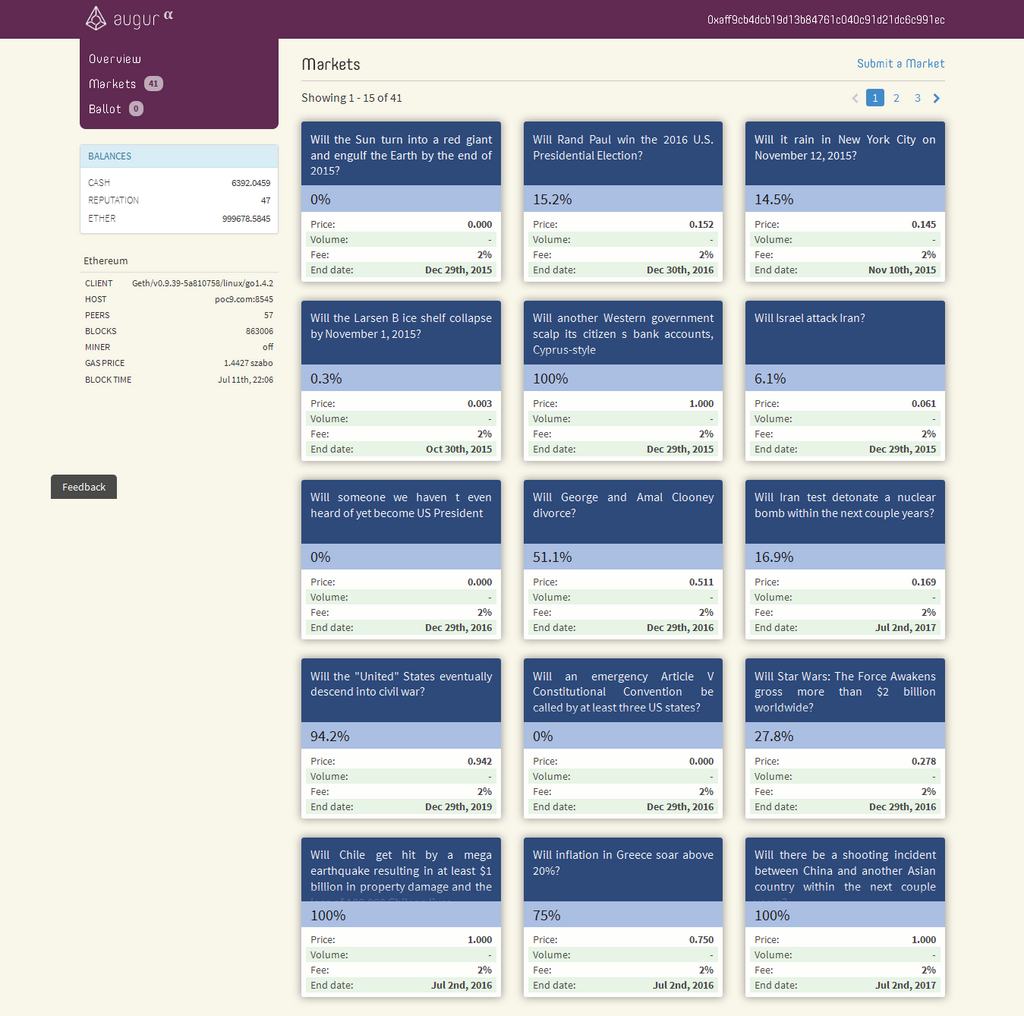
The price of these shares fluctuates between $0 and $1 based on what traders are willing to pay for them. This price directly reflects the market's collective belief about the probability of the event.
If a "Yes" share is trading at 💲0.70, the market is signaling a 70% probability that it will rain. The price of the corresponding "No" share would be 💲0.30.
Participants buy and sell these shares up until the event happens. If you believe the probability of rain is higher than the market's price suggests, you might buy "Yes" shares, hoping their price will rise. If you think the chance of rain is lower, you might buy "No" shares. When the outcome is known, the winning shares pay out $1 each, and the losing shares become worthless.
A Brief History
The concept isn't new. People have been betting on event outcomes for centuries, especially in politics. One of the longest-running formal prediction markets is the Iowa Electronic Markets, started in 1988, which has consistently been more accurate at forecasting U.S. presidential elections than traditional polls.
Over the years, the applications have expanded far beyond politics. Companies like Google and Hewlett-Packard have used internal prediction markets to forecast project deadlines and product sales. In science, they've been used to predict which research findings will be successfully replicated. Today, public platforms allow anyone to trade on a huge range of topics, from economic indicators and tech trends to sports and entertainment.
This quick tour gives a sense of what prediction markets are and how they operate. They serve as a powerful tool for gathering scattered information and turning it into a single, probabilistic forecast.
What is the primary concept that prediction markets are designed to leverage?
In a prediction market for the event "Will it rain tomorrow?", if "Yes" shares are trading at $0.70, what does this price indicate?