Prediction Markets Explained
Introduction to Prediction Markets
Betting on the Future
Imagine a stock market, but instead of trading shares of a company, you trade shares in the outcome of a future event. Will a certain candidate win the next election? Will a new movie break box office records? Will it rain tomorrow? This is the core idea behind a prediction market.
At its core, a prediction market is an exchange where individuals trade contracts that pay out based on whether a future event occurs.
These aren't just for gambling. The main purpose of a prediction market is to forecast events by pooling the knowledge and beliefs of a diverse group of people. It operates on the principle of the “wisdom of the crowd,” suggesting that a large group's collective answer to a question is often better than an expert's. By putting money on the line, participants are incentivized to reveal what they truly think will happen, not just what they hope will happen.
The Mechanics of a Market
So, how does it all work? Every prediction market is built around a specific question about a future event that has a clear, verifiable outcome. For example, “Will the Federal Reserve raise interest rates at its next meeting?”
For this event, the market creates contracts for each possible outcome. In this simple case, there would be two: a “Yes” contract and a “No” contract.
Participants, often called traders, buy and sell these contracts. The price of a contract isn't fixed; it fluctuates based on supply and demand, just like a stock.
Let's say “Yes” contracts are trading at $0.70. This price can be interpreted as the market's collective belief in the probability of that outcome. In this case, the market suggests there's a 70% chance the Fed will raise rates. The price of the “No” contract would then be $0.30, because the probabilities of all outcomes must add up to 100% (or $1.00).
| Outcome | Contract Price | Implied Probability |
|---|---|---|
| Yes, rates will be raised | $0.70 | 70% |
| No, rates will not be raised | $0.30 | 30% |
When the event finally happens and the outcome is known, the market resolves. If the Fed raises rates, each “Yes” contract becomes worth $1.00, and each “No” contract becomes worthless. If they don't, the “No” contracts pay out $1.00 each, and the “Yes” contracts are worth nothing. The price movements leading up to the event create a real-time forecast.
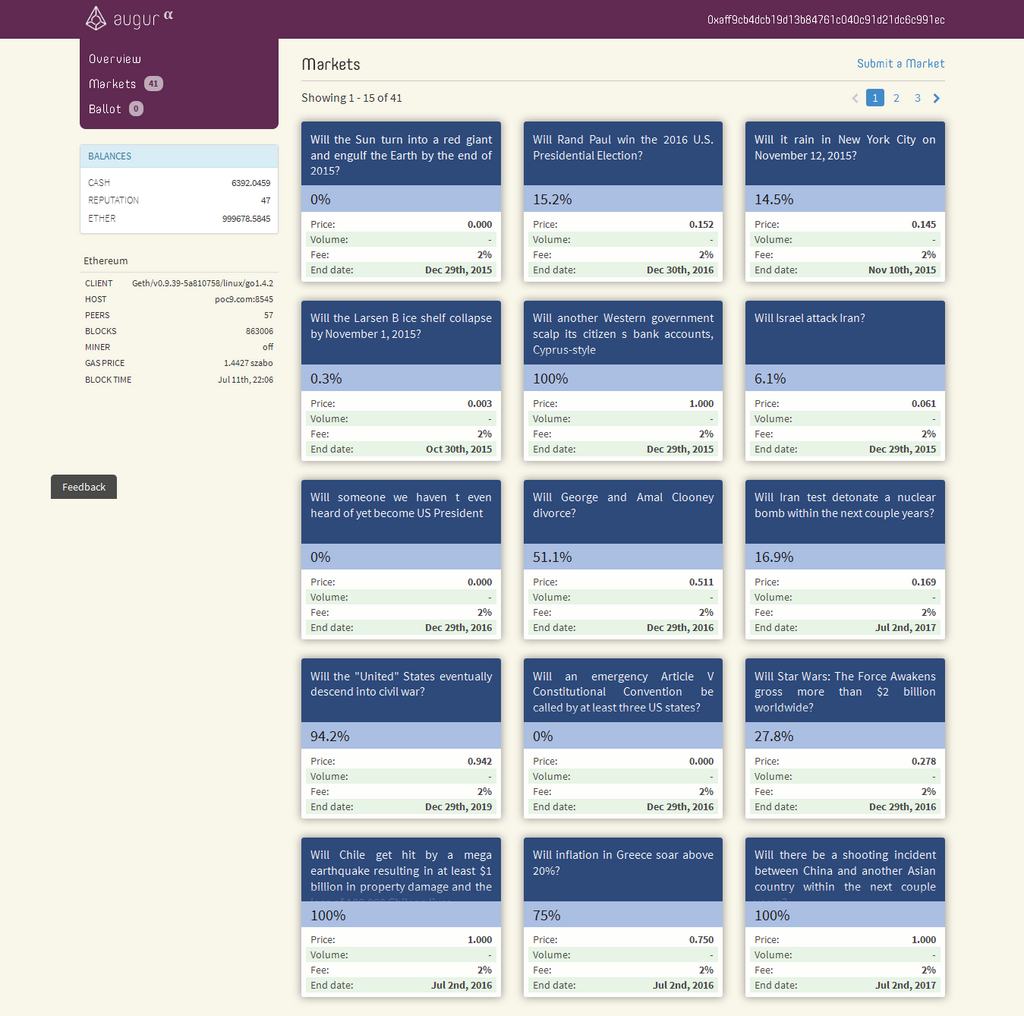
As you can see, the topics can range from the serious to the seemingly silly. What matters is that the outcome is unambiguous.
A Quick History
While they might seem like a modern invention tied to the internet and cryptocurrency, the idea of using markets to predict events is quite old. People have been betting on the outcomes of political elections for centuries.
The first formal, academic use of these markets was the Iowa Electronic Markets (IEM), launched in 1988. The IEM allowed students and faculty to trade contracts on the outcomes of U.S. presidential elections and other political events. Researchers found that the market's predictions were often more accurate than traditional polls.
The foundational principle behind prediction markets is related to the Efficient Market Hypothesis from finance. This theory suggests that asset prices reflect all available information. In a prediction market, the “asset” is the contract, and its price reflects the crowd's collective wisdom and information about that event.
Having “skin in the game” is likely to be the key to the predictive power of prediction markets.
This is the other key principle. When people have something to lose, they tend to be more careful, rational, and honest with their predictions. This financial incentive helps filter out noise and bias, pushing the market toward a more accurate consensus.
What is the primary purpose of a prediction market?
In a simple prediction market for the question "Will Team A win the championship?", the "Yes" contract is trading at $0.25. What is the price of the "No" contract?
Prediction markets provide a fascinating lens for viewing the future. By turning forecasts into tradable assets, they harness the power of the crowd to find the most likely outcomes.