Predicting Startup Success
Startup Fundamentals
More Than Just a New Business
What is a startup? It’s a common question, and the answer isn't as simple as "a new company." A new local coffee shop is a new business, but it isn't a startup. A startup is different because its primary goal is to grow quickly. To do this, it has to search for a business model that is both repeatable and scalable.
A repeatable business model means you can deliver the same value to customers over and over again. Scalable means you can grow revenue much faster than your costs. Adding a new customer should cost very little.
Think about it this way. The local coffee shop can make more money by opening another location, but that involves significant costs—rent, equipment, staff. It’s not easily scalable. In contrast, a software company can sell another subscription to a new customer with almost zero additional cost. That’s scalability. Startups are designed from the ground up to find this kind of explosive growth potential.
The Startup Journey
Every startup goes through a lifecycle, a path from a rough idea to a thriving company. While every journey is unique, it generally follows a few key stages.
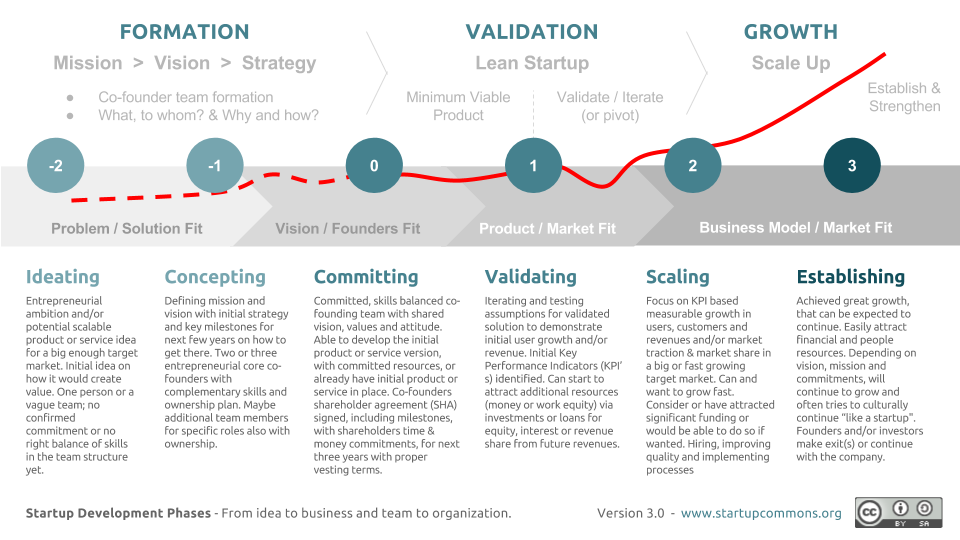
Formation: This is the beginning, where an idea is born. The founders identify a problem and brainstorm a potential solution. The main goal here is to define the concept and figure out if it's even worth pursuing. It's a phase of pure exploration and research.
Validation: The idea now meets reality. The startup builds a Minimum Viable Product (MVP)—a bare-bones version of their product—to see if people will actually use or buy it. This stage is all about testing assumptions, getting feedback from real users, and pivoting or adjusting the plan based on what they learn. The goal is to find "product-market fit," where you've built something a specific group of people truly wants.
Growth: Once the business model is validated, it's time to hit the gas. This stage is focused on scaling up: acquiring more customers, expanding the team, and refining operations to handle increased demand. The company is no longer just searching for a model; it's executing on one.
Unique Hurdles
Startups face a different set of challenges than established companies. The biggest one is uncertainty. A large corporation knows who its customers are, what its products do, and how to make money. A startup has hypotheses about all these things, but no definitive answers.
This uncertainty creates other challenges:
- Limited Resources: Startups often run on a shoestring budget. They need to make every dollar count while they search for a working business model. This means small teams wearing many hats and a constant race against the clock before the money runs out.
- High Risk of Failure: The vast majority of startups fail. The search for a scalable business model is fraught with peril, from building a product nobody wants to being outcompeted by rivals.
- Need for Speed: Because resources are scarce and the market can change quickly, startups must learn and adapt at a blistering pace. They have to build, measure, and learn in rapid cycles.
The difference between startups that thrive and those that perish often comes down to a single factor: validation.
Engines of Change
Despite the risks, startups play a vital role in the economy. They are powerful engines of innovation. Because they aren't tied to existing products or revenue streams, they have the freedom to challenge the status quo and introduce groundbreaking ideas. Think of how Netflix changed video rentals or how Airbnb changed travel accommodation.
This constant innovation has a huge economic impact. Successful startups create new jobs, often in high-skilled roles. They push entire industries to evolve and become more efficient. By solving problems in new ways, they generate wealth and drive technological progress that benefits everyone. A thriving startup ecosystem is a sign of a dynamic and healthy economy.
Ready to test what you've learned about the fundamentals of startups?
Which of the following best exemplifies a startup?
What is the primary goal during the 'Validation' stage of a startup's lifecycle?