Predicting Handball Game Outcomes
Handball Rules
The Playing Field
A standard handball court is a rectangle, 40 meters long and 20 meters wide. It's a bit bigger than a basketball court, giving players plenty of room to run and pass. The most important area is the goal area, a D-shaped semi-circle that extends 6 meters out from the goal. Only the goalkeeper is allowed inside this zone.
The goal itself is 2 meters high and 3 meters wide. A dashed line, 9 meters from the goal, marks the free-throw line. This is where play resumes after minor fouls. A shorter line, 7 meters out, is for penalty throws, similar to a penalty kick in soccer.
These markings create distinct zones that dictate how players can move and attack.
Game On
A regulation handball match for players 16 and older consists of two 30-minute halves, with a 15-minute halftime break. For younger players, the game time is often shortened. Unlike sports with constant stops, the clock in handball only pauses for injuries or timeouts.
The objective is simple: score more goals than your opponent. A goal is awarded when the entire ball crosses the goal line between the posts and under the crossbar. Each goal is worth one point. The fast pace means scores can get high, with teams often scoring 20 or more goals in a game.
Meet the Team
Each team has seven players on the court at one time: one goalkeeper and six outfield players. Teams can also have up to seven substitutes on the bench, and players can be swapped in and out at any time during play, which keeps the energy high.
The six outfield players typically set up in specific positions:
- Backs (Left, Center, Right): These are usually the primary long-range shooters. The center back is the playmaker, directing the offense.
- Wings (Left and Right): Fast players who operate on the sides of the court. They specialize in quick attacks and shooting from tight angles.
- Pivot (or Line Player): This player operates along the 6-meter line, trying to create openings in the defense for teammates or to get in a good scoring position themselves.
Rules of Engagement
Handball has a few key rules that define the flow of the game. When a player has the ball, they must follow the "rule of three."
A player can hold the ball for a maximum of three seconds. A player can take a maximum of three steps while holding the ball. After three steps, they must pass or shoot.
Players are not allowed to touch the ball with their feet or legs below the knee. They also can't pull, hit, or punch the ball out of an opponent's hands. Defensive players can use their torso to obstruct an opponent with the ball, but holding, pushing, or tripping will result in a foul.
When a minor foul occurs, the non-offending team gets a free throw from the spot of the foul, or from the 9-meter line if the foul happened between the 6 and 9-meter lines. If a clear scoring chance is illegally prevented, a 7-meter throw (a penalty shot) is awarded. It's a one-on-one showdown between the shooter and the goalkeeper.
Referees also manage player conduct with a system of escalating punishments.
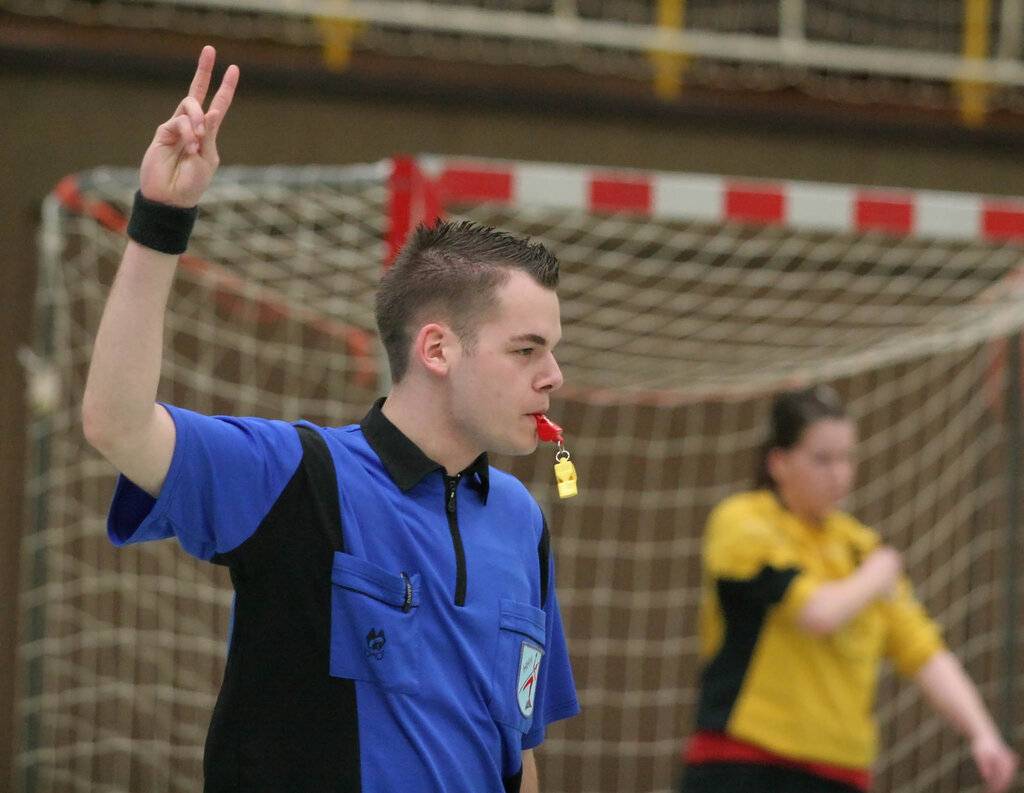
For fouls that are more serious, a player might receive a yellow card as a warning. The next level of punishment is a two-minute suspension, where the player must leave the court and their team plays with one fewer player. Three two-minute suspensions for the same player result in a red card, meaning they are disqualified for the rest of the game.
A red card can also be given immediately for very dangerous fouls. After a red card, the player is gone, but their team can replace them after the two-minute suspension period is over.
Ready to test your knowledge? Let's see how well you know the rules.
What are the dimensions of a standard handball court?
According to the 'rule of three', what is a player holding the ball NOT allowed to do?
Understanding these core rules is the first step to appreciating the speed, skill, and strategy of a handball match.