Preceramic Polymers Unveiled
Introduction to Preceramic Polymers
A Different Path to Ceramics
Most ceramics, from pottery to high-tech components, are made by firing powders at very high temperatures. This process, called sintering, works well but has its limits. It can be difficult to create complex shapes or thin fibers. Preceramic polymers offer a clever alternative. They are special polymers that can be molded like plastic at low temperatures and then converted into strong, heat-resistant ceramics.
The key to this transformation is a process called pyrolysis. When heated to high temperatures in an environment without oxygen, these polymers don't just melt or burn. Instead, their atoms rearrange themselves into a rigid, ceramic structure. This polymer-to-ceramic route allows for much greater flexibility in manufacturing.
pyrolysis
noun
The thermal decomposition of materials at elevated temperatures in an inert atmosphere. It involves a change in chemical composition and is irreversible.
Imagine shaping a piece of clay, but the "clay" is a liquid or a soft solid that can be easily poured into a mold, drawn into a fiber, or painted onto a surface. Once you have the shape you want, you heat it, and it becomes a ceramic. This opens the door to creating materials that would be nearly impossible to make with traditional powder-based methods.
Types of Preceramic Polymers
Preceramic polymers are not one single thing. They are a family of materials, typically containing silicon atoms in their backbone. The specific elements in the polymer chain determine the type of ceramic that forms after pyrolysis. Three common types are polysiloxanes, polysilazanes, and polycarbosilanes.
Each of these polymers yields a different kind of ceramic, tailored for specific high-performance applications. The resulting materials are known as polymer-derived ceramics (PDCs).
| Preceramic Polymer | Key Elements | Resulting Ceramic | Ceramic Formula |
|---|---|---|---|
| Polysiloxanes | Silicon, Oxygen, Carbon | Silicon Oxycarbide | SiOC |
| Polysilazanes | Silicon, Nitrogen, Carbon | Silicon Carbonitride | SiCN |
| Polycarbosilanes | Silicon, Carbon | Silicon Carbide | SiC |
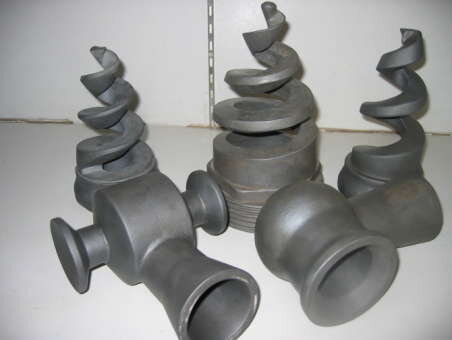
Silicon Carbide (SiC), for example, is an extremely hard and durable material used in high-temperature applications like furnace parts and brake discs. By starting with a polycarbosilane polymer, manufacturers can create complex SiC components that would be difficult to form from SiC powder.
Where They Are Used
The unique properties of polymer-derived ceramics make them valuable in demanding fields. Because they can be formed into fibers, they are used to create ceramic matrix composites (CMCs). These are lightweight, tough materials that can withstand extreme heat, making them ideal for jet engine components and spacecraft heat shields.
They are also used as protective coatings. A thin layer of a preceramic polymer can be applied to a metal part and then pyrolyzed, leaving behind a hard ceramic coating that resists corrosion and wear. This extends the life of components in harsh industrial environments.
The main advantage is control. By starting with a polymer, we gain precise control over the final shape and properties of the ceramic product.
Let's review the key ideas from this section.
Now, test your understanding of these concepts.
What is the primary advantage of using preceramic polymers over traditional powder-based methods for creating ceramics?
The process of heating a preceramic polymer in an oxygen-free environment to convert it into a ceramic is called ______.
By bridging the gap between polymer and ceramic processing, these materials offer innovative solutions for engineering challenges.