Pre-Calculus Foundations
Algebraic Foundations
Algebra's Ground Rules
Algebra is built on the same rules you learned in arithmetic. Think of it as a language for describing relationships between numbers. The core rules—like the commutative property () and the distributive property ()—are the grammar of this language. They allow us to rearrange and simplify expressions in predictable ways.
Manipulating expressions is a key skill. It often means simplifying them to make them easier to work with. One common task is combining like terms. Like terms are pieces of an expression that have the same variable raised to the same power. You can add or subtract their coefficients, which are the numbers in front of the variables.
For example, in the expression , the terms and are like terms. So are and . Combining them simplifies the expression to .
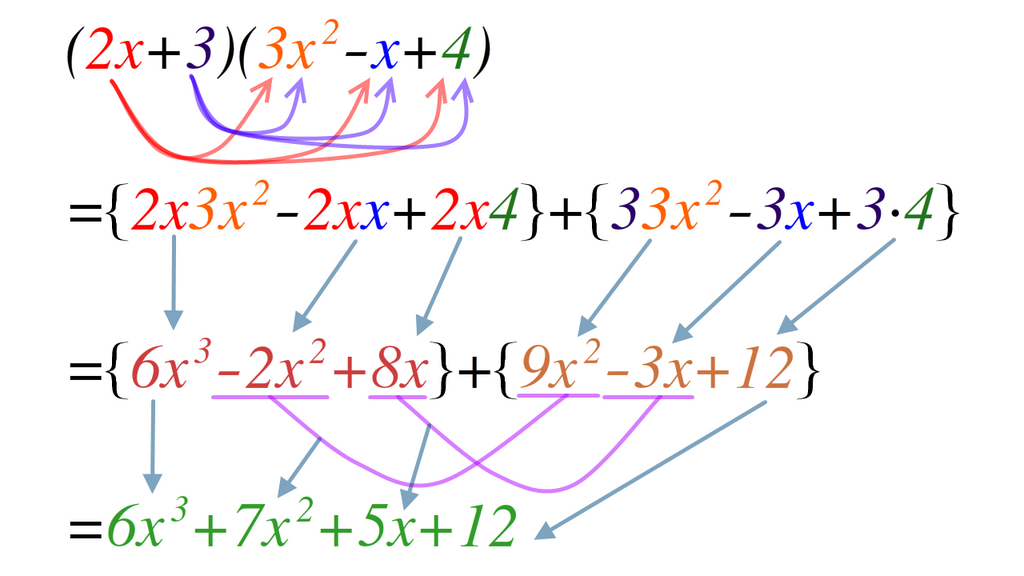
Another essential tool is the distributive property, which lets us multiply a single term by a group of terms inside parentheses. This process, also called expanding, removes the parentheses.
Solving for the Unknown
Much of algebra revolves around solving equations to find the value of an unknown variable. Think of an equation as a perfectly balanced scale. To keep it balanced, whatever you do to one side, you must also do to the other.
With linear equations, the goal is to isolate the variable. We do this by applying inverse operations. Addition undoes subtraction, and multiplication undoes division. Let's solve one step-by-step.
Consider the equation . Our mission is to get by itself.
-
First, we undo the subtraction. We add 5 to both sides to maintain balance.
-
Next, we undo the multiplication. We divide both sides by 3.
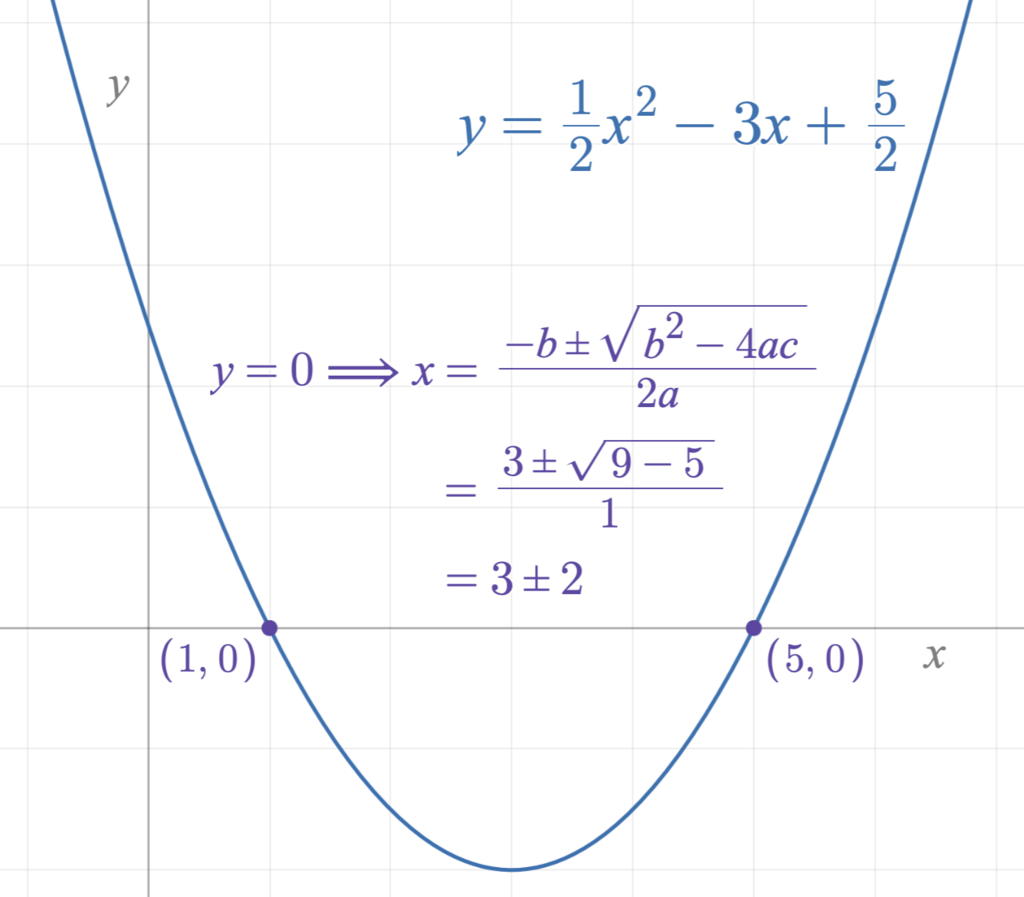
Quadratic equations are a bit different. They involve a variable squared, like , and can have up to two solutions. The standard form is .
One way to solve these is by factoring. This involves rewriting the equation as a product of two expressions that equals zero. This method relies on a simple truth: if two numbers multiply to zero, at least one of them must be zero.
For , we look for two numbers that multiply to 6 and add to 5. Those numbers are 2 and 3. So we can factor the equation:
Now, either or . Solving these gives us the two solutions: and .
When factoring isn't easy, the quadratic formula is a reliable tool that works for any quadratic equation.
Simply identify the values of , , and from your equation and plug them into the formula. The symbol means you'll perform the calculation once with addition and once with subtraction to find the two potential solutions.
Working with Inequalities
Inequalities compare values that aren't equal, using symbols like (greater than) and (less than or equal to). You can solve them much like equations, with one critical difference.
When you multiply or divide both sides of an inequality by a negative number, you must flip the direction of the inequality sign.
Let's see this in action with the inequality .
-
First, subtract 3 from both sides:
-
Now, divide both sides by -2. Because we're dividing by a negative number, we must flip the
>to a<.
The solution isn't just one number, but a whole range of numbers: any value less than -3.