Practical Programming and Logic Foundations
Advanced Logic Structures
Beyond Basic Decisions
You already know how to use if, elif, and else to make your programs choose a path. But real-world problems often require more than a single decision. They involve layers of conditions. For example, a program that grants access to a secure area might need to check multiple things: is the user an employee? Are they on the authorized list for this specific area? Is it during work hours?
One way to handle this is with nested conditionals. You put an if statement inside another if statement.
# Checking access permissions
is_employee = True
authorized_area = True
is_work_hours = False

if is_employee:
    print("Employee status confirmed.")
    if authorized_area:
        print("Area authorization confirmed.")
        if is_work_hours:
            print("Access granted.")
        else:
            print("Access denied: Outside of work hours.")
    else:
        print("Access denied: Not authorized for this area.")
else:
    print("Access denied: Not an employee.")
This works, but it can get messy. As you add more conditions, the code indents further and further to the right, creating what's often called the "arrow anti-pattern." It becomes difficult to read and follow the logic.
A cleaner way is to combine conditions using logical operators like and and or. This flattens the structure and makes the logic much clearer.
# The same logic, but flattened
if is_employee and authorized_area and is_work_hours:
    print("Access granted.")
elif not is_employee:
    print("Access denied: Not an employee.")
elif not authorized_area:
    print("Access denied: Not authorized for this area.")
else:
    print("Access denied: Outside of work hours.")
Smarter, Faster Logic
When you combine conditions with and and or, Python is smart about how it evaluates them. It uses a technique called to save time.
With the and operator, if the first condition is False, Python knows the entire expression must be False. It doesn't even bother to check the rest of the conditions. In our example is_employee and authorized_area and is_work_hours, if is_employee is False, Python stops right there.
Similarly, with the or operator, if the first condition is True, Python knows the entire expression must be True and stops. This isn't just about speed; it's a powerful tool for writing safer code. You can check if an object exists before you try to access one of its properties, preventing an error.
What if you need to check a condition against many items in a list? You could write a for loop, but Python provides a more elegant solution with the all() and any() functions.
all() returns True only if every item in an iterable is true. any() returns True if at least one item is true. They are incredibly readable and efficient, as they also use short-circuiting. all() stops at the first False item, and any() stops at the first True item.
# Using any() and all()
student_scores = [88, 92, 75, 100, 68]

# Check if all students passed (score >= 60)
all_passed = all(score >= 60 for score in student_scores)
print(f"Did all students pass? {all_passed}")

# Check if any student got a perfect score
perfect_score = any(score == 100 for score in student_scores)
print(f"Did any student get a perfect score? {perfect_score}")
Designing Logical Flows
The real skill in programming is translating a complex requirement into a clean, logical structure. Think of it like creating a for your program. The goal is to make the code efficient and, just as importantly, easy for a human to read and understand.
Let's model a business rule: "To qualify for a premium discount, a customer must have been with us for at least two years and have either an annual spending of over $5000 or a loyalty program status of 'Gold'."
Before writing code, break it down:
- Primary condition:
years_as_customer >= 2. - Secondary condition: This is an 'or' group:
annual_spending > 5000ORloyalty_status == 'Gold'.
The structure becomes (Condition 1) and (Condition 2A or Condition 2B).
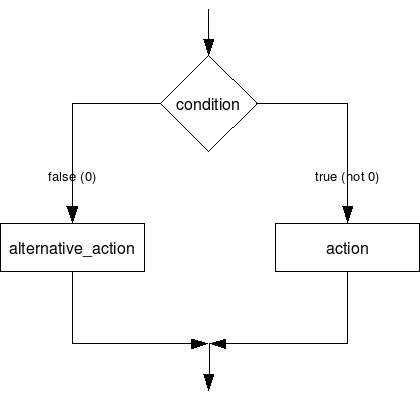
By placing the conditions in parentheses, we control the order of evaluation. This ensures the or check is performed first, and its result is then combined with the and check. This approach turns a complex sentence into a simple, single line of logical code.
years_as_customer = 3
annual_spending = 4000
loyalty_status = 'Gold'

# Translate the business rule into a single conditional

if (years_as_customer >= 2) and (annual_spending > 5000 or loyalty_status == 'Gold'):
    print("Customer qualifies for premium discount.")
else:
    print("Customer does not qualify.")

# Output: Customer qualifies for premium discount.
By combining nested logic, boolean operators, and functions like any() and all(), you can construct powerful and efficient decision-making structures that remain readable and maintainable.
What is the primary problem associated with deeply nested if statements, often referred to as the "arrow anti-pattern"?
Consider the following Python code:
permissions = [True, True, False, True]
if any(permissions):
    print("At least one permission is granted.")
if all(permissions):
    print("All permissions are granted.")
What will be the output?