Practical Mastery of Machine Learning Systems
Advanced Ensemble Methods
Beyond a Single Tree
A single decision tree is a powerful and interpretable model. It makes predictions by learning a set of simple if-then-else rules from data. But its simplicity can also be a weakness. A single tree is often prone to overfitting, meaning it learns the training data too well, including its noise, and fails to generalize to new, unseen data. It can be unstable; small changes in the data can lead to a completely different tree.
To overcome these limitations, we can use ensemble methods. The core idea is simple: a team of models working together is often stronger than any single model working alone. Instead of relying on one decision tree, we combine the predictions from many of them. This approach leads to better predictive performance, increased robustness, and a reduction in overfitting.
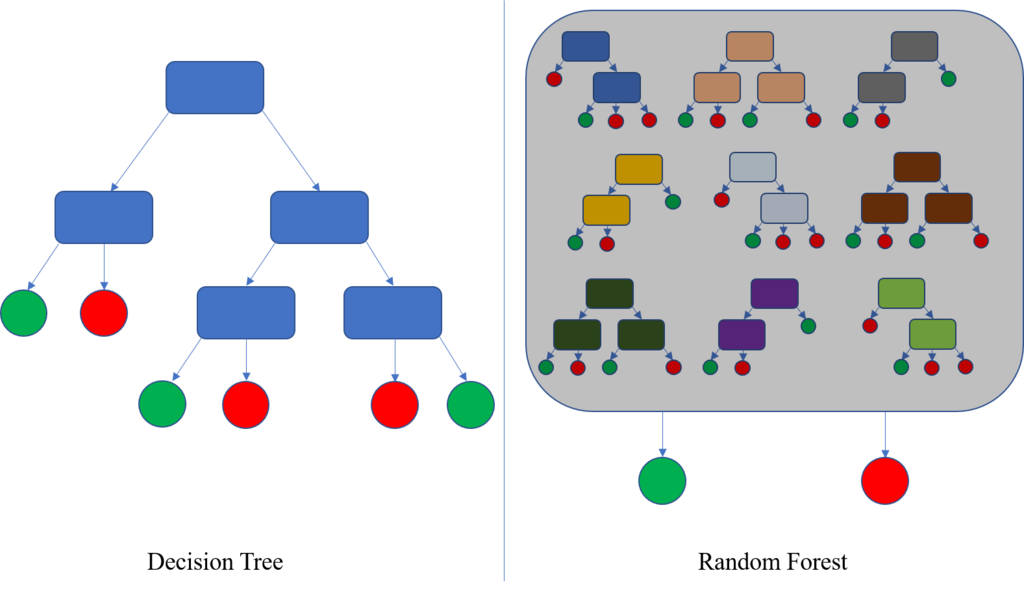
There are two main strategies for building these tree-based ensembles: bagging and boosting. They approach the problem of teamwork from two very different philosophical angles.
Bagging and Random Forests
Bagging, which stands for Bootstrap Aggregating, focuses on reducing variance. High variance is what makes a single decision tree unstable and prone to overfitting. Bagging tackles this by introducing randomness.
Imagine you want to estimate the average height of people in a city. Instead of measuring everyone, you take a random sample and calculate the average. To be more confident, you could take many different random samples, calculate the average for each, and then average those averages together. This final result would be much more stable and reliable than the estimate from any single sample. This is the essence of bagging.
It works like this:
- Bootstrap: From the original training dataset, we create many new, smaller datasets by sampling with replacement. This means some data points might appear multiple times in a sample, while others might not appear at all.
- Aggregate: We train a separate decision tree on each of these bootstrap samples. Since each tree sees a slightly different version of the data, each one will be slightly different.
- Vote: To make a prediction, we let all the trees vote. For a classification task, the final prediction is the class that gets the most votes. For a regression task, it's the average of all predictions.
This process of averaging the results from many different trees smooths out the individual errors and reduces the model's overall variance.
A Random Forest is a popular ensemble method that builds on this idea. It uses bagging but adds one more layer of randomness: when splitting a node in a tree, it only considers a random subset of all available features. This forces the trees to be even more different from each other, which further reduces variance and improves the model's performance.
Because each tree in a random forest is trained independently of the others, the entire process can be parallelized. You can train all the trees simultaneously on different CPU cores, making random forests relatively fast to train on large datasets.
Boosting and Gradient Boosted Trees
Boosting takes a completely different approach. Instead of building independent models in parallel, boosting builds models sequentially, where each new model attempts to correct the errors made by the previous ones. The goal here is primarily to reduce bias.
Think of it like a team of students working on a difficult problem set. The first student tries to solve all the problems. The teacher then looks at their answers, notes the mistakes, and asks the second student to focus specifically on those tough problems the first student got wrong. This continues, with each subsequent student paying more attention to the remaining errors. The final result is a combination of all their efforts, weighted by how well they performed.
Gradient Boosted Decision Trees (GBDTs) are a powerful implementation of this idea. The process works as follows:
- Start with a simple, weak model (like a very small decision tree) that makes an initial prediction.
- Calculate the errors, or residuals, between the model's predictions and the actual values.
- Train the next tree to predict these residuals. The idea is that this new tree will learn to correct the mistakes of the previous one.
- Add the predictions of this new tree to the previous model's predictions, thereby updating the overall model.
- Repeat steps 2-4 for a specified number of iterations, with each new tree incrementally improving the ensemble.
Ensemble Methods: Combine multiple decision trees using techniques like Random Forests or Gradient Boosted Trees to enhance accuracy and robustness.
Because this process is sequential, it cannot be parallelized in the same way as a random forest. Each tree must be trained after the one before it. This can make GBDTs slower to train. However, by focusing on errors, GBDTs can often achieve higher accuracy than random forests, especially on structured, tabular data. This performance comes at a cost: GBDTs have more hyperparameters and are more sensitive to them, requiring careful tuning to avoid overfitting.
| Feature | Bagging (Random Forest) | Boosting (GBDT) |
|---|---|---|
| Training Process | Parallel (independent trees) | Sequential (trees learn from prior errors) |
| Main Goal | Reduce variance | Reduce bias |
| Model Strength | Uses fully grown, complex trees | Uses weak learners (shallow trees) |
| Performance | Strong and robust | Often state-of-the-art, but needs tuning |
| Speed | Generally faster to train | Generally slower to train |
Modern Optimizations
The power of GBDTs has led to the development of highly optimized and efficient libraries that are staples in machine learning competitions and real-world applications. Two of the most famous are XGBoost and LightGBM.
LightGBM, for example, introduced several clever techniques to make gradient boosting faster and more memory-efficient without sacrificing accuracy.
LightGBM implements a conventional Gradient Boosting Decision Tree (GBDT) algorithm with the addition of two novel techniques: Gradient-based One-Side Sampling (GOSS) and Exclusive Feature Bundling (EFB).
Let's break those down:
Gradient-based One-Side Sampling (GOSS): In gradient boosting, not all data points are equally hard to model. Some are easily predicted early on, while others consistently produce large errors. The "gradient" is a measure of this error. GOSS keeps all the data points with large gradients (the hard ones) and randomly drops a fraction of the ones with small gradients (the easy ones). This focuses the training effort where it's needed most, speeding up the process significantly.
Exclusive Feature Bundling (EFB): In sparse datasets (like one-hot encoded data), many features are mutually exclusive, meaning they are never non-zero at the same time. For example, a feature is_color_red and is_color_blue can't both be 1 for the same data point. EFB intelligently bundles these exclusive features into a single, denser feature, reducing the number of features the model has to consider and further speeding up training.
These optimizations allow models like LightGBM to train on massive datasets much faster than traditional GBDT implementations, making them a go-to choice for performance-critical tasks.
Now, let's review the key concepts we've covered.
Ready to test your knowledge?
What is a primary weakness of a single decision tree that ensemble methods are designed to overcome?
What is the core idea behind the bagging (Bootstrap Aggregating) technique used in models like Random Forests?
By moving from single decision trees to powerful ensembles like Random Forests and Gradient Boosted Trees, you gain a significant boost in predictive power and model stability.