Practical Marine Electricity
Electricity Basics
The Language of Electricity
To understand electricity, we first need to learn its language. It's a language with four key words: voltage, current, resistance, and power. Let's start with the first three, which are deeply connected.
Imagine electricity flowing through a wire is like water flowing through a pipe.
Voltage (V) is the pressure pushing the water. It's the potential for energy to be released. More pressure means a stronger push. We measure voltage in volts (V).
Current (I) is the actual flow of water through the pipe. It’s the rate at which electric charge moves. A faster flow means more current. We measure current in amperes (A), often called amps for short.
Resistance (R) is anything that slows the water down, like a narrow section of the pipe. It’s the opposition to the flow of current. More resistance means less flow. We measure resistance in ohms (Ω).
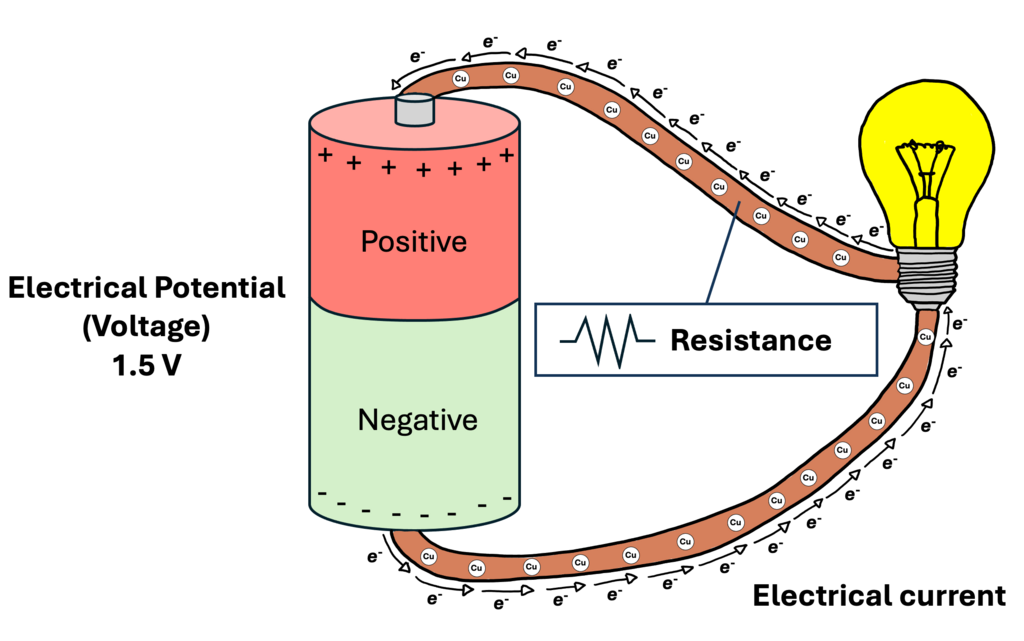
In a real circuit, the battery provides the voltage. The wires allow the current to flow. And a component like a light bulb provides resistance, converting electrical energy into light and heat.
Ohm's Law
These three concepts aren't just related by an analogy; they're linked by a fundamental rule called Ohm's Law. It's a simple but powerful formula that describes how voltage, current, and resistance interact in most circuits.
Ohm's Law states that the voltage across a component is equal to the current flowing through it multiplied by its resistance.
This makes intuitive sense. If you increase the pressure (voltage) in a pipe, the flow rate (current) will increase. If you make the pipe narrower (increase resistance) while keeping the pressure the same, the flow rate will decrease.
We can rearrange this formula to solve for any of the three values. For example, if you know the voltage and resistance, you can find the current: .
Let's say you have a 9-volt battery connected to a 300 Ω resistor. The current flowing through the resistor would be:
, or 30 milliamps (mA).
Power and Work
So, we have this flow of electricity. What is it good for? The answer lies in our fourth key term: power (P). Power is the rate at which electrical energy is converted into another form, like light, heat, or motion. It's the amount of work being done by the circuit. We measure power in watts (W).
watt
noun
A unit of power, equivalent to one joule per second, that quantifies the rate of energy transfer.
Power is directly related to both voltage and current. A higher voltage or a higher current will result in more power. The formula is straightforward:
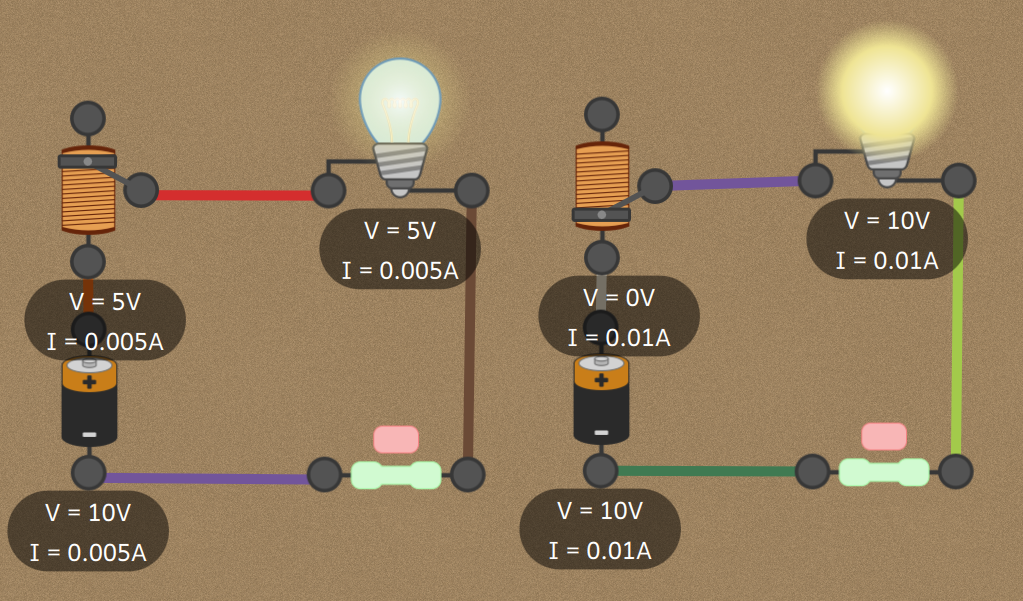
Think of a light bulb. A bulb connected to a higher voltage source will be brighter because more power is being dissipated. Your electricity bill is based on the amount of power you use over time (measured in kilowatt-hours).
Two Types of Current
Finally, it's important to know that current can flow in two different ways: Direct Current (DC) and Alternating Current (AC).
Direct Current (DC) is electricity that flows in one constant direction. It's the type of power you get from batteries, USB ports, and solar cells. Most electronics, like your phone and laptop, run on DC power.
Alternating Current (AC) is electricity that changes direction periodically. It flows back and forth. This is the type of power that comes from the outlets in your home. AC is better for transmitting electricity over long distances, which is why our power grid uses it.
While your wall outlet provides AC, most of your devices need DC. That's why you have power adapters—the little blocks on your charging cords. They convert the high-voltage AC from the wall into low-voltage DC that your device can safely use.
In the analogy of electricity flowing like water in a pipe, what does the water pressure represent?
A simple circuit has a 12V battery and a light bulb with 3Ω of resistance. Using Ohm's Law (), what is the current (I) flowing through the circuit?