Practical Machine Learning and Model Strategy
Mathematical Intuition and Trade-offs
The Goal of Supervised Learning
In supervised learning, the goal is to learn a mapping function that can predict an output variable () from an input variable (). We can think of this as learning a function such that . The machine learns by looking at a dataset with thousands of examples, each containing both the input and the correct output, or 'label'.
How does it 'learn'? By trying to minimize its mistakes. The model makes a prediction, compares it to the correct label, and calculates the error. This process is guided by an , often called a loss function, which quantifies how wrong the model's predictions are. The entire training process is an automated effort to tweak the model's internal parameters to make the value of this function as low as possible.
The algorithm uses optimization techniques, like gradient descent, to systematically find the parameters that result in the minimum error. In essence, it's a sophisticated form of trial and error, guided by mathematics, to find the best possible mapping from input to output based on the data it has seen.
Finding Patterns in the Dark
Unsupervised learning is a different beast entirely. Here, we don't have labeled outputs. The dataset is just a collection of inputs, and the goal is to find hidden patterns or intrinsic structures within the data itself.
Instead of minimizing a prediction error against a known label, the objective is to model the underlying structure or distribution of the data. This can take two primary forms:
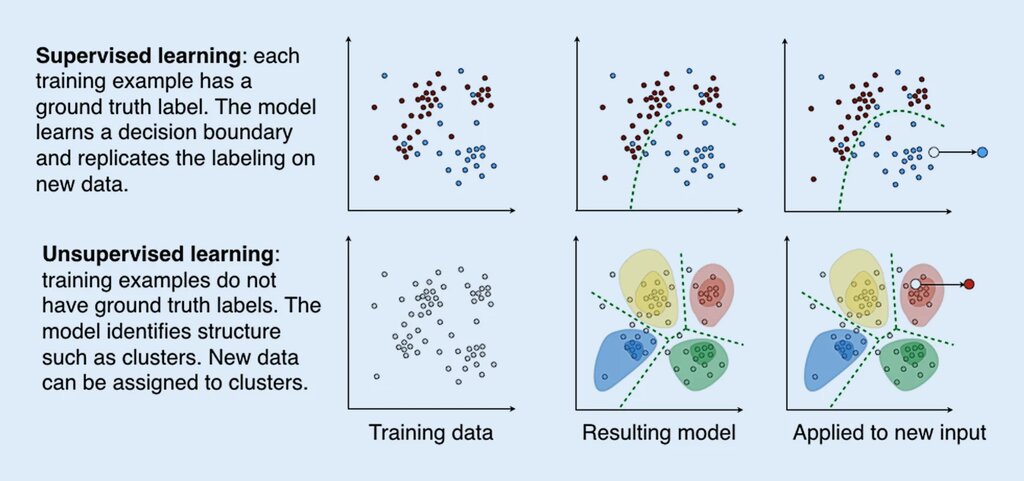
- Clustering: This involves grouping data points together so that objects in the same group (a cluster) are more similar to each other than to those in other groups. Algorithms like k-means try to find cluster centers that minimize the distance from each data point to its assigned center.
- : When data has many features (high dimensionality), it can be difficult to work with. Dimensionality reduction aims to simplify it by projecting it onto a lower-dimensional space while preserving as much of the important information as possible. Techniques like Principal Component Analysis (PCA) find new axes (principal components) that capture the maximum variance in the data.
In both cases, the machine isn't being told what the patterns are; it's discovering them on its own by analyzing the data's statistical properties.
Learning from Consequences
Reinforcement Learning (RL) operates on a principle of trial and error. An 'agent' interacts with an 'environment' by taking actions. For each action, it receives feedback in the form of a 'reward' or 'penalty'. The agent's sole objective is to learn a strategy, or 'policy', that maximizes its total cumulative reward over time.
This entire process is formally described by (MDPs). An MDP is a mathematical framework for modeling decision-making in situations where outcomes are partly random and partly under the control of a decision-maker.
Unlike supervised learning, there are no 'correct' labels. The reward signal is the only feedback. The challenge for the agent is often credit assignment: if it receives a large reward, which of the many actions it took leading up to that point was responsible? RL algorithms are designed to solve this problem, allowing agents to learn complex behaviors in dynamic environments, from playing games to controlling robotic arms.
A fundamental dilemma in RL is the exploration vs. exploitation tradeoff.
The agent must balance exploiting what it already knows to get rewards with exploring new actions to discover potentially better strategies.
The Balancing Act
No matter which paradigm we use, every model faces a fundamental challenge: the bias-variance tradeoff. This concept is central to understanding why a model might perform poorly and how to improve it.
The bias-variance trade-off is a central concept in supervised learning.
- Bias is the error from overly simplistic assumptions in the learning algorithm. High bias can cause a model to miss relevant relations between features and target outputs. This is known as underfitting.
- Variance is the error from being too sensitive to small fluctuations in the training set. High variance can cause a model to capture random noise instead of the intended output. This is known as overfitting.
A simple model, like a straight line trying to fit a curvy dataset, will have high bias. It's too simple to capture the underlying pattern. A highly complex model, like a polynomial that wiggles to hit every single data point, will have high variance. It has learned the noise in the training data, not the signal, and will perform poorly on new, unseen data.
The goal is to find a sweet spot—a model complex enough to capture the true pattern but not so complex that it mistakes noise for signal.
When you have a limited amount of labeled data but a vast sea of unlabeled data, supervised learning can be expensive and unsupervised learning might not solve your specific problem. This is where semi-supervised learning comes in.
It's a hybrid approach that uses the unlabeled data to help learn a better model. For example, an algorithm might first cluster all the data (labeled and unlabeled) to understand its overall structure. It can then use this structural knowledge to help classify the labeled points more accurately, assuming that points in the same cluster likely belong to the same class. This approach bridges the gap, allowing models to benefit from large datasets without the high cost of manual labeling for every single data point.
What is the primary goal of supervised learning?
A machine learning model trained on a dataset of images consistently fails to distinguish between cats and dogs, performing poorly on both the training data and new data. This model is most likely suffering from:
Understanding these mathematical foundations and tradeoffs is key to moving beyond simply using machine learning models to effectively building and diagnosing them.