Practical Harmony and Music Theory
Scale Construction Principles
The Major Scale Formula
A scale isn't just a random collection of notes. It's a precise sequence with a specific emotional character, and that character comes from its unique pattern of intervals. The foundational pattern for most Western music is the major scale.
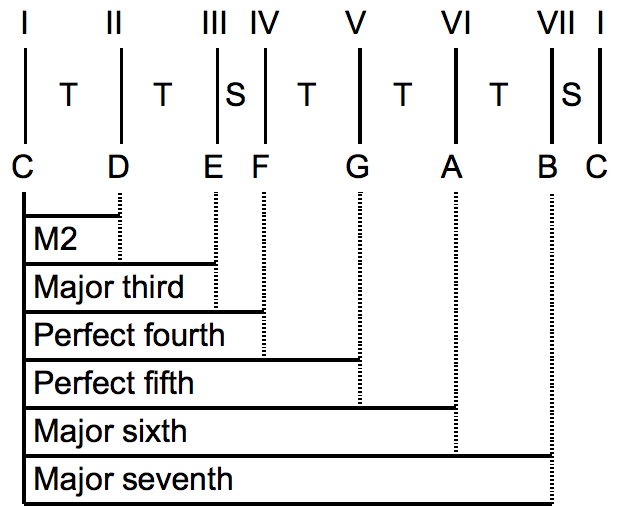
Every major scale, no matter what note it starts on, follows the same formula of whole steps (W) and half steps (H): W-W-H-W-W-W-H. A whole step is the distance of two piano keys (black or white), while a half step is the distance to the very next key.
Major Scale Pattern: Whole - Whole - Half - Whole - Whole - Whole - Half
Let's build a C major scale to see this in action. Starting on C:
- C to D is a whole step.
- D to E is a whole step.
- E to F is a half step (there's no black key between them).
- F to G is a whole step.
- G to A is a whole step.
- A to B is a whole step.
- B to C is a half step (again, no black key).
The resulting notes are C, D, E, F, G, A, B, C. This pattern creates the familiar, bright sound of the major scale.
Meet the Scale Degrees
Each note in a scale has a specific function and a technical name called a scale degree. These names describe the note's relationship to the starting note, or the tonic—the musical "home base" of the key.
The most important relationship in a key is the tension between the fifth degree, the dominant , and the tonic. The dominant creates a feeling of wanting to resolve, pulling your ear back home to the tonic. The seventh degree, the leading tone, is also crucial. It's only a half step below the tonic, creating a strong melodic pull upwards.
| Degree | Name | Function |
|---|---|---|
| 1 | Tonic | The "home" note; point of stability and rest. |
| 2 | Supertonic | Sits above the tonic. |
| 3 | Mediant | Midway between the tonic and dominant. |
| 4 | Subdominant | The fifth note down from the tonic. |
| 5 | Dominant | Creates tension that resolves to the tonic. |
| 6 | Submediant | Midway between the tonic and subdominant (descending). |
| 7 | Leading Tone | Creates strong melodic pull up to the tonic. |
The World of Minor Scales
Minor scales offer a different emotional palette, often described as sadder or more mysterious. There are two main ways to relate a major scale to a minor one: relative and parallel.
Relative Minor: Every major scale has a relative minor that uses the exact same notes, just starting from a different place. You can find it by going to the sixth degree (the submediant) of the major scale. For C major (C-D-E-F-G-A-B), the sixth note is A. So, the relative minor is A minor (A-B-C-D-E-F-G). No sharps, no flats—same key signature.
Parallel Minor: This involves starting on the same tonic but applying a minor scale formula. So, the parallel minor of C major is C minor. This requires changing some of the notes (in this case, E, A, and B become E♭, A♭, and B♭).
Things get interesting because there isn't just one minor scale; there are three common variations.
Key Signature
noun
The set of sharp (♯) or flat (♭) symbols placed on the staff at the beginning of a piece of music. It indicates which notes are to be consistently raised or lowered throughout the piece, defining the key.
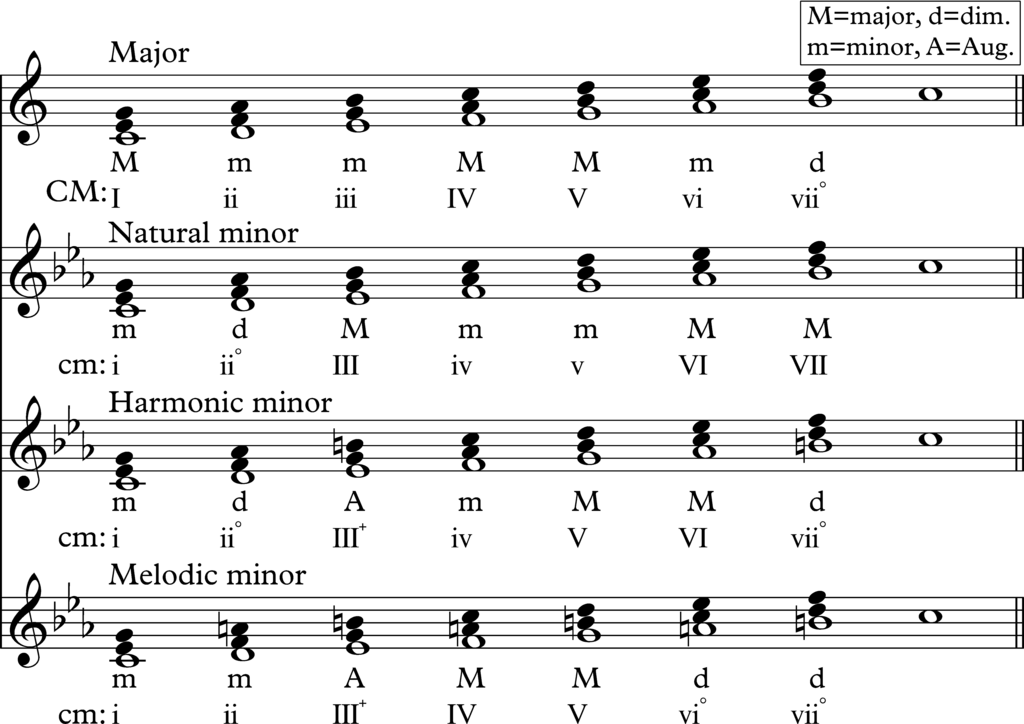
First is the natural minor scale, which we found with the relative minor (A-B-C-D-E-F-G). Its pattern is W-H-W-W-H-W-W. It has a smooth, somber sound, but it lacks a strong pull back to the tonic because the seventh degree is a whole step away from the tonic.
To fix this, composers created the harmonic minor scale. They raised the seventh degree by a half step. In A minor, this changes the G to a G♯. Now, G♯ is a leading tone that strongly resolves to A. This change creates a unique, dramatic-sounding gap of an augmented second (three half steps) between the sixth (F) and seventh (G♯) degrees.
Finally, the melodic minor scale was developed to smooth out that awkward jump in the harmonic minor, especially for singers. When ascending, both the sixth and seventh degrees are raised (F becomes F♯, and G becomes G♯). This creates a smoother melodic line. When descending, these notes are lowered back to their natural minor form, as the pull to the tonic is no longer needed.
Let's review the concepts we've just covered.
Ready to test your knowledge?
What is the correct pattern of whole (W) and half (H) steps for a major scale?
Which scale degree is known as the 'dominant' and creates a strong feeling of wanting to resolve back to the tonic?
Understanding these scale patterns is the key to unlocking how melodies and harmonies are built. By manipulating just one or two notes, you can completely change the emotional landscape of a piece of music.