Practical Ethical Hacking and Penetration Testing
Ethical Hacking Frameworks
Professional Frameworks
Ethical hacking isn't about aimlessly poking at systems until something breaks. It's a structured, professional discipline guided by established methodologies. These frameworks provide a roadmap for a consistent, thorough, and repeatable process. They ensure that when you're hired to test a system, you cover all the necessary ground and deliver valuable, actionable results.
Two of the most recognized standards are the Penetration Testing Execution Standard (PTES) and the National Institute of Standards and Technology (NIST) Special Publication 800-115. PTES breaks down a penetration test into seven distinct phases, offering a comprehensive guide from initial communication to final reporting. NIST SP 800-115 provides a more high-level framework, outlining four key phases for conducting information security testing and assessments.
While these frameworks outline the technical steps, a professional engagement starts with something far more important: permission and rules.
Rules of the Game
Before a single packet is sent, a contract known as the Rules of Engagement (RoE) is established. This document is the bedrock of any ethical hacking project. It defines the scope of the test: what systems are in-bounds, what techniques are allowed, and what the objectives are. It’s a get-out-of-jail-free card, but it's also a strict set of boundaries.
Operating without a clear RoE is not ethical hacking; it’s a crime. Laws like the Computer Fraud and Abuse Act (CFAA) in the United States carry severe penalties. Even with an RoE, testers must be mindful of privacy regulations like GDPR, which governs the data of EU citizens. Some organizations adopt "Safe Harbor" policies, which legally protect security researchers who discover and report vulnerabilities in good faith, provided they follow specific guidelines.
The RoE legally distinguishes a professional security audit from a malicious attack. It's the single most important document in a penetration test.
The scope defined in the RoE also determines how much information the ethical hacker receives upfront. This leads to three primary types of testing.
Levels of Knowledge
The amount of information a client gives a penetration tester dictates the approach and simulates different kinds of real-world attackers. These approaches are known as black, grey, and white box testing.
| Test Type | Knowledge Provided | Pros | Cons |
|---|---|---|---|
| Black Box | None. The tester only gets a target name or IP. | Simulates an external attacker with no prior knowledge. | Can be time-consuming; may miss complex internal vulnerabilities. |
| Grey Box | Limited. The tester has some information, like user credentials. | Balances realism with efficiency; simulates an insider threat. | May not uncover all vulnerabilities an unauthenticated attacker could find. |
| White Box | Complete. The tester has full access to source code, documentation, and diagrams. | Most comprehensive and efficient; identifies deep-seated flaws. | Least realistic simulation of an external attacker. |
A black box test is the most realistic simulation of an external hacker, but it might miss vulnerabilities that are only visible from inside the network. A white box test is the most thorough, allowing testers to analyze the code and architecture directly, but it doesn't accurately reflect how an outside attacker would operate. Grey box testing offers a middle ground, often simulating a scenario where an attacker has already gained a foothold, like stealing a user's password.
Assessment vs. Penetration
It's crucial to understand the difference between two common security audits: a vulnerability assessment and a penetration test. They are not the same thing.
A vulnerability assessment is an automated or manual process that identifies and reports potential vulnerabilities. Think of it as walking around a building and listing all the unlocked doors, open windows, and weak-looking locks. The goal is to create a comprehensive list of potential weaknesses.
A penetration test takes the next step. It actively tries to exploit those vulnerabilities to see how far an attacker could get. In our building analogy, this means actually opening the unlocked door, climbing through the window, and trying to pick the weak lock to see what's inside. It confirms whether a potential vulnerability is truly an exploitable risk.
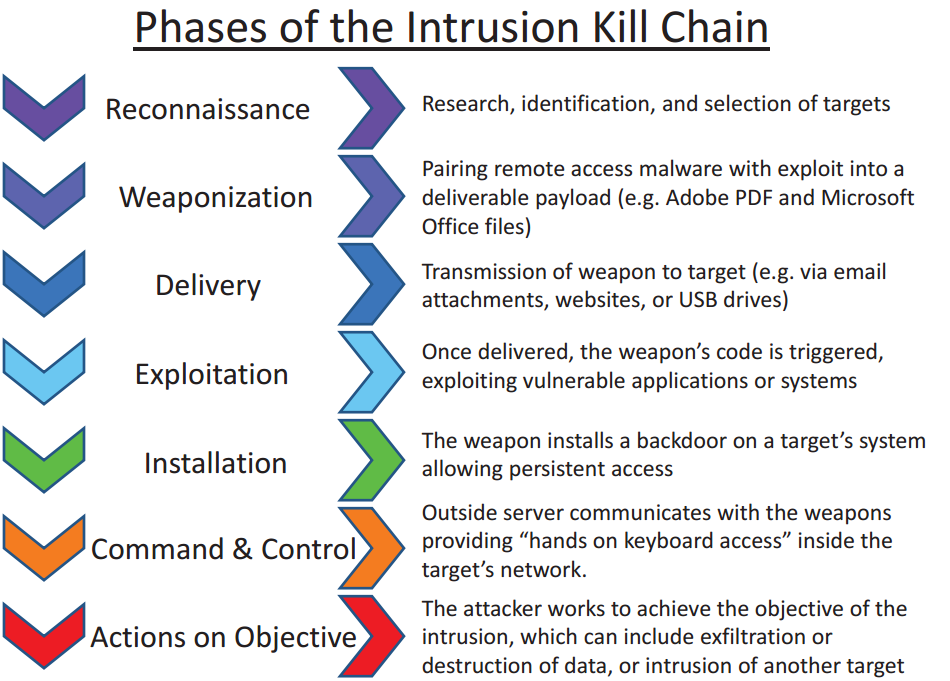
Models like the Intrusion Kill Chain break down an attack into sequential phases. An ethical hacker follows a similar, methodical path. A vulnerability assessment might find a weakness in the "Delivery" phase, while a penetration test would try to execute the entire chain, from reconnaissance to achieving the final objective. This methodical approach, guided by frameworks and a strict RoE, is what defines professional ethical hacking.
Ready to check your understanding of these professional standards?
What is the primary purpose of the Rules of Engagement (RoE) in an ethical hacking engagement?
An ethical hacker is given user-level credentials to a system to simulate an attack from a malicious insider or an attacker who has stolen a password. What type of test is this?
Understanding these frameworks, rules, and distinctions is the foundation for performing professional and effective security testing.