Practical Data Analytics and Decision Science
Data Lifecycle Strategy
Frame the Problem First
Before you write a single query or import a dataset, the most critical step is to define the problem you're trying to solve. Data analysis without a clear business objective is just data tourism. You might see interesting things, but you won't arrive at a useful destination.
Start by translating a business need into a specific, answerable question. A goal like "increase sales" is too vague. A better approach is to ask, "Which marketing channels have the highest customer lifetime value for new sign-ups in the last quarter?" This question is specific, measurable, and directly tied to a business outcome.
This is where Key Performance Indicators (KPIs) come in. KPIs are the quantifiable measures that track progress toward a business goal. If the objective is to reduce customer churn, your KPIs might be the monthly churn rate, the average tenure of a churned customer, or the number of support tickets filed before cancellation. Your entire analysis should be designed to move these specific metrics.
A precise question is halfway to a precise answer. Vague goals lead to vague, unactionable results.
Audit Your Raw Materials
Once you have a clear question, you need to assess your data. Think of this as an audit, not just a casual glance. You're looking for issues that could compromise your analysis down the line. Is the data complete? Are there glaring inconsistencies? Most importantly, could there be hidden biases?
Bias can be subtle. If a customer satisfaction survey was only sent to users who have been active in the last 30 days, your data is inherently biased against the opinions of infrequent or lapsed users. Recognizing this upfront is crucial. It doesn’t necessarily invalidate the data, but it frames the scope of your conclusions: you're analyzing active user satisfaction, not all user satisfaction.
This audit phase also informs your definition of 'clean' data. There is no universal standard for cleanliness. For one project, a dataset with 5% missing values in a non-critical column might be perfectly acceptable. For another, that same percentage could make the data unusable. 'Clean' is defined by the requirements of your specific business problem.
| Quality Check | Description | Common Issue |
|---|---|---|
| Completeness | Are there missing values? | A user's sign-up date is null. |
| Consistency | Is the same data represented differently? | State is listed as 'CA', 'Calif.', and 'California'. |
| Validity | Does the data conform to its defined format? | An age column contains text strings instead of integers. |
| Timeliness | Is the data recent enough to be relevant? | Analyzing Q4 sales using data that only goes up to Q2. |
| Uniqueness | Are there duplicate records? | The same customer ID appears multiple times with identical data. |
Select the Right Tool for the Job
With a clear question and an understanding of your data's quality, you can choose how to extract and prepare it. The most common decision is between SQL and a programming language like Python. This isn't a matter of which is better, but which is more appropriate for the task at hand.
SQL is the language of databases. It is unparalleled for filtering, joining, and aggregating massive datasets directly at the source. If you need to pull a specific subset of data from a 10-terabyte warehouse, running a SQL query is almost always more efficient than loading the entire table into memory with Python.
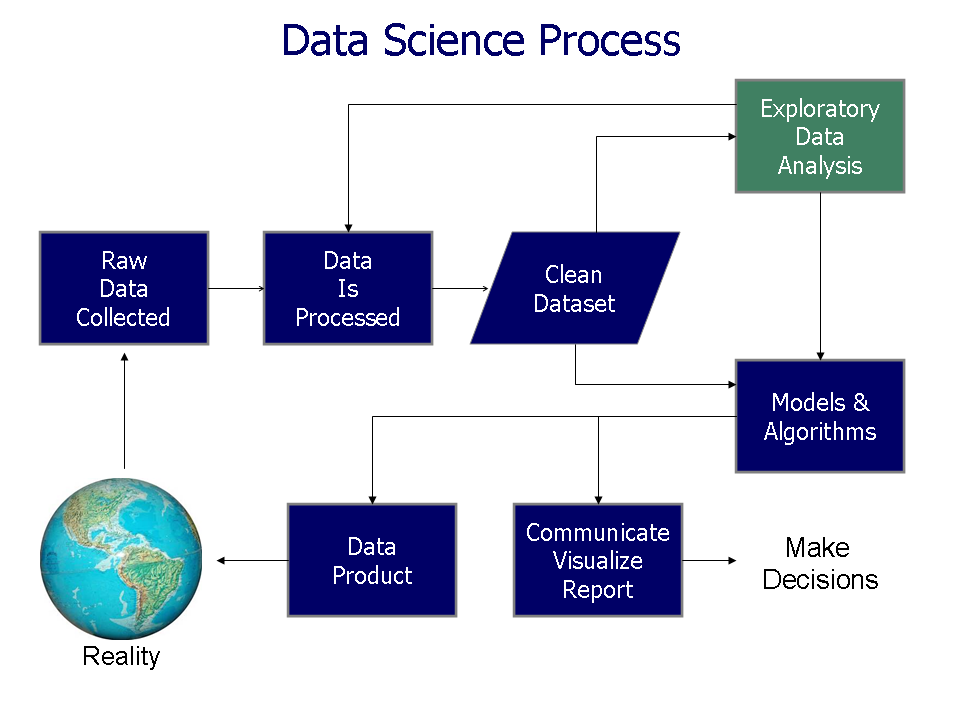
Data cleaning and preprocessing are critical steps in the data science workflow.
Python, with libraries like Pandas, excels at complex, iterative transformations that are cumbersome or impossible in SQL. Think of tasks like imputing missing values based on a statistical model, applying complex text cleaning functions, or reshaping data in ways that require procedural logic. A Python script also provides a clear, reproducible record of every transformation you apply. This documentation is vital for collaboration and for validating your work later.
A common and highly effective pattern is to use both: use SQL for the initial heavy lifting of extracting and filtering the precise data you need, then load that smaller, more manageable dataset into Python for detailed preparation.
Ultimately, a robust data lifecycle strategy begins long before the analysis itself. By carefully framing the business problem, auditing your data sources, and making strategic choices about your tools, you set the stage for producing insights that are not just statistically sound, but also genuinely valuable.
A marketing team wants to "improve customer engagement." Which of the following is the most effective translation of this business goal into a specific, answerable question for data analysis?
What is the primary role of Key Performance Indicators (KPIs) in the data analysis process?