Practical Data Analytics and Decision Making
Strategy and Lifecycle
From Business Goal to Data Plan
You can't get where you're going without a map. In data mining, that map is a process model. It provides a reliable framework to move from a raw business idea to a deployed, valuable solution. The most widely used framework is the Cross-Industry Standard Process for Data Mining, or CRISP-DM.
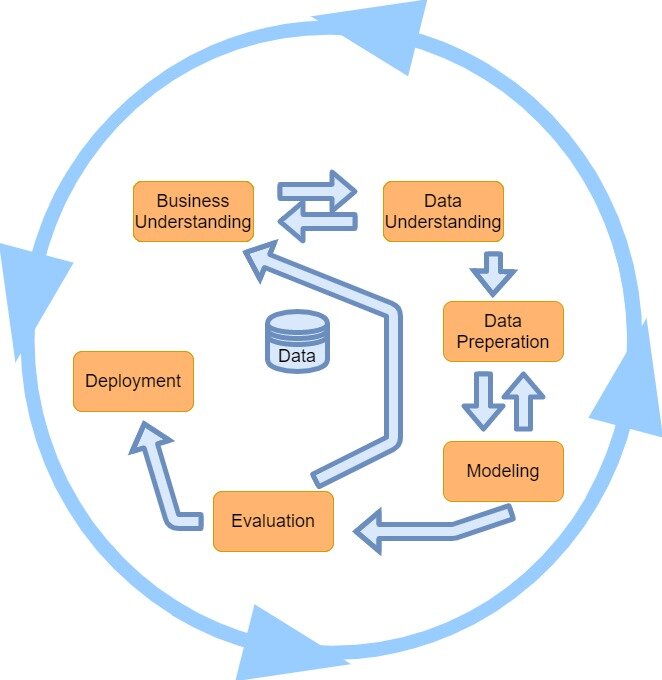
CRISP-DM breaks a project down into six phases: Business Understanding, Data Understanding, Data Preparation, Modelling, Evaluation, and Deployment. The arrows in the diagram show the most common paths, but the process is highly iterative. Findings in the Modelling phase might send you back to Data Preparation to create new variables, or even all the way back to Business Understanding to refine the project's goals. Let's start at the beginning.
Start with Why
The Business Understanding phase is the most important step, because it sets the direction for everything that follows. A project without a clear business goal is just a technical exercise. Your first task is to translate a vague business request into a concrete analytical goal.
Imagine a stakeholder says, "We need to sell more." That's a business objective, but it's not a data mining goal. To make it one, you need to ask clarifying questions:
- What are we selling? To whom?
- Are we trying to acquire new customers or sell more to existing ones?
- What factors do we believe influence a customer's decision to buy?
- What data do we have about our customers and their past purchases?
Answering these questions helps you reframe the problem. "Sell more" might become "Identify which of our current customers are most likely to buy a new product in the next quarter."
This new goal is specific, measurable, and directly points towards a data mining task: building a predictive model. Now you have a clear destination for your project.
Defining Success
Once you have a clear goal, you need to define what success looks like. This happens on two levels: business success and data mining success. Business success criteria measure the project's impact on the organisation. Data mining success criteria are technical measures that tell you how well your model is performing.
| Type | Example Success Criterion |
|---|---|
| Business | Increase sales of the new product by 15% among the targeted customer group. |
| Business | Achieve a 5% conversion rate on the marketing campaign. |
| Data Mining | Build a model that correctly identifies likely buyers with at least 80% accuracy. |
| Data Mining | Rank customers by purchase probability so that the top 20% of the list contains 60% of the actual buyers. |
Defining these criteria up front is crucial. It ensures everyone agrees on the project's purpose and provides a benchmark for the Evaluation phase later on.
Finally, the Business Understanding phase involves a preliminary project plan. You'll assess the resources needed, identify potential risks, and check the overall feasibility. Is the necessary data available? Do you have the tools and expertise to complete the project? Answering these questions early prevents costly surprises down the road.
Remember, the goal isn't to create a rigid, unchangeable plan. The iterative nature of data mining means you will almost certainly revisit these initial assumptions. But by starting with a solid understanding of the business problem, you ensure your technical work is always focused on creating real-world value.
What is the primary purpose of the Business Understanding phase in the CRISP-DM framework?
A manager states, "We need to reduce customer churn." Which of the following is the best example of translating this business objective into a data mining goal?
With a clear business goal and success criteria, you are ready to move on to the next phase: understanding the data itself.