Practical Cybersecurity and Defensive Strategy
Applying the CIA Triad
Operationalising the CIA Triad
The CIA triad is more than a theoretical model; it's a practical framework for making security decisions in an enterprise environment. Confidentiality, Integrity, and Availability aren't just abstract goals. They are measurable objectives that directly influence system architecture, risk management strategies, and daily operations.
When building or assessing a system, each component of the triad serves as a lens. We don't just ask, "Is it secure?" We ask specific, actionable questions: What data must be kept confidential, and who is authorised to see it? What processes ensure the integrity of our data, preventing unauthorised changes? And how do we guarantee the system remains available to users who need it?
Answering these questions turns cybersecurity from a vague concept into a set of engineering problems. This approach allows teams to design controls, allocate resources, and measure the effectiveness of their security posture in concrete terms.
The core objectives of cybersecurity are structured around a fundamental framework known as the CIA Triad: Confidentiality, Integrity, and Availability.
Security Trade-offs
In a perfect world, every system would offer absolute confidentiality, perfect integrity, and constant availability. In reality, these objectives often exist in tension with one another. Strengthening one pillar can sometimes weaken another, forcing organisations to make difficult trade-offs based on their specific needs and risks.
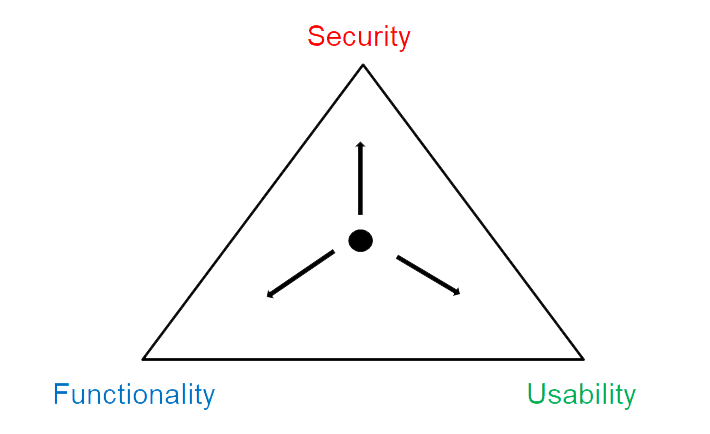
Consider the relationship between confidentiality and availability in a high-speed environment, like a financial trading platform. To maximise confidentiality, you could implement multiple layers of strong, complex encryption on all data in transit. However, encryption and decryption aren't instantaneous; they consume processing power and introduce latency. For a trading algorithm where milliseconds matter, this delay could make the system unusable, thus crippling its availability. The business might have to accept a slightly different encryption standard to achieve the necessary speed.
Similarly, think about integrity monitoring in a transaction-heavy e-commerce system. To ensure the highest level of integrity, you could digitally sign and verify every single order as it enters the database. This provides a robust check against data tampering. But during a major sales event with thousands of transactions per minute, the computational overhead of this verification process could slow the system to a crawl, leading to lost sales and frustrated customers. The system's availability suffers. The organisation must find a balance, perhaps by verifying transactions in batches or using less resource-intensive methods.
Mapping Workflows to CIA Pillars
Applying the CIA triad provides diagnostic clarity. It helps you analyse security incidents and vulnerabilities by mapping them to the specific pillar that has failed. This moves the conversation from a generic "security breach" to a precise diagnosis that points toward a solution.
Here are a few common scenarios viewed through the CIA lens:
-
A misconfigured cloud bucket: An engineer accidentally sets a cloud storage bucket containing customer records to be publicly readable. This is a failure of Confidentiality. The data's integrity and availability are unaffected, but unauthorised parties can now access it.
-
A ransomware attack: An attacker encrypts a company's critical databases and demands a ransom to unlock them. This is a direct attack on Availability. The data is still there (integrity) and may even remain confidential, but the business cannot access it to perform its functions.
-
Database tampering: An insider threat subtly alters financial records over several months to hide fraudulent activity. This is a breach of Integrity. The system is available and the data is confidential, but it can no longer be trusted.
This mapping exercise is fundamental to formal risk management. Security frameworks like NIST SP 800-53 and ISO 27001 are built around this logic. They provide structured controls designed to uphold confidentiality, integrity, and availability, allowing organisations to systematically assess their security posture and assign accountability for protecting critical assets.
What are the three core components of the CIA triad in information security?
A disgruntled employee uses their database access to alter sales figures, making their performance seem better than it was. Which pillar of the CIA triad has been primarily violated?
By moving beyond simple definitions, you can use the CIA triad as an effective tool for designing, managing, and defending complex systems.