Practical Circuit Design and Analysis
Advanced Circuit Theorems
Beyond Ohm's Law
You already know how to handle simple series and parallel circuits. But what happens when a circuit is a complex web of interconnected loops and sources? That's where we move beyond basic Ohm's Law and into more powerful techniques. These methods don't replace Ohm's Law, they build on it, giving us a systematic way to solve any circuit, no matter how tangled it looks.
The foundation for this advanced analysis rests on two principles you've likely met before: Kirchhoff’s Laws. Let's briefly re-acquaint ourselves.
Kirchhoff’s Current Law (KCL): The sum of currents entering a node must equal the sum of currents leaving it. It's a statement of the conservation of charge—what flows in must flow out.
Kirchhoff’s Voltage Law (KVL): The sum of all voltage drops and rises in any closed loop must equal zero. This is a statement of the conservation of energy.
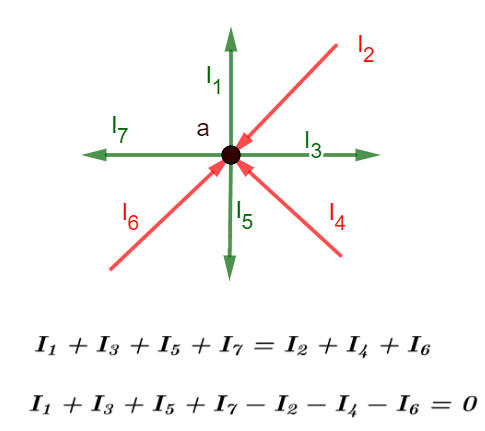
These laws seem simple, but they are the bedrock for two powerful, organized methods of circuit analysis: Mesh Analysis and Nodal Analysis. Think of them as structured recipes for applying KVL and KCL to complex problems.
Organizing Complexity
Let's start with Mesh Analysis. This method is a direct application of KVL. A "mesh" is just a loop in the circuit that doesn't contain any other loops within it. The strategy is to assign a hypothetical current to each mesh, called a mesh current, and then write a KVL equation for each one.
Mesh
noun
A closed loop in a planar circuit that does not contain any other loops within it. It's the simplest possible loop in a network.
For a circuit with two meshes, you'd define currents and . For each mesh, you'd trace the path, adding up the voltage drops across resistors () and subtracting or adding the voltage sources. The trickiest part is handling resistors shared between two meshes. The current through a shared resistor is the difference between the two mesh currents, or , depending on which loop's equation you're writing. This process gives you a system of linear equations that you can solve for the unknown mesh currents.
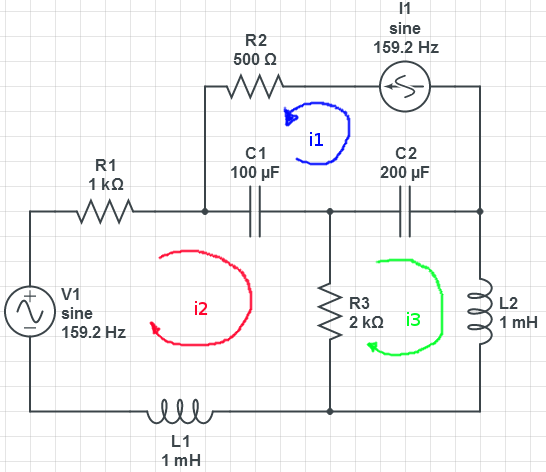
Nodal Analysis, on the other hand, uses KCL. Instead of focusing on loops, it focuses on nodes—points where two or more components connect. The steps are:
- Choose one node as a reference node (usually ground, or 0V).
- Label the voltage at all other essential nodes (, , etc.). These voltages are relative to the reference node.
- Write a KCL equation for each non-reference node. Assume all unknown currents are flowing out of the node. The current flowing through a resistor between two nodes, say and , is expressed using Ohm's Law as .
Just like with mesh analysis, you end up with a system of equations, but this time you're solving for the unknown node voltages. Once you have the node voltages, you can find any current in the circuit.
Simplifying with Equivalents
Imagine you're designing a complex audio system. One part is the pre-amplifier, and the next is the power amplifier. To the power amplifier, the entire pre-amp circuit, with all its transistors and resistors, just looks like a single source. This is the magic of equivalent circuits. They let us replace a complicated part of a network with something much, much simpler, without changing the behavior of the rest of the circuit. The two most important are the Thévenin and Norton equivalents
The Thévenin equivalent circuit consists of a single voltage source () in series with a single resistor (). The Norton equivalent consists of a single current source () in parallel with a single resistor (). Any linear circuit can be reduced to one of these simple forms.
To find them:
- is the open-circuit voltage between the two terminals of interest.
- is the short-circuit current that flows through a wire connecting the terminals.
- (which equals ) is the equivalent resistance looking back into the terminals with all independent sources turned off (voltage sources become short circuits, current sources become open circuits).
A handy relationship connects the two: . This is just Ohm's Law, confirming that they are two sides of the same coin.
Juggling Multiple Sources
What if your circuit has multiple independent voltage or current sources? Mesh or nodal analysis still works, but the algebra can get messy. The offers a different approach. It states that in any linear circuit with multiple independent sources, the total current or voltage for any component is the algebraic sum of the values produced by each source acting alone.
The process is straightforward:
- Pick one source to keep active.
- Turn off all other independent sources. (Replace voltage sources with a short circuit and current sources with an open circuit).
- Calculate the desired voltage or current due to that one active source.
- Repeat for every source in the circuit.
- Add up the results from each step to find the total value.
Whenever you see a circuit with multiple sources, superposition! should pop into your head.
Finally, let's consider a practical problem. When you connect a load (like a speaker) to a source (like an amplifier), how do you get the most power into the load? The provides the answer. It states that to obtain maximum external power from a source with a finite internal resistance, the resistance of the load must equal the resistance of the source as viewed from its output terminals.
This theorem is critical in applications like audio engineering and radio communications, where you need to deliver the strongest possible signal from one stage to the next. By matching the impedance of the load to the impedance of the source, you ensure that the maximum amount of energy gets where it needs to go.
Now, let's test your understanding of these powerful analytical tools.
Mesh analysis is a systematic application of which fundamental circuit law?
In Nodal Analysis, how is the current flowing from a node with voltage to a node with voltage through a resistor R typically expressed?
These theorems are the core tools for an electrical engineer. They allow us to systematically deconstruct and simplify any linear circuit, moving from a confusing mess of wires to a clear, solvable system.