Practical AI Implementation and Architecture
Model Paradigms
Sorters vs. Creators
At its core, all machine learning is about learning patterns from data. But not all models use those patterns for the same purpose. The biggest split is between models that sort information and models that create new information. This is the fundamental difference between discriminative and generative AI.
Imagine you have a big pile of fruit. A discriminative model is like a very picky sorter. Its job is to look at a piece of fruit and decide which bucket it belongs in: apple, banana, or orange. It learns the specific features that separate these categories. It's looking for the line, or the boundary, that distinguishes one from the other.
In contrast, a generative model is like an artist who has studied thousands of fruits. Instead of just sorting, it learns the essence of what makes an apple an apple. It understands the distribution of colours, shapes, and textures. With that knowledge, it can generate a picture of a completely new, unique apple that has never existed before.
Discriminative models classify, generative models create.
The Math Behind the Models
This difference in purpose comes from how the models handle probability. Let's say we have some input data, (the features of a piece of fruit), and we want to determine its label, (apple, banana, or orange).
A discriminative model directly learns the conditional probability . In simple terms, it answers the question: "Given this specific set of features , what is the probability that it belongs to class ?" It focuses entirely on mapping inputs to outputs. It learns the decision boundary between classes in the feature space. This is why they excel at classification and regression tasks.
A takes a different route. It learns the joint probability distribution, . This means it learns how the features and the labels occur together. By understanding this deeper relationship, it can do some clever things. Using Bayes' theorem, it can calculate for classification, but it can also be used to generate new data by sampling from the learned distribution. It essentially learns how to create data that looks like the original training data.
Choosing the Right Tool
So when would you choose one over the other? It depends entirely on the problem.
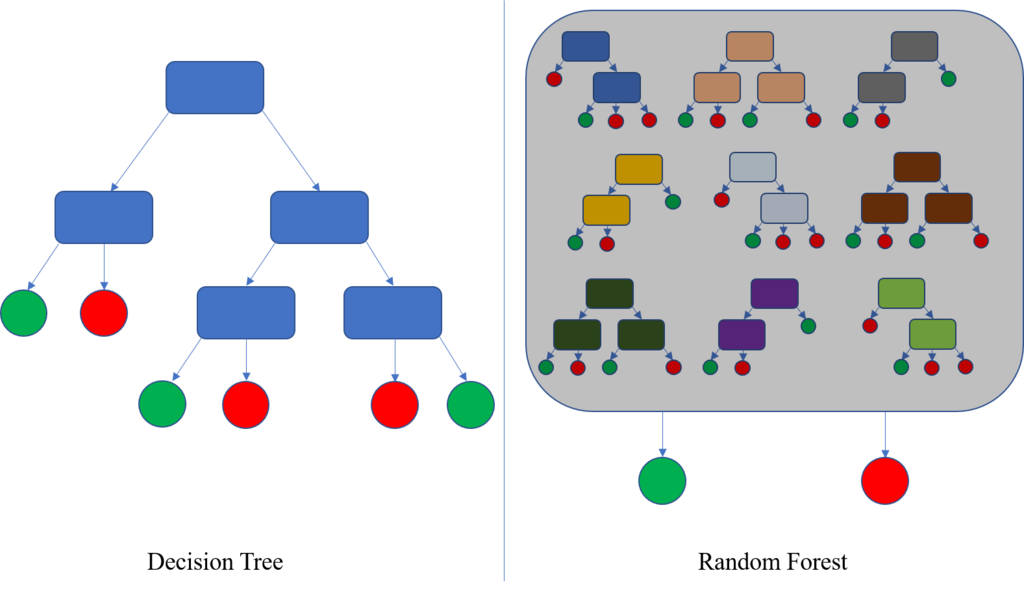
For a task like fraud detection, a business needs a clear, decisive answer. Is this transaction fraudulent or not? This is a classic classification problem. The model needs to draw a sharp line between legitimate and suspicious activity. A Random Forest or a Support Vector Machine, both discriminative models, would be excellent choices. Their performance is measured by metrics like accuracy, precision, and recall. We care about how many predictions are correct.
Now, consider building a customer support chatbot. The goal isn't to classify a query into a rigid category, but to generate helpful, human-like text. Here, you need a generative model like a Transformer (the architecture behind models like ChatGPT). Its job is to create a new distribution of data, in this case, a sequence of words that forms a coherent answer.
For generative models, performance metrics are trickier. How do you measure creativity or fluency? While there are technical scores like BLEU for translation or Perplexity for language models, evaluation often involves human judgment on the quality and relevance of the generated content.
Transformer
noun
A type of neural network architecture that excels at handling sequential data, like text. It uses a mechanism called 'self-attention' to weigh the importance of different words in the input when processing and generating new sequences. It is the foundation for most modern large language models.
| Feature | Discriminative Models | Generative Models |
|---|---|---|
| Goal | Predict a label or value | Create new data |
| Approach | Learns decision boundaries | Learns data distribution |
| Probability | Models | Models |
| Example Task | Spam detection, Image classification | Chatbots, Image generation |
| Example Model | Logistic Regression, Random Forest | GANs, VAEs, Transformers |
| Metrics | Accuracy, Precision, Recall | Perplexity, Inception Score, Human evaluation |
Understanding this distinction is key to applying AI effectively. It's not about which paradigm is better, but which one is built for the task at hand. Choosing correctly means the difference between a tool that works and one that struggles because it’s being asked to do a job it was never designed for.
Ready to test your knowledge on these model paradigms?
What is the primary function of a discriminative AI model?
A tech company wants to build an application that can write original poems in the style of Shakespeare. Which type of AI model would be the most appropriate choice for this task?