Power Struggles of Revolutionary France
Club Origins and Ideologies
The Birth of Political Parties
In the early, chaotic years of the French Revolution, there were no formal political parties. Instead, clubs emerged as centers of debate and organization. These weren't social gatherings; they were political engines where deputies, journalists, and ordinary citizens hammered out the future of France. Initially, they were informal groups of representatives from the Estates-General who met to coordinate their strategy. One of the earliest and most influential was the Breton Club, formed by deputies from Brittany.
After the National Assembly moved to Paris, this group rented a former Dominican monastery on the Rue Saint-Honoré. The Dominicans in Paris were known as Jacobins, and the name stuck. Officially called the Society of the Friends of the Constitution, the quickly became the most prominent political network in France. It wasn't just a Parisian affair; the Jacobins established a vast web of affiliated clubs in the provinces, allowing them to shape public opinion across the nation.
In its early days, the Jacobin Club included a wide spectrum of revolutionary thought. But the king's failed attempt to flee the country in June 1791, the Flight to Varennes, shattered any remaining unity. The attempt exposed Louis XVI's opposition to the revolution and forced a critical question upon the nation: could France trust a monarch who tried to abandon his people? This event acted as a political catalyst, splintering the revolutionaries into distinct, opposing factions.
The Great Schism
The immediate fallout from the king's flight was a crisis of leadership. Radicals now openly called for the abolition of the monarchy and the establishment of a republic. Moderates, fearing that deposing the king would lead to civil war and foreign invasion, argued for keeping him as a figurehead in a constitutional monarchy.
This disagreement led to a formal split within the Jacobin Club. The moderate, constitutional monarchist faction walked out. They established their own club in the former monastery of the Feuillants, also on the Rue Saint-Honoré, and became known as the Feuillants. They believed the revolution had gone far enough. Their goal was to uphold the new Constitution of 1791, which established a constitutional monarchy, and to maintain law and order. They saw the calls for a republic as a dangerous step toward anarchy.
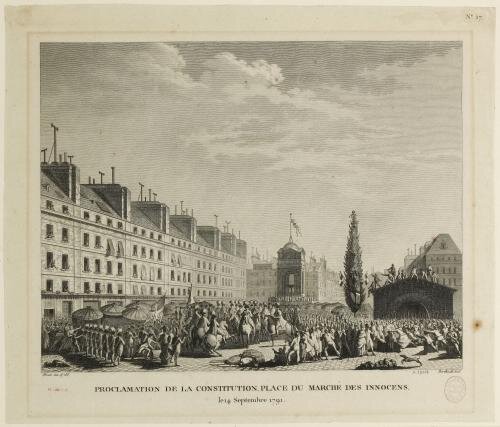
Meanwhile, another club had already carved out a space on the radical left. The Society of the Friends of the Rights of Man and of the Citizen, better known as the , met in a former Franciscan convent. Unlike the Jacobins, who charged high membership fees, the Cordeliers were open to all, including working-class citizens known as the sans-culottes. Their platform was populist and uncompromising. Led by fiery orators like Georges Danton and the radical journalist Jean-Paul Marat, the Cordeliers were among the first to demand a republic.
| Club | Key Ideology | Leading Figures | Social Base |
|---|---|---|---|
| Feuillants | Constitutional Monarchy | Barnave, Lafayette | Wealthy bourgeoisie |
| Jacobins | Republicanism (increasingly) | Robespierre, Brissot | Middle class, professionals |
| Cordeliers | Radical Populism, Direct Democracy | Danton, Marat, Hébert | Working class (sans-culottes) |
The Breaking Point
The ideological divisions were no longer just theoretical. On July 17, 1791, the Cordeliers organized a massive demonstration at the Champ de Mars to present a petition demanding the king's abdication. The mood was tense. The moderate-controlled municipal government, backed by the Feuillants, declared martial law.
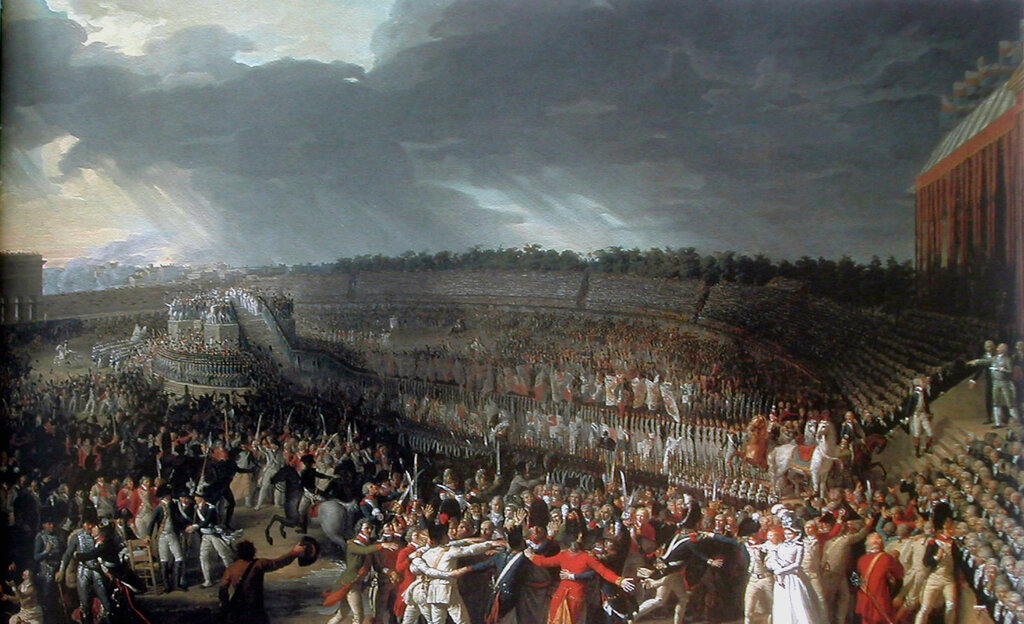
The National Guard, commanded by the Marquis de Lafayette, arrived to disperse the crowd. Accounts differ on what happened next, but someone fired a shot, and the soldiers responded with a volley into the unarmed petitioners. Dozens were killed in what became known as the Champ de Mars Massacre. The event was a point of no return. It violently suppressed the republican movement for a time, but it also destroyed the credibility of moderates like Lafayette. The blood spilled on the Champ de Mars radicalized many and drew a clear line between those who wanted to end the revolution and those who believed it had just begun. The alliance between the now more radical Jacobins and the populist Cordeliers solidified, setting the stage for the overthrow of the monarchy and the coming Reign of Terror.
Now, let's test your understanding of these crucial political factions.
What event was the primary catalyst for the split within the Jacobin Club, leading to the formation of the more moderate Feuillants Club?
Which political club was known for its populist stance, low membership fees, and early calls for a republic?
The split between these clubs defined the revolution's path. The failure of the Feuillants to establish a stable constitutional monarchy opened the door for the more radical visions of the Jacobins and Cordeliers to take hold.